How Is Eugenol Isolated From Clove Oil?
Eugenol comes out of clove oil because of one chemical quirk: it is a phenol, so it dissolves in caustic solution as a salt while the rest of the oil does not. Almost everything else in industrial isolation is tidying up around that step. Following a drum of clove oil through the process also explains why the finished material smells narrower and sweeter than the oil it came from.

The starting oil is already mostly eugenol
Clove oil is a mixture whose makeup depends on the plant part. In a 2023 European Food Safety Authority dossier, seven batches of clove bud oil, steam-distilled from dried buds from Indonesia, averaged 75.06% eugenol by GC-MS, with 13.20% beta-caryophyllene and 7.92% eugenyl acetate. Six batches of leaf oil averaged 82.60% eugenol, 13.45% caryophyllene and under 1% eugenyl acetate (EFSA FEEDAP Panel, 2023). A broader review puts eugenol at 45% to 90% of clove oil depending on where it comes from (Kamatou et al., Molecules, 2012). Our articles on content by plant part and on other eugenol-rich plants go through the ranges.
So isolation is less a rescue of a trace than a refinement of a majority: the work is in removing the other 10% to 25% and deciding how completely.
The alkali trick
PubChem gives eugenol a pKa of 10.19 and a water solubility of about 2,460 mg/L at 25 C, roughly a quarter of one percent (PubChem, eugenol). Reasoning from the pKa, a strong alkali strips the proton from eugenol's hydroxyl group and leaves a charged salt that water will carry. Caryophyllene is a hydrocarbon with no such handle, so it stays behind in the oily layer.
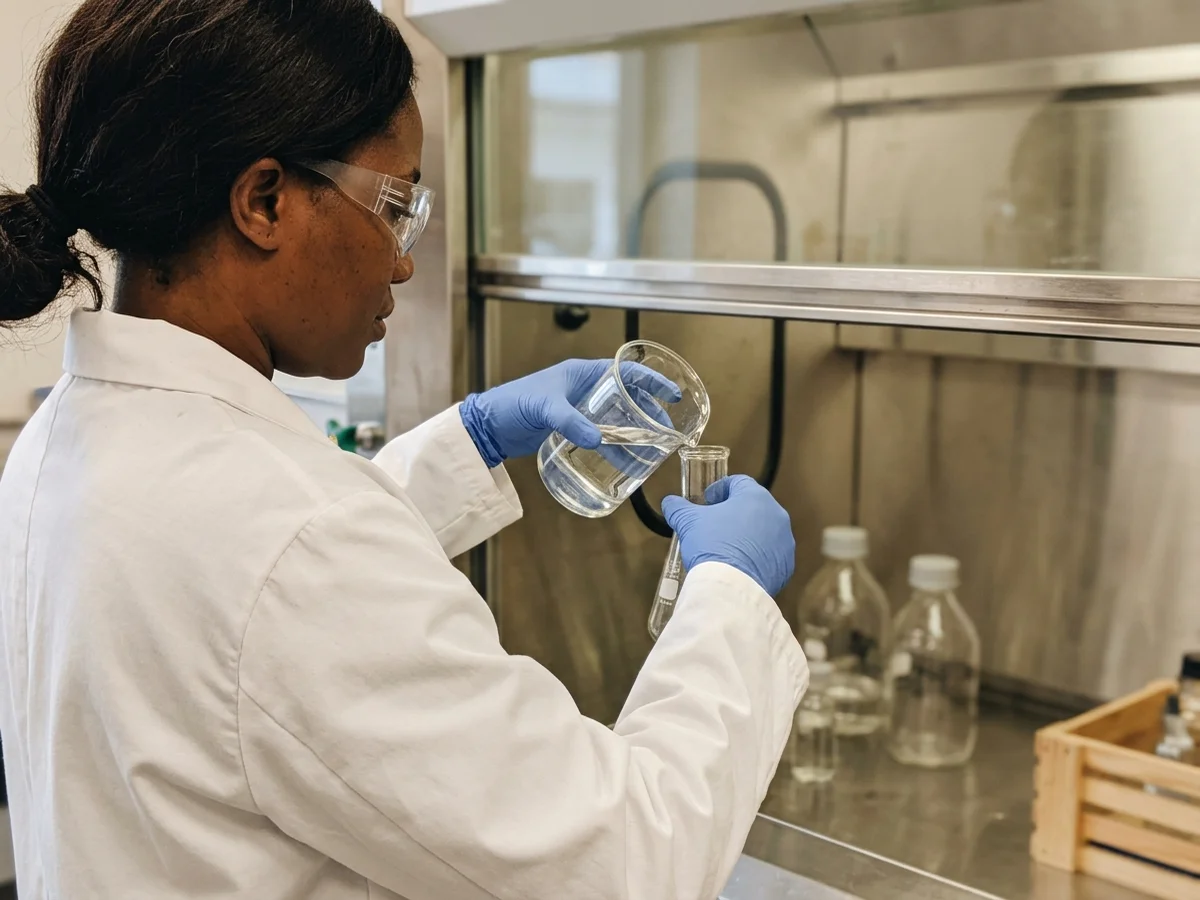
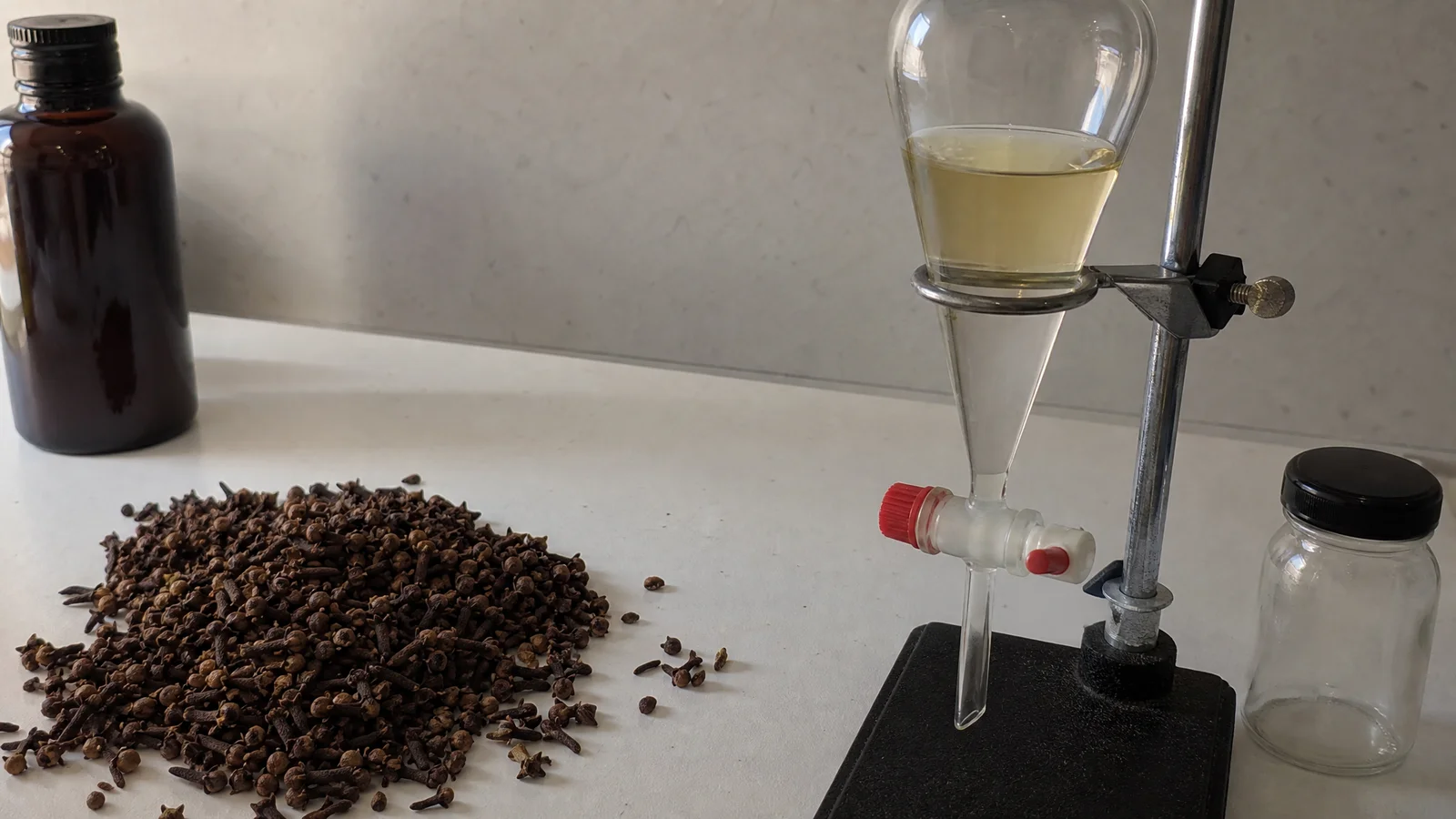
The Kamatou review sums up the classic route neatly. The oil is mixed with excess aqueous alkali, about 3% sodium or potassium hydroxide, to form the phenolic salt. The non-phenolic part is removed with a solvent or by steam distillation. The remaining solution is acidified at low temperature to release the eugenol, which is then purified by fractional distillation. The review says eugenol is "predominantly prepared from natural oil sources" this way.
Why the last step is a still
Acidifying hands you crude eugenol with water and traces of whatever tagged along. A fractional distillation separates it by boiling point, and PubChem puts eugenol's at 252 to 256 C. Its record also says the liquid darkens in air and may decompose in light, so a producer wants the lowest temperature and least air that still gives a clean split, which is what a vacuum column provides. Our How We Test page describes continuous vacuum fractional distillation in a tower, carried out where the fractionation capacity is, in practice India or China, by a specialist producer. We choose the producer, write the specification and check what arrives, and we sell the result as the isolate it is.
What gets left behind
Eugenyl acetate is an ester, and esters generally react with strong alkali, so reasoning from basic organic chemistry the 8% of it in a bud oil could be split into eugenol and acetate during the alkali step and add to the yield. We offer that as an inference about chemistry, not as a documented plant procedure. What the literature does establish is the destination: a material that is overwhelmingly one molecule.
That narrowing has a sensory price, and it is the reason eugenol oil is not simply a stronger clove oil. Our How We Test page calls the isolate narrower than the oil it came from, on purpose. The caryophyllene and the ester add roundness to clove oil, and without them what remains is the warm, spicy, carnation-like core. Which one belongs on your bench depends on the job, and eugenol oil versus clove oil helps you choose.
The other route to the same molecule
Eugenol can also be built from guaiacol and allyl chloride, which the Kamatou review calls the most practical synthetic method. Solvay's 2021 announcement of a synthetic eugenol for fragrance said that natural origin "is not essential" and that it would offset "quality, supply and price fluctuations occurring in the sourcing of natural eugenol extracted from cloves" (Solvay, 2021). At high purity the two are the same compound, so a GC trace cannot tell them apart. Only radiocarbon analysis can show whether the carbon came from a plant, and ASTM D6866 describes that method while noting that it does not address geographical origin (ASTM D6866-22). We take that question further in natural versus synthetic eugenol.
Three questions that follow from the process
- The assay, and which method gave it. The same bud oil read 82.7% by GC-FID and 75.06% by GC-MS in the EFSA dossier, so a bare number means little. See what a GC percentage means.
- The named carry-overs. Eugenyl acetate and caryophyllene are the obvious ones, and methyl eugenol, found at 0.039% to 0.128% in the EFSA bud oil, has its own story in our methyl eugenol article.
- An isotope report, if the word "natural" is going on a label.
We would encourage a buyer to ask for all three for a specific lot, in writing, from us or anyone else, and our How We Test page invites you to quote your lot number when you do.
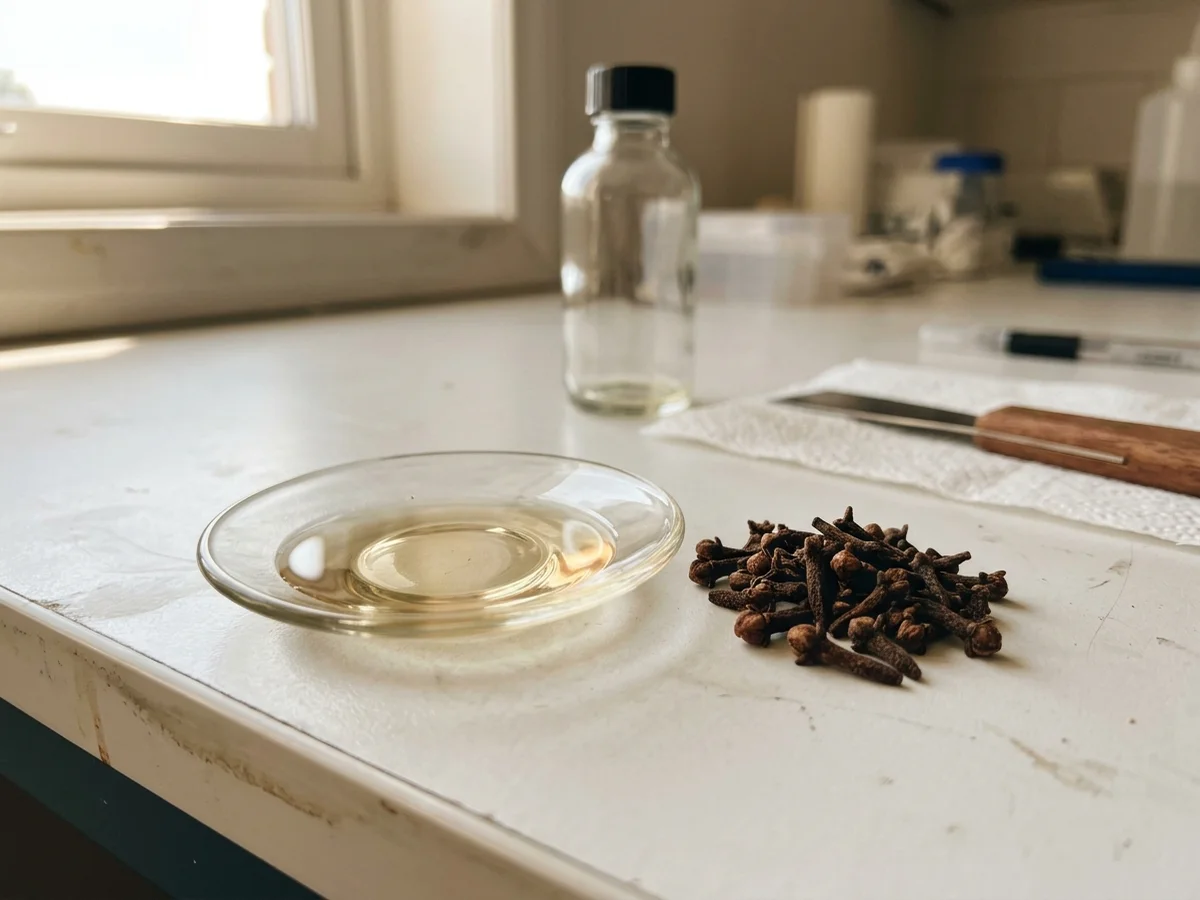
Next time you hold a bottle of any clove-derived material to your nose, remember the tall still behind it. The warm, sweet spice you smell is the result of a great deal of patient sorting.
An explanation, not a bench recipe
The steps above involve caustic solution, acid, solvents and heat, and eugenol is itself a skin sensitiser. A home attempt would also end without an assay, so the result could not go into an IFRA calculation. For fragrance work, a characterised material is the better route, and our adulteration article covers checks on what arrives. If the chemistry itself is what you love, a supervised teaching laboratory is the place to do it.
It is a pleasing piece of chemistry: a wet, ordinary acid-base trick, a tall still, and a single warm molecule at the end.
Sources & Further Reading
- EFSA FEEDAP Panel, 2023. Safety and efficacy of clove oils for use in food and feed. pmc.ncbi.nlm.nih.gov/articles/PMC10375362
- Kamatou GP, Vermaak I, Viljoen AM, 2012. Eugenol: from the remote Maluku Islands to the international market place. Molecules 17(6):6953-6981. pmc.ncbi.nlm.nih.gov/articles/PMC6268661
- PubChem, eugenol (CID 3314). pubchem.ncbi.nlm.nih.gov/compound/Eugenol
- Solvay, 2021. Solvay launches Eugenol Synth for fragrance applications (press release). solvay.com press release PDF
- ASTM International. D6866-22, radiocarbon biobased content. store.astm.org/d6866-22