How Much Eugenol Is in Clove Oil? Bud, Leaf, Stem
"Clove oil is 80% eugenol" gets repeated until it stops meaning anything. The honest answer is that it depends on three things: which part of the tree was distilled, which instrument did the measuring, and which batch happened to be on the bench. The spread between honest measurements of the same oil is wider than most people expect, and that is exactly what makes the refined isolate a different material.

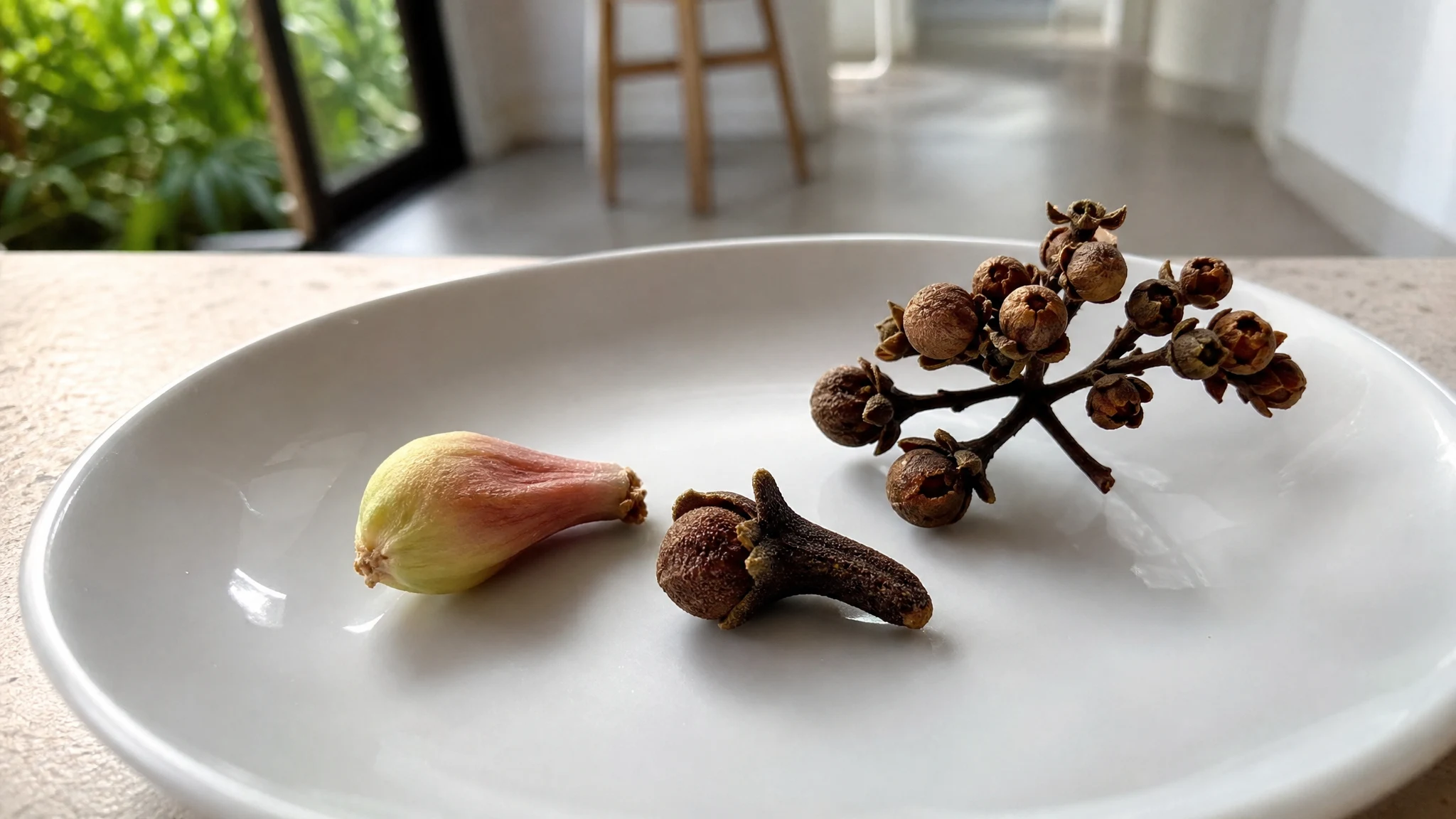
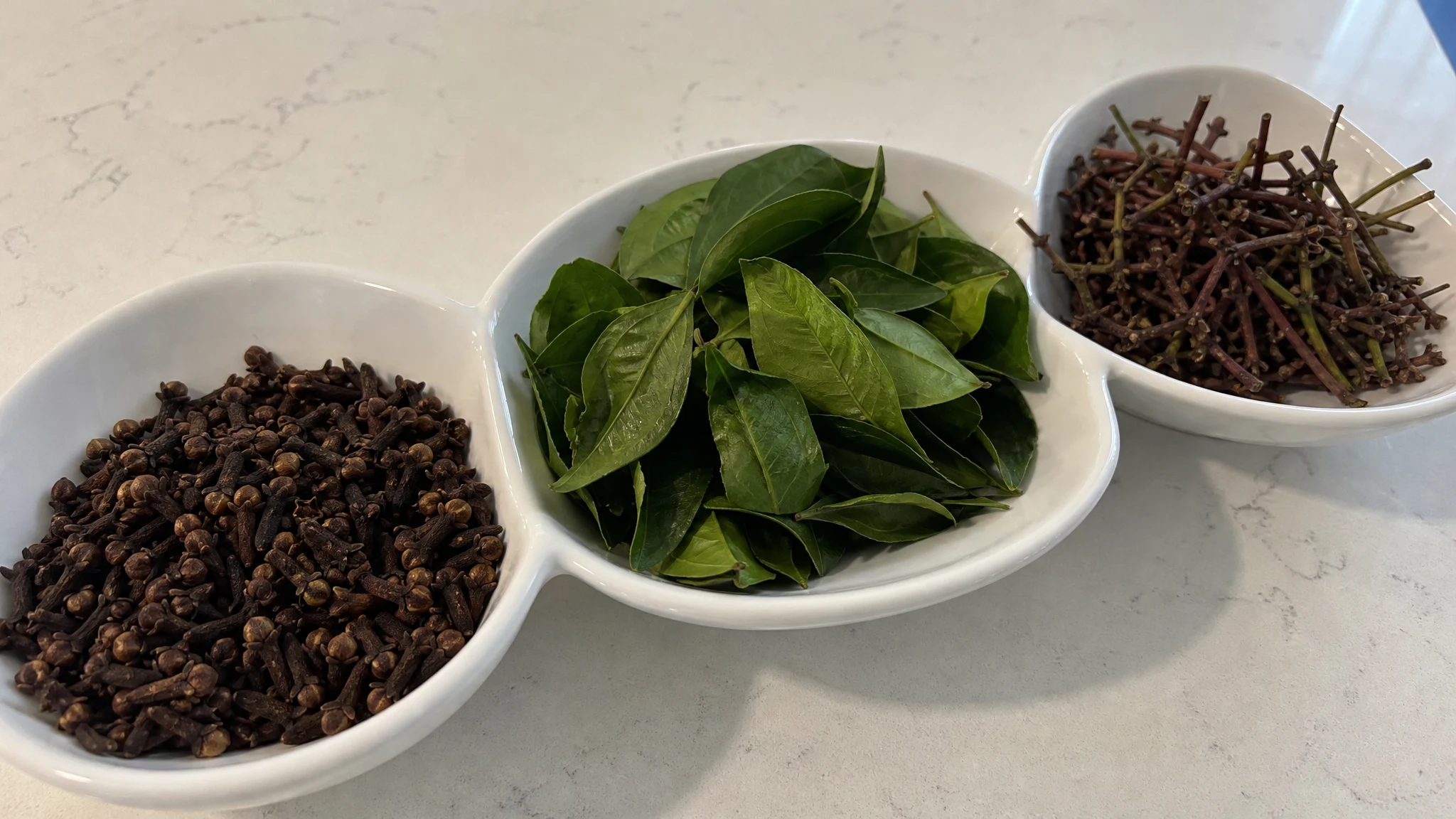
Bud, leaf and stem, side by side
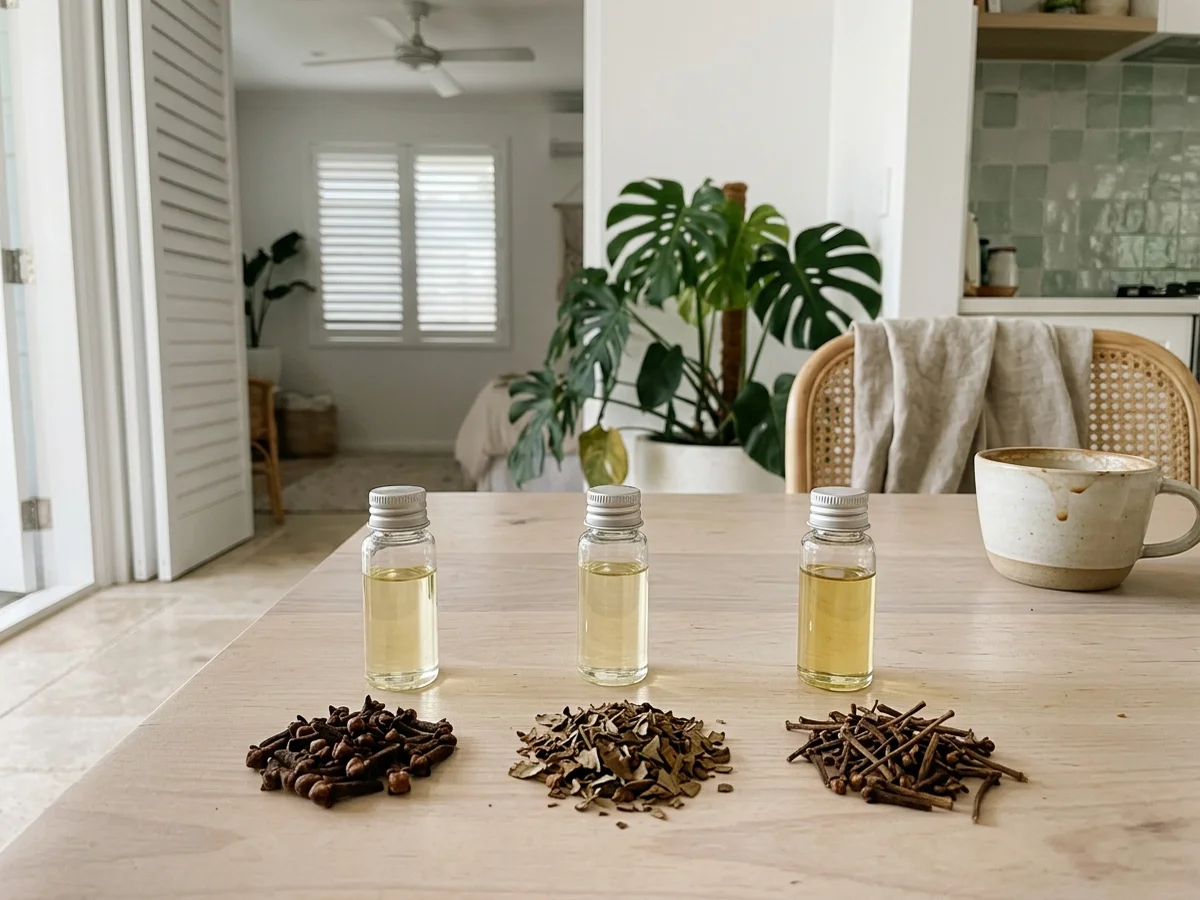
EFSA's 2023 review of clove oils for animal feed analysed batches from named sources. Seven batches of bud oil, from buds sourced in Indonesia, averaged 75.06% eugenol by GC-MS. Six batches of leaf oil, from Madagascar and Indonesia, averaged 82.60% (EFSA FEEDAP Panel, 2023). The leaf range overlapped what a study on Buru Island, Indonesia reported for bud oils, 76.1 to 87.7%. The same Buru study found stem oil much higher, at 94.2 to 97.6%, though it identified only two compounds and came from one harvest, so we would not generalise from it (Sohilait et al., BioResources, 2023). A review sums up the whole literature at 45 to 90% eugenol in clove oil (Kamatou et al., Molecules, 2012), which is the fair headline: wide, and dependent on what was distilled.
The instrument can matter more than the plant part
Here is the surprising bit. EFSA reported its seven bud oil batches by two methods. By GC-FID the mean eugenol figure was 82.7%, and by GC-MS it was 75.06%. That is a gap of about 7.6 percentage points, bigger than the difference between bud and leaf. Caryophyllene moved even more, from 6.7% to 13.20%. All the figures are area percent, so a supplier's "85%" and a paper's "75%" are not in conflict until you know the method. Our GC-MS explainer goes through why.
What really separates the three
Take the instrument out of the picture and bud and leaf are closer on eugenol than the headlines suggest. The real difference is the company eugenol keeps. Bud oil averaged 7.92% eugenyl acetate in EFSA's GC-MS table; leaf oil averaged 0.70%. Caryophyllene is close to equal in the two EFSA tables, at 13.20% in bud and 13.45% in leaf. Methyl eugenol shows up only as a trace, a separate molecule with its own rules (see our comparison).
For a perfumer, eugenyl acetate is the interesting one. The Kamatou review says the ester does not have the powerful spicy notes of the free phenol. Reasoning from that, a bud oil rich in the ester and a leaf oil nearly free of it will not smell the same even at equal eugenol, which is one more reason a single percentage never tells the whole story. For a plant-by-plant look beyond clove, see where else eugenol turns up.
How to smell the difference yourself
If you have a bottle of clove oil on the shelf, put a drop of it on one strip and a drop of eugenol oil on another, and hold them a hand's width from your nose. Whole clove oil tends to smell broader and a little rougher, with woody and sometimes sharp corners. The refined material smells warmer, rounder and more carnation-like. Smell them again after twenty minutes, then after an hour. Noses differ, so trust your own reading over any description, ours included.
From clove oil to eugenol oil
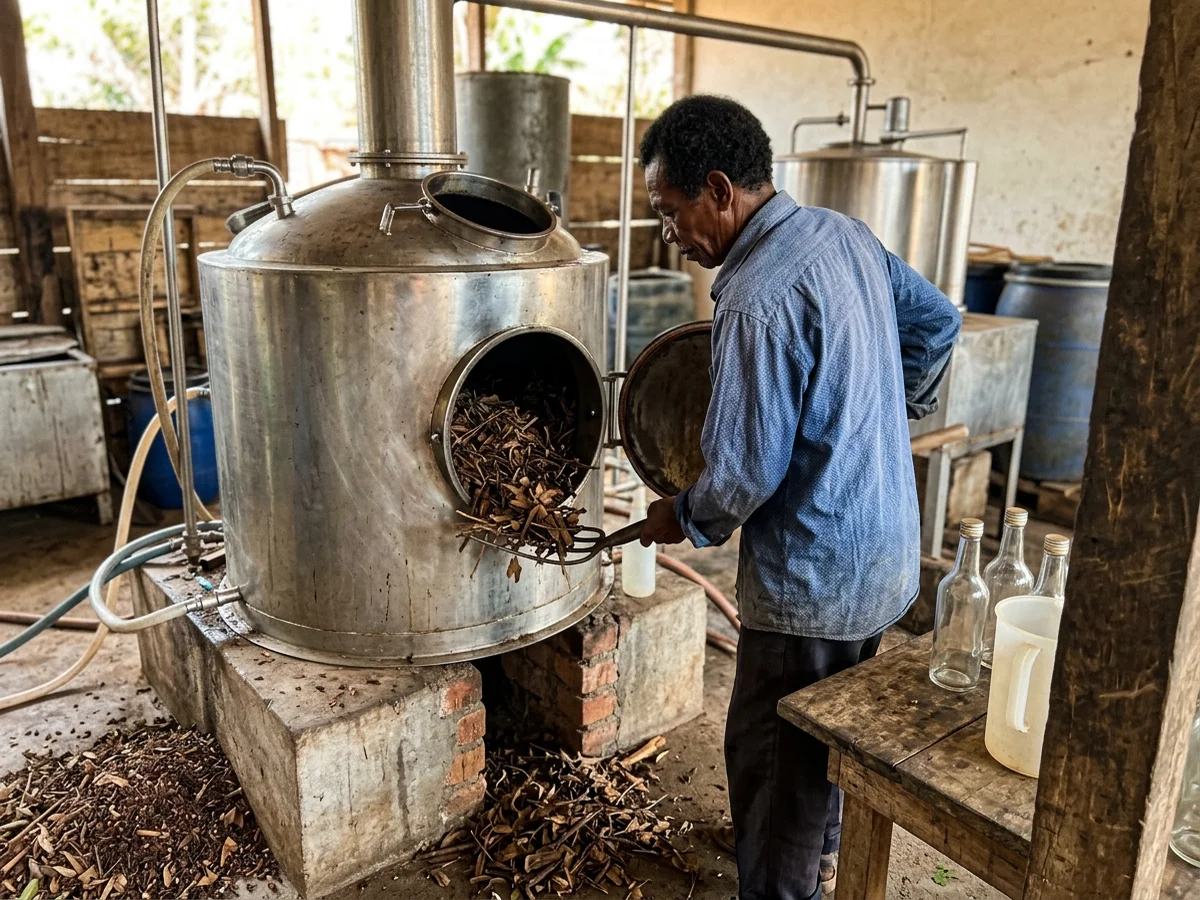
Whole clove oil is the starting material for what we sell, not the finished product. The route described by Kamatou and colleagues mixes the oil with about 3% aqueous sodium or potassium hydroxide so the phenol forms a salt, removes the non-phenolic portion, acidifies at low temperature and purifies the liberated eugenol by fractional distillation. Our isolation walk-through follows that path. We sell the result as eugenol oil, a refined isolate, and our How We Test page says plainly that it is not an essential oil. A bud oil figure of 75 to 83% therefore describes the raw material, not our bottle.
The Certificate of Analysis we publish for one batch lists appearance, smell, a relative density of 1.065 and a refractive index of 1.541. For comparison, EFSA's bud oil batches ran a refractive index of 1.534 to 1.537, and PubChem lists 1.5405 for eugenol itself. A reading at the eugenol end of that range is what a high-eugenol material would give, but a physical constant cannot give you a percentage. If you need the assay or impurity profile for a lot, ask us in writing through the contact page, and ask any supplier the same.
Why the number matters in a formula
If a recipe includes clove bud oil, its eugenol counts toward the IFRA limit even though you never added the isolate. IFRA's guidance says restrictions apply whether the restricted material is added directly or indirectly. As a worked example with invented quantities, 1 g of clove bud oil in 100 g of body oil is a 1% dose. Using EFSA's two bud figures, that carries 0.75% to 0.83% eugenol, above the 0.64% ceiling for body creams, oils and lotions in the 51st Amendment (IFRA Standards). In fine fragrance, with its 2.5% ceiling, the same oil has far more room. Our blend calculation article and IFRA limits article work through the other categories.
That is formulation arithmetic, not a safety assessment, so a regulatory specialist should sign off anything sold to the public. The takeaway we like best is the simplest: when someone quotes a clove oil figure, ask which part, which method and which batch.
Sources & Further Reading
- EFSA FEEDAP Panel, 2023. Safety and efficacy of feed additives consisting of essential oils derived from the flower buds or the leaves of Syzygium aromaticum. EFSA Journal 21(7):8183. PMC10375362
- Sohilait HJ, Kainama H, Kaihena M, 2023. Chemical composition and antioxidant activities of the essential oils of Eugenia caryophyllata from Northern Buru Island, Moluccas. BioResources 18(4):7551-7565. bioresources.cnr.ncsu.edu/?p=44147
- Kamatou GP, Vermaak I, Viljoen AM, 2012. Eugenol: from the remote Maluku Islands to the international market place. Molecules 17(6):6953-6981. PMC6268661
- PubChem, Eugenol, CID 3314. pubchem.ncbi.nlm.nih.gov/compound/Eugenol
- IFRA, 2023. IFRA Standards, 51st Amendment, Eugenol (CAS 97-53-0). ifra-standards-51st-amendment.pdf