Handling Eugenol Oil: Gloves, Spills and Storage
Good habits with eugenol oil come down to one idea: protect your skin and your eyes first. Fire and fumes come a distant second. That ordering follows from how the compound is classified, and it tells you where to spend your money at the bench.

Setting up the bench
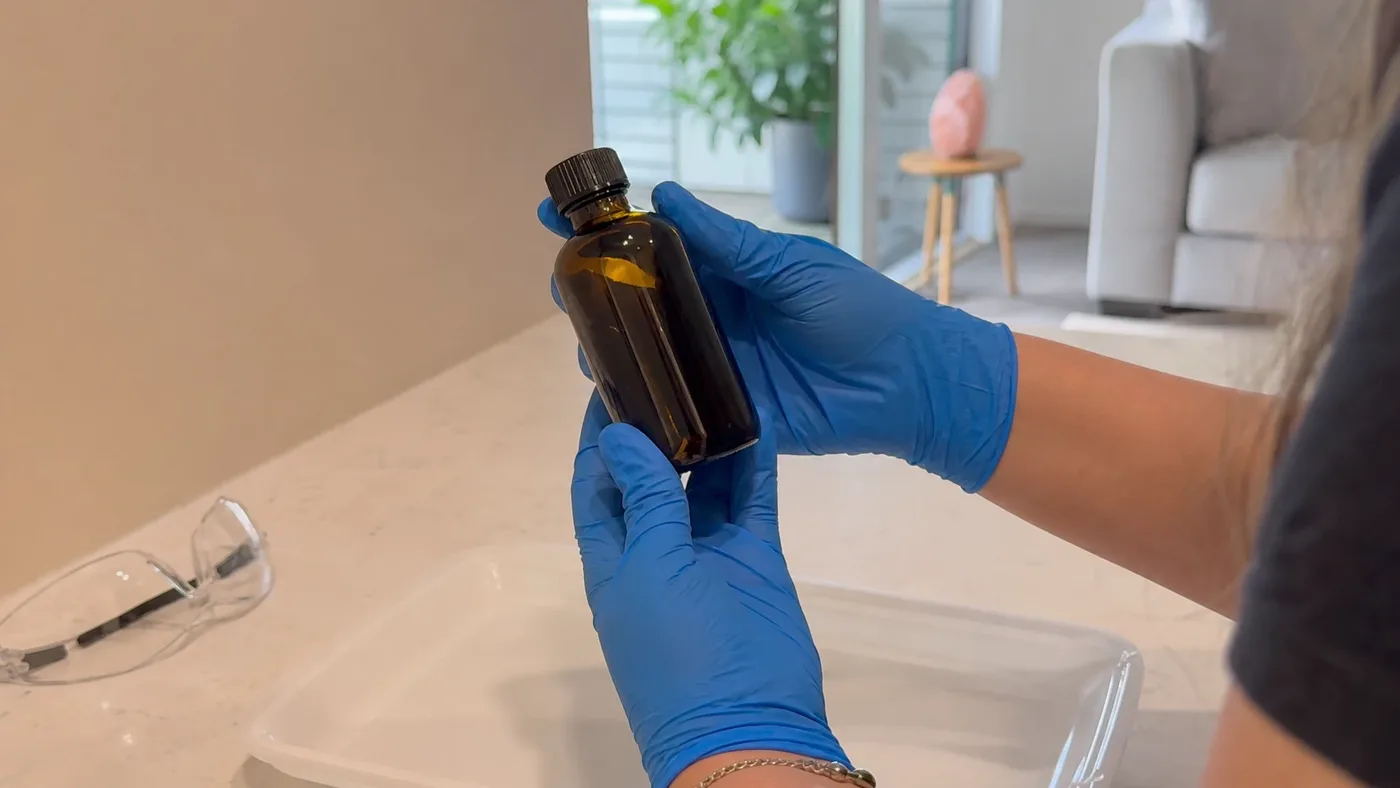
Before the bottle opens, clear the space. Put down a tray or a sheet of paper you can throw away, pull on your gloves, set up the scale, and keep paper towels and a labelled waste bag within arm's reach. A tidy bench is not fussiness: it means a spill is a small event with an obvious next step.
What the classification says
PubChem collects the European Chemicals Agency's notifications for eugenol: of 2,820 company reports, 99.8% list H317, may cause an allergic skin reaction, and 80.4% list H319, serious eye irritation, while smaller shares list skin irritation (20.6%) and harmful if swallowed (17.3%) (PubChem, eugenol). NOAA's CAMEO Chemicals describes it as a primary irritant and sensitizer. The two supplier sheets we have read, from ChemScene and Central Drug House, carry the same H317 and H319 statements. Sensitisation is the constant, and it is why we suggest a gloved, small-amount approach every time. The sheet that arrives with your lot governs, and our SDS guide goes through it section by section.
What you will notice when you open it
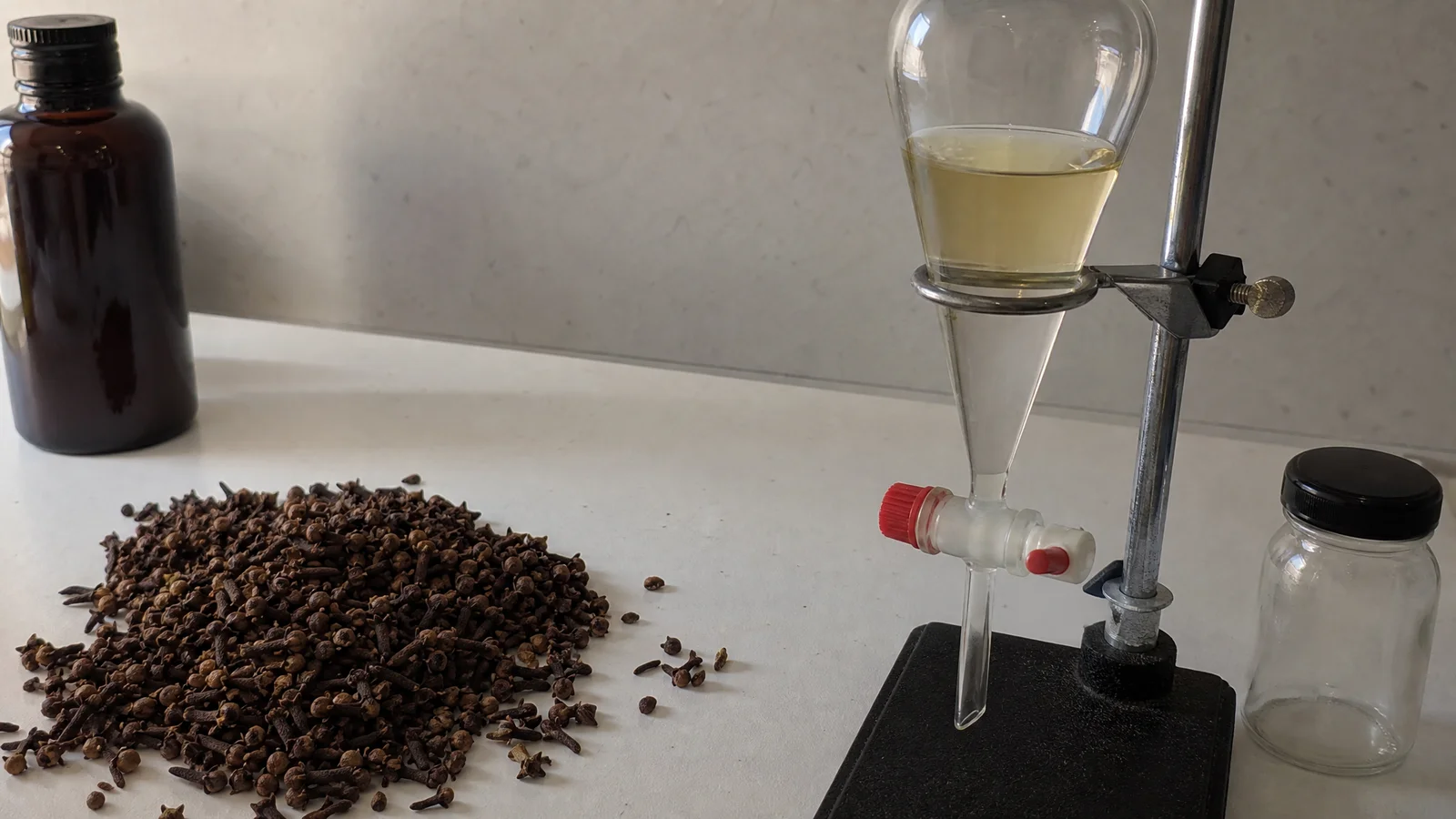
Eugenol oil is a pale yellow liquid with a warm, spicy, carnation-like scent, sweeter and more focused than whole clove. It is tempting to sniff straight from the bottle. Resist that, and waft from a paper strip held at arm's length instead.
Gloves and eyes
Wear gloves and, when pouring or weighing, splash goggles. Glove material matters, because generic names hide big differences between makers. If you are handling more than a few millilitres, ask the glove maker for permeation data against eugenol (CAS 97-53-0), treat thin disposable gloves as splash protection, and change them the moment they are wetted. For eyes, rinse immediately with plenty of water and call a physician or poison centre; the first-aid section of your sheet gives the details.
Pouring and weighing
Pour slowly into a small beaker rather than straight into your batch, keep the lip of the bottle close to the beaker, and wipe the neck with a paper towel before you recap. Oil left in the threads ends up on your fingers next time. Recap the moment you are done, every time.
Ventilation
An open bottle gives off little at room temperature. PubChem lists eugenol's vapour pressure at about 0.02 mmHg at 25 C, and warm or heated material gives off more, so a pot of melting wax deserves more airflow than a closed bench. On respirators, CAMEO suggests a half-face respirator with an organic vapour cartridge when weighing or diluting the neat chemical, and sheets vary, so check yours. An industrial hygienist is the person to settle it for a workplace; at a home bench, a window and a fan go a long way.
Spills
CAMEO's advice is to remove ignition sources, pick the liquid up with absorbent paper, seal the paper and any contaminated clothing in a bag, and wash the surface with 60 to 70% ethanol and then soap and water. Eugenol dissolves in water only to about 2.5 g per litre at 25 C according to PubChem, so a plain water wipe tends to spread the oil. A millilitre weighs about 1.07 g at the density on our Certificate of Analysis, which gives you a sense of how much cloth a spill needs. Keep flames away while you use ethanol, and expect a mark on porous surfaces, since eugenol darkens as it ages (why it darkens).
A word about labels
Anything you decant should carry a label you can read at a glance in poor light: the name, the date and a short hazard note copied from your sheet. A tiny bottle with no label is how good habits quietly fall apart, so write it down the moment you pour.
Storage
Keep it tightly capped in a cool, dark place, away from heat and light. We pack every size in dark glass. CAMEO lists strong alkalis, strong oxidisers, iron and zinc as incompatible, so soap makers should not shelve it beside lye. We say typically two to four years, and a part-used bottle ages faster, so decant working amounts into a small dark bottle and label it with the product name, the hazard wording from your safety data sheet and the date. Our storage guide has the full reasoning.
Washing up
Even with gloves on, wash your hands with soap and water when you finish. Peel the gloves off inside out so the outside never touches your skin, bag them, and wipe the bench. Rinse your beakers promptly too, because oil that dries on glass is harder to shift and easier to forget.
Our own rules of thumb
Use small amounts, wash your hands after handling, and keep the oil away from eyes, children and pets, and out of casual reach. It is not for internal use and not offered for any medical or dental purpose. For skin products, work from the IFRA limit for your category, and see the compliance guide for the numbers. We sell the oil only, so gloves, goggles and eyewash come from a safety-supply shop.
Handled with a little respect, eugenol is a pleasure to work with. Gloves on, bottle capped, notes labelled, and the spicy warmth takes care of the rest.
Sources & Further Reading
- National Library of Medicine. PubChem, eugenol, CID 3314 (ECHA C&L Inventory, vapour pressure, solubility). pubchem.ncbi.nlm.nih.gov/compound/Eugenol
- NOAA. CAMEO Chemicals: Eugenol. cameochemicals.noaa.gov/chemical/20399
- ChemScene LLC. Safety data sheet, Eugenol 98% (stabilized with TBC), CS-7807. file.chemscene.com
- Central Drug House (P) Ltd. Safety data sheet, Eugenol, CAS 97-53-0. cdhfinechemical.com