Eugenol vs Methyl Eugenol: Why the Difference Matters
Eugenol and methyl eugenol differ by one methyl group and are regulated for different reasons. Eugenol is a skin sensitiser that has to be declared on cosmetic labels. Methyl eugenol is a carcinogenicity concern, and in 2023 the International Agency for Research on Cancer moved it up a category. If you blend spice oils, the more useful question is not "is my eugenol clean?" but "which of my other ingredients is carrying methyl eugenol?"
A correction to the common summary
You will still see methyl eugenol described as an IARC Group 2B "possible carcinogen", which was true from the Volume 101 evaluation in 2013. An IARC working group met in Lyon from 6 to 13 June 2023, and IARC's announcement says it reclassified methyleugenol to Group 2A, "probably carcinogenic to humans" (IARC, 2023). The stated basis: sufficient evidence in animals, strong mechanistic evidence in experimental systems, and inadequate evidence in humans. Group 2A here is a statement about the strength of the evidence, not a measurement of risk at a given dose. The same announcement classified isoeugenol, the other clove-derived molecule, as Group 2B. The page we read makes no statement about eugenol itself, so do not carry either classification across to it.
Same family, different hazards
| Eugenol | Methyl eugenol | |
|---|---|---|
| Formula, mass | C10H12O2, 164.20 | C11H14O2, 178.23 |
| Chemical name (PubChem) | 2-methoxy-4-prop-2-enylphenol | 1,2-dimethoxy-4-prop-2-enylbenzene |
| Boiling point, reported | 252 to 256 C (three sources) | 249 to 254.7 C (two sources) |
| Most-notified GHS statements (ECHA notifications via PubChem) | H317 allergic skin reaction (99.8% of 2,820 reports), H319 eye irritation (80.4%) | H351 suspected of causing cancer (93.6% of 1,814 reports), H302 harmful if swallowed (93.9%), H341 suspected of causing genetic defects (91.4%), H317 (70.9%) |
The structural difference is where the one extra carbon sits. Eugenol has a free phenolic hydroxyl group (the "ol"); in methyl eugenol that hydroxyl is capped as a second methoxy group. That small change is enough for a GC column to tell them apart, which is why a proper GC report can report each one separately. The PubChem notification percentages are the share of company reports that carry each statement, not an official classification, and PubChem lists newer Japanese (NITE) entries that differ from the ECHA aggregate for both molecules. That variation is exactly what reading an SDS has to account for.
What regulators did about methyl eugenol in perfumery
The EU's cosmetics safety committee (then the SCCNFP) adopted an opinion on methyleugenol on 24 October 2000 (SCCNFP, 2000). It considered only genotoxicity and carcinogenicity, concluded that methyleugenol should not be intentionally added as a cosmetic ingredient, and proposed maximum levels in the finished product where it arrives with naturally occurring fragrance materials: 0.01% in fine fragrance, 0.004% in eau de toilette, 0.002% in fragrance cream, 0.001% in rinse-off products, and 0.0002% in other leave-on products. Those are the values as that opinion states them. We could not open the current legal text on EUR-Lex, so check the present Annex III entry for methyleugenol in Regulation (EC) 1223/2009 and any amendments before relying on a figure, and ask a regulatory specialist how it applies to your product.
The scale is the notable part. The leave-on figure is 0.0002%, which is 2 parts per million. For comparison, our own shop copy gives 0.5% to 2% as a skin dilution for eugenol oil. Eugenol's concern is allergy; methyl eugenol's is cancer-related, and the numbers show how differently the two are policed.
Where methyl eugenol actually turns up
A 2023 review of alkenylbenzenes in plants gives reported ranges for essential oils (Gotz et al., Plants, 2023; full text on PMC). It is a literature compilation, so the ranges reflect different samples and methods:
- Allspice berry oil: 0.1 to 82% (63% in one steam-distilled commercial Mexican sample; 4 to 9% in Jamaican hydro-distilled oils).
- Basil: 9 to 87% in oils from aerial parts, with some Moroccan, French and Italian oils under 0.8%. A separate 2026 analysis of one Egyptian basil oil found 7.2% methyl eugenol and 73.0% estragole (Sytykiewicz et al., Molecules, 2026).
- West Indian bay leaf oil: 0 to 64%, with 43% in one oil and 0 to 12% in commercial bay oil.
- Nutmeg kernel oil: 17% in one report, 0.6% in a Sri Lankan sample.
- Ylang-ylang flowers: 0.2 to 1.5%. (Ylang ylang is on our shop page's list of blend partners for eugenol.)
- Rose: the PubChem record for methyl eugenol lists rose oil as a source with no percentage, citing a 1981 reference.
Whole clove oil sits at the bottom of this scale. The EFSA feed-additive opinion analysed seven clove bud oil batches and found methyl eugenol in all of them at 0.039 to 0.128% (average 0.078%), and in four of six clove leaf oil batches at 0.010 to 0.030% (EFSA FEEDAP Panel, 2023; full text on PMC). The same opinion treats clove oils as skin sensitisers and notes that unprotected users handling them can be exposed to methyleugenol, so it advises minimising exposure. That opinion is about animal feed additives, but the composition data are for clove oils generally.
Why an isolate does not automatically solve it
Eugenol and methyl eugenol boil within a few degrees of each other in the sources above. Reasoning from that, a plain distillation cut has little power to separate them, so whatever methyl eugenol is in the starting oil may travel with the eugenol fraction. As an upper-order illustration only: if nothing separated them, a 98% eugenol material made from bud oil with 75.06% eugenol and 0.078% methyl eugenol (the EFSA averages) would carry about 0.078 x 98 / 75.06 = 0.10% methyl eugenol. That number is arithmetic on published averages. It is not a measurement of any lot, ours included, and a refiner who uses a different separation may do better.
Here is why that matters at the bench. Using the SCCNFP leave-on figure only as an illustration, a skin oil at 0.5% of a material containing 0.10% methyl eugenol delivers 0.0005%, against a 0.0002% figure for "other leave-on products". Because the arithmetic can land on either side of a limit, the only answer is a number from the GC report of the lot you buy. A candle or reed diffuser is a different regulatory category from a cosmetic, which is why the right table to use depends on the product. The blend calculation shows how to run it.
What to ask the supplier, and what to ignore
- A GC report that names methyl eugenol as its own peak, with the method (FID or MS), and states a detection limit if the result is "not detected". "Not detected" without a limit tells you nothing.
- The same for every spice oil in the blend, especially bay, allspice and basil. They are the likelier contributors.
- Ignore "methyl eugenol free" as a marketing claim unless it comes with that report.
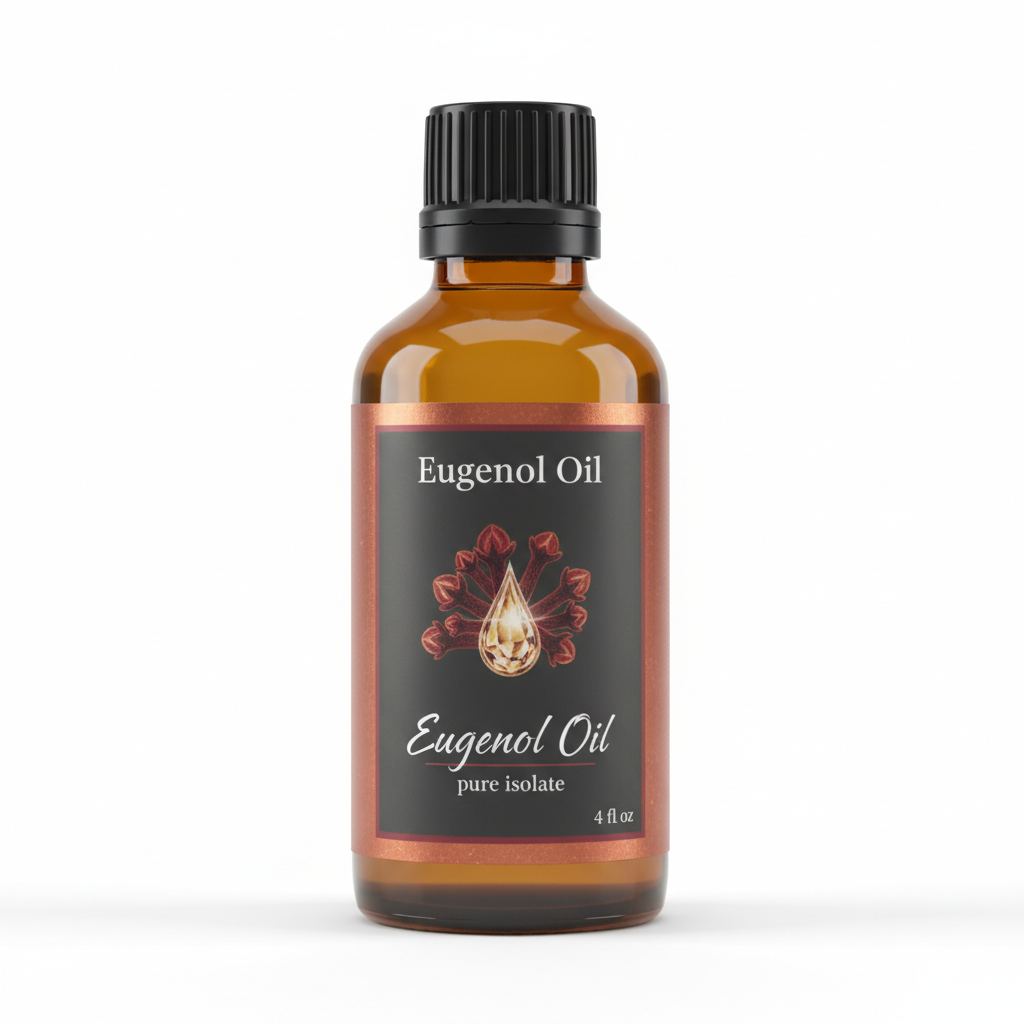
Our published COA reports density and refractive index for one batch, which cannot say anything about impurities. It lists no assay, no chromatogram and no impurity data, so it does not answer this question for our oil either. Our eugenol oil is a refined isolate from clove oil, sold undiluted. We do not sell methyl eugenol or isoeugenol (see our isoeugenol comparison for that molecule). If your formula needs a methyl eugenol figure, ask for the GC report in writing before you buy, from us or anyone. How to read one is in our COA guide.
Who should decide
Whether a given product is acceptable depends on the category, the market and the current regulation. That is a toxicologist's or regulatory specialist's call, with a cosmetic chemist for formula changes. Nothing here is legal advice. For the sensitisation side of eugenol, which is a separate and more common issue for makers, see eugenol skin sensitization.
Eugenol and methyl eugenol are near neighbours on a GC trace and far apart in regulation, so treat the second one as its own line in the spreadsheet and its own line on the supplier's report.
Sources & Further Reading
- IARC, 2023. IARC Monographs evaluation of the carcinogenicity of aspartame, methyleugenol and isoeugenol. iarc.who.int
- SCCNFP, 2000. Opinion concerning methyleugenol (adopted 24 October 2000). ec.europa.eu/health, sccp_out126
- PubChem. Eugenol (CID 3314) and methyleugenol (CID 7127): GHS classification, boiling point, formula. pubchem.ncbi.nlm.nih.gov/compound/3314, pubchem.ncbi.nlm.nih.gov/compound/7127
- Gotz ME, et al., 2023. Occurrence of alkenylbenzenes in plants. Plants. pubmed.ncbi.nlm.nih.gov/37299054
- EFSA FEEDAP Panel, 2023. Safety and efficacy of feed additives consisting of essential oils from Syzygium aromaticum. EFSA Journal. pubmed.ncbi.nlm.nih.gov/37522096
- Sytykiewicz H, et al., 2026. GC-MS profiling of basil and clove essential oils. Molecules. pmc.ncbi.nlm.nih.gov/articles/PMC13609182