How to Read a Eugenol Certificate of Analysis
The Certificate of Analysis we publish for eugenol oil is short. It covers one batch and reports five results: appearance, smell, relative density, refractive index and optical rotation. The skill worth having is knowing what those five physical readings can tell you, and where the next question begins, so let us read ours line by line.

What the certificate says
The PDF names the product "Eugenol Essential Oil" with the botanical name Syzygium aromaticum, gives batch number EUGLUUSAIDC006A, lists "Parts Used: Leaf" and "Extraction Method: Steam Distilled", and prints a best-by date of 07/21/2026. Its conclusion is that all tested parameters comply with pharmacopoeia standards. The results read:
| Test | Result | Standard on the certificate |
|---|---|---|
| Appearance | Pale yellow liquid | Pale yellow liquid |
| Smell | Unique aroma of eugenol | Unique aroma of eugenol |
| Relative density, 20 C | 1.065 | 1.064 - 1.070 |
| Refractive index, 20 C | 1.541 | 1.540 - 1.542 |
| Optical rotation, 20 C | n/a | n/a |
It describes the batch on that certificate, and we publish one certificate for one batch. Our How We Test page says plainly that this is not an essential oil but an isolate, one molecule pulled out of a distillate and concentrated, and describes a specification of 99.0% minimum eugenol by GC-FID area. That figure is a specification, so the certificate on its own does not show an assay.
Checking the numbers against something outside the document
A certificate that measures a result against a "standard" printed on the same sheet only goes so far, because the supplier chose both columns. A sturdier check uses a reference you did not get from the supplier.
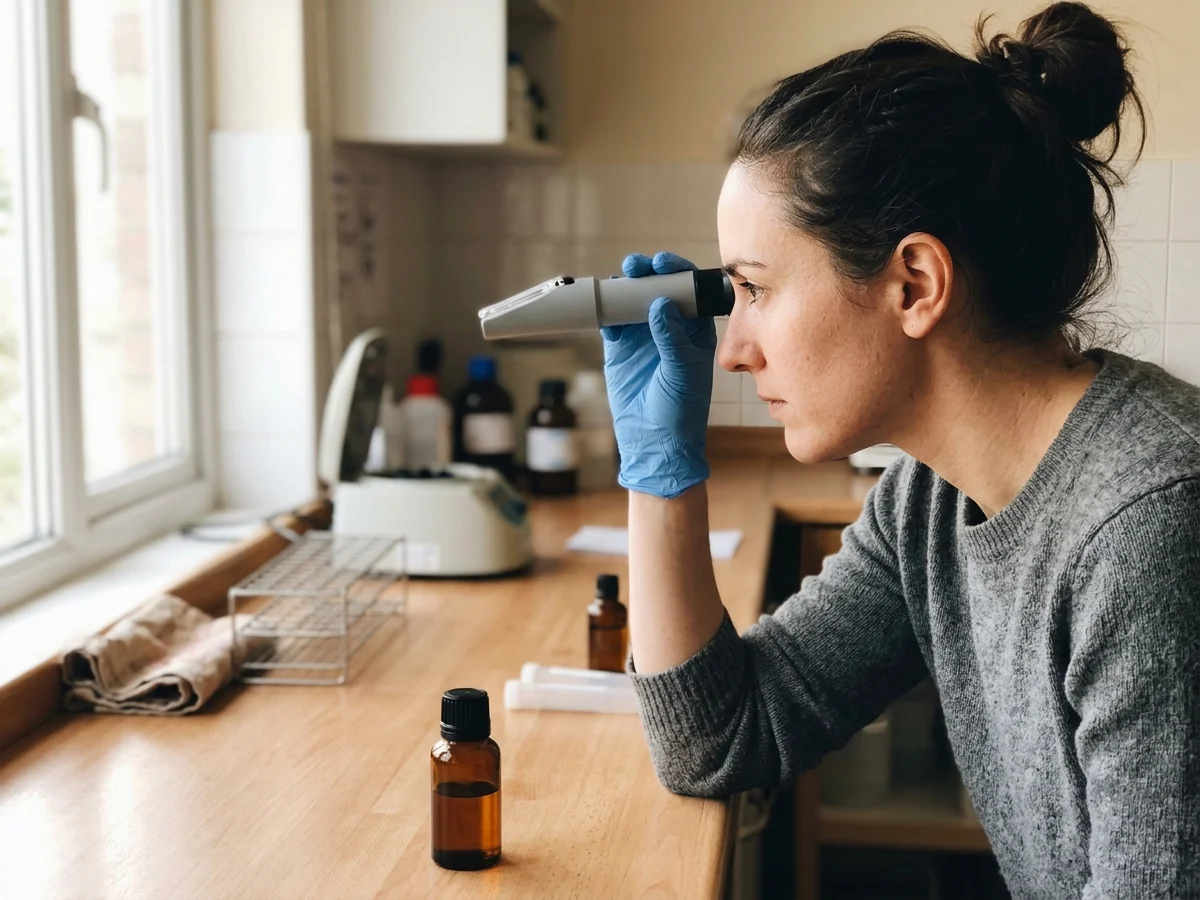
PubChem lists experimental eugenol properties of density 1.064 to 1.070 and refractive index 1.540 to 1.542, with the CRC Handbook giving 1.5405 at 20 C (PubChem, eugenol). Those are the same ranges as the standard column on our certificate, so the batch is being held up against the textbook figures for the compound, and 1.065 and 1.541 sit comfortably inside them. That is a useful, honest result. Note that the certificate does not name which pharmacopoeia it used, and PubChem lists eugenol grades as Technical, USP and FCC, so "pharmacopoeia" alone does not tell you which grade you hold.
Now compare whole clove oil. In the EFSA feed-additive dossier, bud oil specific gravity ran 1.0559 to 1.0593 with refractive index 1.534 to 1.537, and leaf oil refractive index 1.5315 to 1.5323 (EFSA FEEDAP Panel, 2023). Reasoning from those, a density of 1.065 and an index of 1.541 sit above the whole oils and match the pure compound, which is what you would expect of material concentrated toward eugenol. Two bulk constants cannot say whether the figure is 95% or 99.5% eugenol, which is why they are a first check and not a final one. Our clove oil content article has the composition ranges.
What "optical rotation n/a" is telling you
Bud oil in the EFSA dossier rotated light slightly negatively, between -0.64 and -1.0 degrees across five batches, because it is a mixture. PubChem describes eugenol itself as optically inactive, so a blank here is unsurprising. Read it as a line without information, since nothing was measured, and leave it out of your thinking.
Where the next questions begin
Five physical readings leave plenty of room for questions. The certificate does not carry an assay or purity percentage, a GC-FID or GC-MS trace, figures for eugenyl acetate or caryophyllene, isotope analysis, a CAS number, an origin, a laboratory name, a date of analysis, method references or allergen data. That is a normal shape for a short certificate and a useful map of what to request.
Method matters even when an assay is printed. In the EFSA dossier the same bud oil gave 82.7% eugenol by GC-FID and 75.06% by GC-MS, so a percentage with no method beside it can swing seven points on one oil. Our GC-MS article explains why, and the adulteration article covers what a chromatogram can miss.
The "natural" question
Eugenol can be made synthetically from guaiacol, and Solvay's 2021 launch of a synthetic eugenol for fragrance stated that "natural origin is not essential" (Solvay, 2021). Our How We Test page says synthetic and clove-derived eugenol are the same molecule at high purity, and that only carbon isotope analysis separates them. The standard method is radiocarbon analysis under ASTM D6866, which measures biobased carbon and, by its own scope, does not address geographical origin (ASTM D6866-22). A certificate with no isotope data cannot support a "natural" claim, ours or anyone's, so if the word will go on your label, ask for the isotope report on your lot.
One practical tip: print the certificate and keep it beside your batch notes, then circle the lines you understand and put a question mark by the ones you do not. That short list of question marks becomes your email to the supplier.
A short list for any supplier
- The lot number you will receive, with a certificate that matches that lot.
- An assay with the method named, and the chromatogram.
- Figures for the companions: eugenyl acetate, caryophyllene and, for IFRA arithmetic, methyl eugenol and isoeugenol.
- An isotope or biobased-content result if you will make a natural-origin claim.
- The safety data sheet and, if you sell finished fragrance, an IFRA certificate. Our SDS guide covers the first.
- The best-by or retest date and the storage the supplier assumes.
For our oil, our How We Test page invites you to quote a lot and ask for figures. The place to ask in writing is our contact page, or the wholesale page for volume. Whatever exists for your lot is what we will send.

A certificate is a quality document and not a safety clearance. It cannot tell you whether a formula meets IFRA limits, which the IFRA article takes up, and anyone with a skin reaction should see a dermatologist. Used for what it does well, the five results confirm that the bottle is behaving like eugenol, and your written questions about purity, origin and lot do the rest.
Sources & Further Reading
- PubChem, eugenol (CID 3314): density, refractive index, optical activity and grades. pubchem.ncbi.nlm.nih.gov/compound/Eugenol
- EFSA FEEDAP Panel, 2023. Safety and efficacy of clove oils for use in food and feed. pmc.ncbi.nlm.nih.gov/articles/PMC10375362
- Solvay, 2021. Solvay launches Eugenol Synth for fragrance applications (press release). solvay.com press release PDF
- ASTM International. D6866-22, radiocarbon biobased content. store.astm.org/d6866-22