Eugenol Oil Adulteration: What GC Misses and What to Ask For
A GC report showing high eugenol does not prove that a bottle is natural, undiluted, or from the plant part the label names. GC reads what is volatile and tells you how much eugenol is present; it cannot tell you where the eugenol molecule came from, and it cannot see everything that might be mixed in with it. This guide sets out what the published studies document, what each test answers, and which papers to request before you buy, including from us.
What adulteration has actually been documented in clove oil
The studies we could read concern clove essential oil, not refined eugenol isolate, so applying them to an isolate is an inference. With that said: Vargas Jentzsch and colleagues (2018) tested 19 commercial clove essential oil samples with a handheld Raman spectrometer. Two samples were adulterated with benzyl alcohol and one with a vegetable oil. Benzyl alcohol showed up easily, through an intense band at 1003 cm-1; the vegetable oil needed multivariate analysis to detect. Their 2019 overview adds the point that matters for a buyer: GC detects only volatile and semi-volatile compounds, so a non-volatile adulterant stays in the injection port and never appears as a peak. The same overview notes that peak-area changes can hint at adulteration but also reflect regional and seasonal variation.
That is a small sample (19) from one lab group, and it does not give a rate for the market. It does give you a pattern: some diluents show up on a chromatogram and some do not.
The case GC cannot settle: synthetic eugenol
Synthetic eugenol is an openly sold material, not a secret. In a press release dated January 28, 2021, an aroma-chemical manufacturer announced a "high purity synthetic eugenol" with "olfactory properties comparable to that derived from cloves", positioned for applications "for which natural origin is not essential", and credited its integration in guaiacol, a key intermediate in its diphenol chain, for the process. The release says the aim was to offset "quality, supply and price fluctuations" in sourcing natural eugenol from cloves. It is a manufacturer's statement, not an independent test.
Reasoning from that: eugenol is one molecule, 4-allyl-2-methoxyphenol, so a chromatogram of a synthetic lot and a clove-derived lot shows the same compound. Synthetic eugenol is not adulteration when it is sold as synthetic. It becomes misdescription when it is sold as natural, and a composition report alone will not catch that. Our natural versus synthetic comparison covers how the two are made.
What isotope and radiocarbon tests answer, and what they do not
ASTM D6866 is titled "Standard Test Methods for Determining the Biobased Content of Solid, Liquid, and Gaseous Samples Using Radiocarbon Analysis." Its text says the methods "directly discriminate between product carbon resulting from contemporary carbon input" and fossil-based input, and its scope excludes geographic origin. Method B pairs accelerator mass spectrometry with isotope ratio mass spectrometry; Method C uses liquid scintillation counting. The 2019 overview above says isotope-ratio mass spectrometry has "demonstrated great efficiency" against synthetic versions of essential oil compounds, but it does not give eugenol-specific results, and we found no published eugenol reference ranges, so we quote no isotope numbers.
Reasoning from the ASTM scope, the practical consequences are these.
- A eugenol made from fossil-derived starting materials should read as non-biobased on a radiocarbon test. A lot that reads biobased has plant-derived carbon.
- That result does not say "clove". A synthetic route that starts from a plant-derived intermediate would also read biobased, so the test answers "fossil or not", not "which plant". Stable-isotope methods may separate more, but ask the lab what reference data it uses.
- Chiral GC, which the overview also credits, does not help with eugenol: the molecule has no stereocentre.
- No isotope test tells you the origin country.
Bud, leaf, stem: eugenol percentage does not tell you
IFRA's annex of indicative eugenol levels (printed with the 2020 Amendment 49 text) gives clove bud oil 82%, clove leaf oil 85.3% and clove stem oil 88%. Those are typical figures to use when you lack your own analysis, not a specification. The point is that "leaf oil sold as bud" cannot be caught by the eugenol figure, because leaf oil's typical figure is not lower. And in a refined isolate, the plant part is largely lost in the refining. Reasoning from that, treat the part named on a document as paperwork you trace, not a property you can measure from the bottle.
What to ask any supplier for
| Question | Document to request |
|---|---|
| How much eugenol, and what else is in it? | A GC assay for the lot, with the chromatogram, method and date |
| Is anything non-volatile hiding? | Ask what the assay would not see; ask if a second method was run |
| Is the carbon plant-derived? | A biobased-carbon (ASTM D6866) or stable-isotope report for the same lot, from a named lab |
| Where and how was it made? | Origin and producer traceability, in writing |
| Can I use it in a product I sell? | The SDS and the IFRA certificate; neither is a quality guarantee |
| Does the paper match the bottle? | Lot number on the document equal to the lot number on the label; check any date on it |
Density and refractive index are quick physical checks. Reasoning from how mixtures behave, a large amount of a diluent with different physical constants would pull both numbers, while a small amount may not move them noticeably, and neither number can reveal synthetic origin. Our COA guide, listing checklist, buying guide and GC-MS explainer take each of these further.
Price as a signal (reasoning, with no numbers)
The manufacturer's own release frames the natural supply as one with price swings. Reasoning from that, a price far below what comparable clove-derived material sells for, paired with a "natural" claim, is a reason to ask for the isotope report before you order. It is not proof of anything: scale, grade and supply can all move a price. For context on pricing, see our price guide. We name no supplier here and accuse none.
What we can say about our own oil, and what we cannot
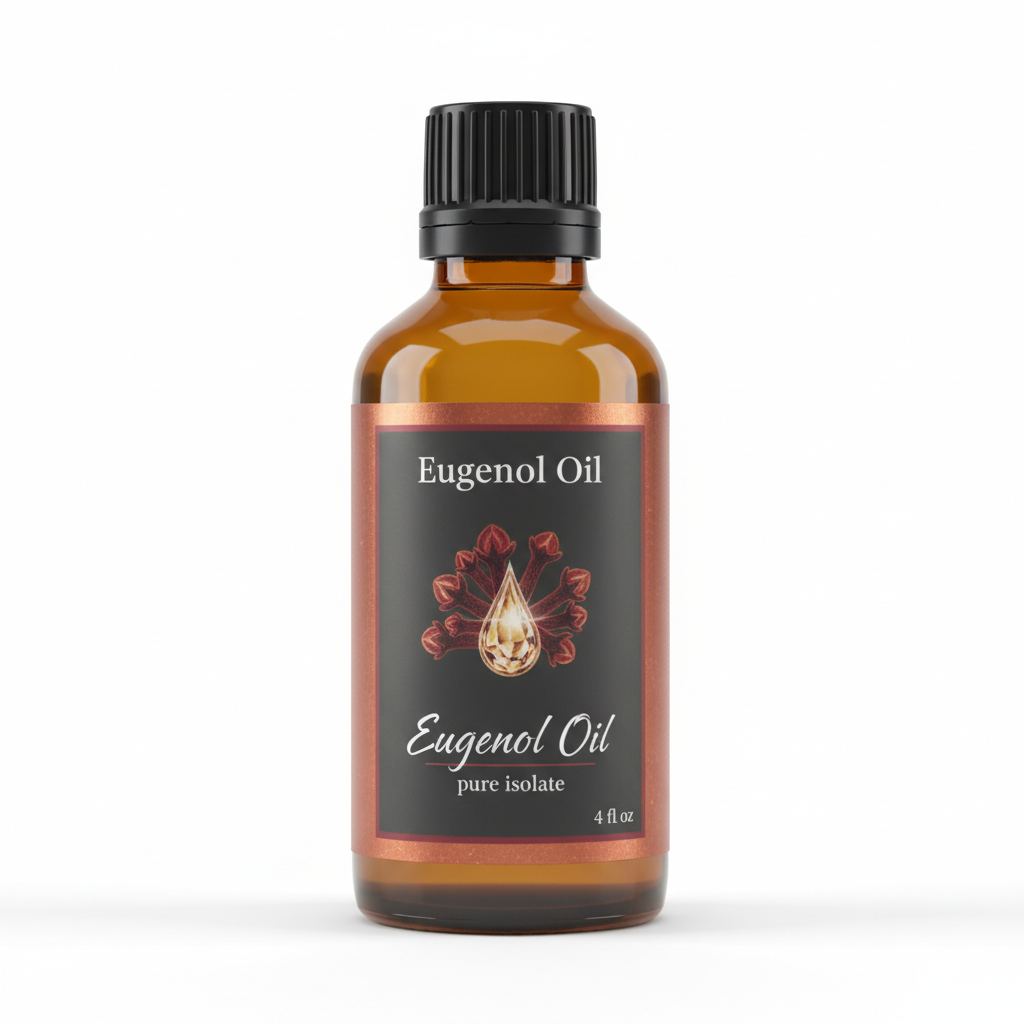
Our shop page describes the product as a refined isolate obtained from clove oil, sold as botanical grade. Our published certificate of analysis covers one batch (EUGLUUSAIDC006A) and reports physical parameters: appearance, relative density 1.065 at 20 C (standard 1.064 to 1.070), refractive index 1.541 at 20 C (standard 1.540 to 1.542), and a best-by date of 07/21/2026. It lists "steam distilled" and "leaf" as extraction method and part. It reports no assay percentage, no chromatogram, no impurity data and no isotope analysis. Our How We Test page describes a GC assay specification and isotope work, but the published certificate does not show either, and those pages do not line up perfectly with each other. So, as with any supplier: if natural origin or assay matters to you, ask us for the lot's GC report and isotope or biobased analysis in writing, and do not buy on the strength of this article. We do not claim an IFRA certificate or SDS here; ask for them.
Our eugenol oil is sold for fragrance and formulation work, and is not offered for dental or other medical use. Have a cosmetic chemist or regulatory specialist review anything you build with it, and have a chemist or analytical lab interpret the reports.
Sources & Further Reading
- Vargas Jentzsch P, Ramos Guerrero L, Ciobota V, 2018. Adulteration of clove essential oil: detection using a handheld Raman spectrometer. redi.cedia.edu.ec/document/16217
- Vargas Jentzsch P, Ramos Guerrero L, Ciobota V, 2019. Detection of essential oils adulteration: a quick overview and current challenges. American Journal of Biomedical Science & Research 4(1). biomedgrid.com/AJBSR.MS.ID.000746
- ASTM International. D6866: Standard test methods for determining the biobased content of solid, liquid, and gaseous samples using radiocarbon analysis. store.astm.org/d6866-22
- Solvay, 2021. Solvay launches Eugenol Synth for fragrance applications (press release, January 28, 2021). solvay.com press release
- IFRA, 2022. The complete IFRA Standards up to and including the 50th Amendment (Amendment 49 Eugenol text, Annex of natural contributions). standards-compiled.pdf