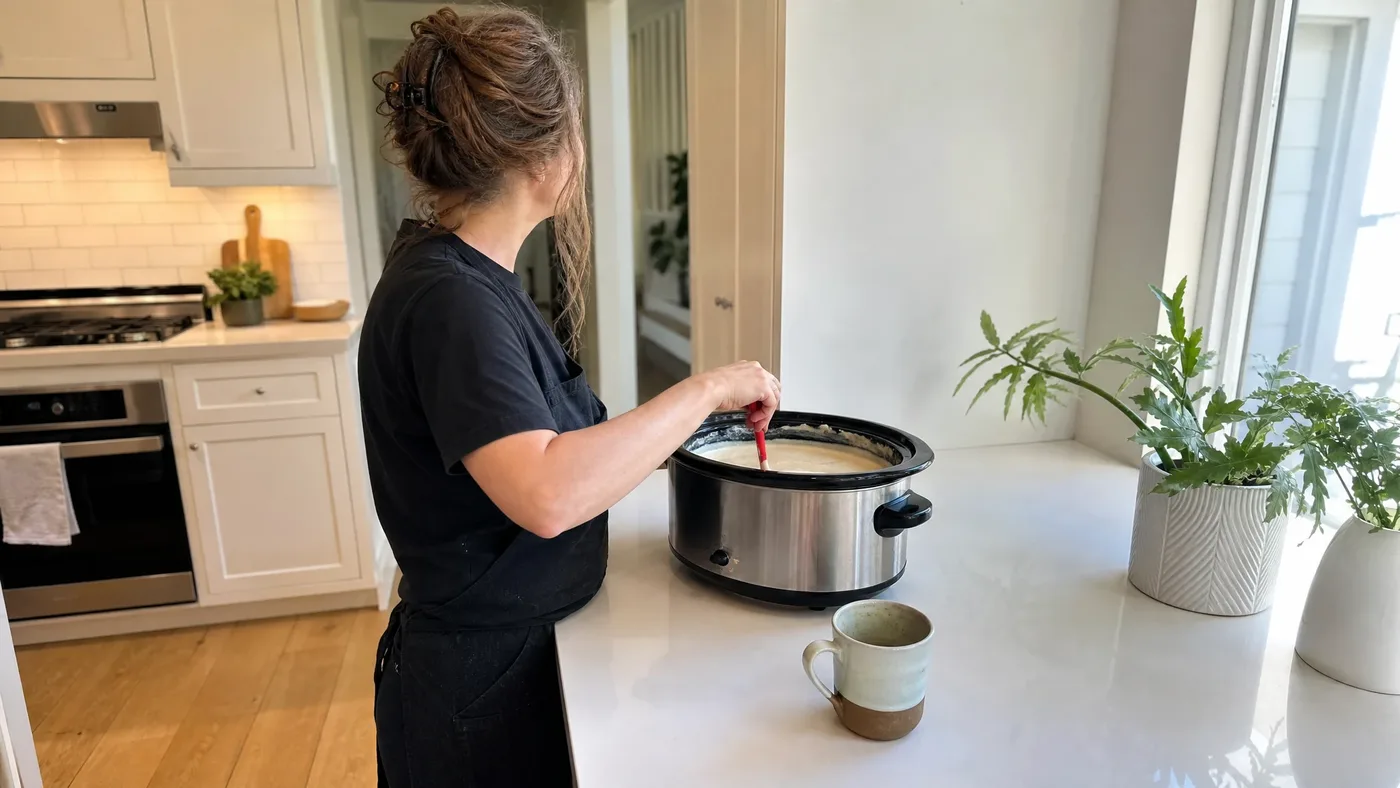
Hot Process Soap With Eugenol: Timing, Heat, Portion Test
Hot process has one feature that suits a volatile, reactive material like eugenol: the fragrance goes into soap that has already finished reacting with the lye, not into a raw, caustic batter. It does not remove the other two problems, which are heat and the regulatory ceiling. Below is the order of operations, what the sources we read actually say about timing, and a way to use the one-cook, several-portions design to find your own rate.
Decide first: is hot process the right route for this scent?
Choose hot process for eugenol when you want to add the fragrance after saponification, you are comfortable handling a hot, thick mass, and you accept a rustic bar. Stay with cold process when you want smooth tops and fine swirls, and with melt and pour when you do not want to handle lye at all. Neither route changes the rule from our usage rate post: the amount of eugenol is set by the regulatory limit, and you can only go lower.
The sequence, as a retailer's guide gives it
We have not made hot process soap with eugenol, and no batch data from us is published. The sequence below follows one soap supplier's published method (Voyageur Soap & Candle, hot process guide), which is a retailer's how-to and not a controlled study.
- Set a large pot of water to boil and put the soap pot inside it as a double boiler.
- Make the soap to trace. The guide says: "Do not add specialty oils or fragrance into the soap at trace."
- Cook covered, stirring occasionally, for 1.5 to 2 hours with the water below at a slow boil. The soap "should begin to have a slight translucent look," which the guide gives as a sign of neutralising.
- Add fragrance and specialty oils once neutral. The guide says fragrances will be "truer" added this way, and that if the soap is too thick, you can thin it with isopropyl alcohol or vodka.
- Ladle into moulds and tap out air pockets. Soap that hardens early can be re-melted in the double boiler.
What the guide does not give is a temperature for the fragrance step, and it gives no test for completion other than appearance and time. Fill that gap with your own thermometer and a recipe source you trust; we have no figure to supply.
Why after the cook, and what that does not fix
The "truer" claim is the retailer's, with no data behind it on the page. Reasoning from the chemistry, the benefit is plausible: in cold process the fragrance sits in a mix where lye is still reacting, and the finished soap is a different environment (a source for how the pH of finished hot soap compares was not found, so do not read this as measured). Two other facts remain true whichever way you add it:
- Heat is still there. Eugenol's flash point is listed as 219 F (about 104 C, NTP, 1992) and above 212 F (above 100 C, closed cup, NFPA 2010) in PubChem's eugenol record. Those are for the neat material, not your blend. A blend's lowest-flashing component sets the practical limit, so read the SDS for each oil in it (see how to read an SDS) and stir the fragrance in with the pot off the boil, not on it. Reasoning from ordinary volatility, heat drives off the lightest molecules first, which is an argument for adding the fragrance as late and as cool as the mass will allow.
- Eugenol is acidic enough to matter in alkali. PubChem gives eugenol a pKa of 10.19 at 25 C (from a 1961 reference). Reasoning from that, in any soap whose pH sits near or above 10, part of the eugenol will be present as its phenolate. Whether that changes colour or scent in hot process soap is a hypothesis we can't source. Observe it in your own control.
Handling the lye stage properly
The CDC/NIOSH Pocket Guide entry for sodium hydroxide lists exposure by inhalation, ingestion, skin and eye contact, with irritation of eyes, skin and mucous membrane, and eye and skin burns. Its first aid is to irrigate eyes and flush skin with water immediately, and its protective measures include keeping an eyewash and quick-drench facility available and removing wet or contaminated clothing. NIOSH's IDLH page gives a recommended exposure ceiling of 2 mg/m3 and reports irritation of the respiratory system at workplace levels of 2 to 8 mg/m3. For a bench maker the practical reading is simple: mix lye in a ventilated place, wear eye protection and gloves, and keep children and pets out of the room. An industrial hygienist is the person to ask if you are scaling beyond a hobby batch.
One cook, several portions: a design for finding your rate
Hot process gives you something cold process does not: a neutral, finished mass you can divide before the fragrance goes in. That lets you vary eugenol while holding everything else fixed. This is a method, not our data.
- From the usage rate arithmetic, write down your ceiling C in grams of eugenol for the whole batch, counting every oil that contains it.
- Cook the batch, then divide it into three equal portions by weight, each carrying one third of the oils.
- Add eugenol to each portion at one third of C multiplied by 25%, 50% and 75% (placeholders to illustrate the design; nothing here is a recommended rate). For a ceiling of 3.0 g that is 0.25 g, 0.50 g and 0.75 g per portion.
- Keep the fragrance totals equal across portions by topping up with the rest of the blend, so only the eugenol changes.
- Mould, unmould, and judge scent and colour at 24 to 72 hours and after a four-week cure, the interval Candle Science uses for its cold process fragrance tests.
Sub-gram quantities need a 0.01 g scale or a diluted stock. If you cannot weigh 0.25 g with confidence, prepare the fragrance as a weighed stock first. Fixing scent that fades in the pot is a separate subject; see anchoring spice notes in soap.
Who should skip this
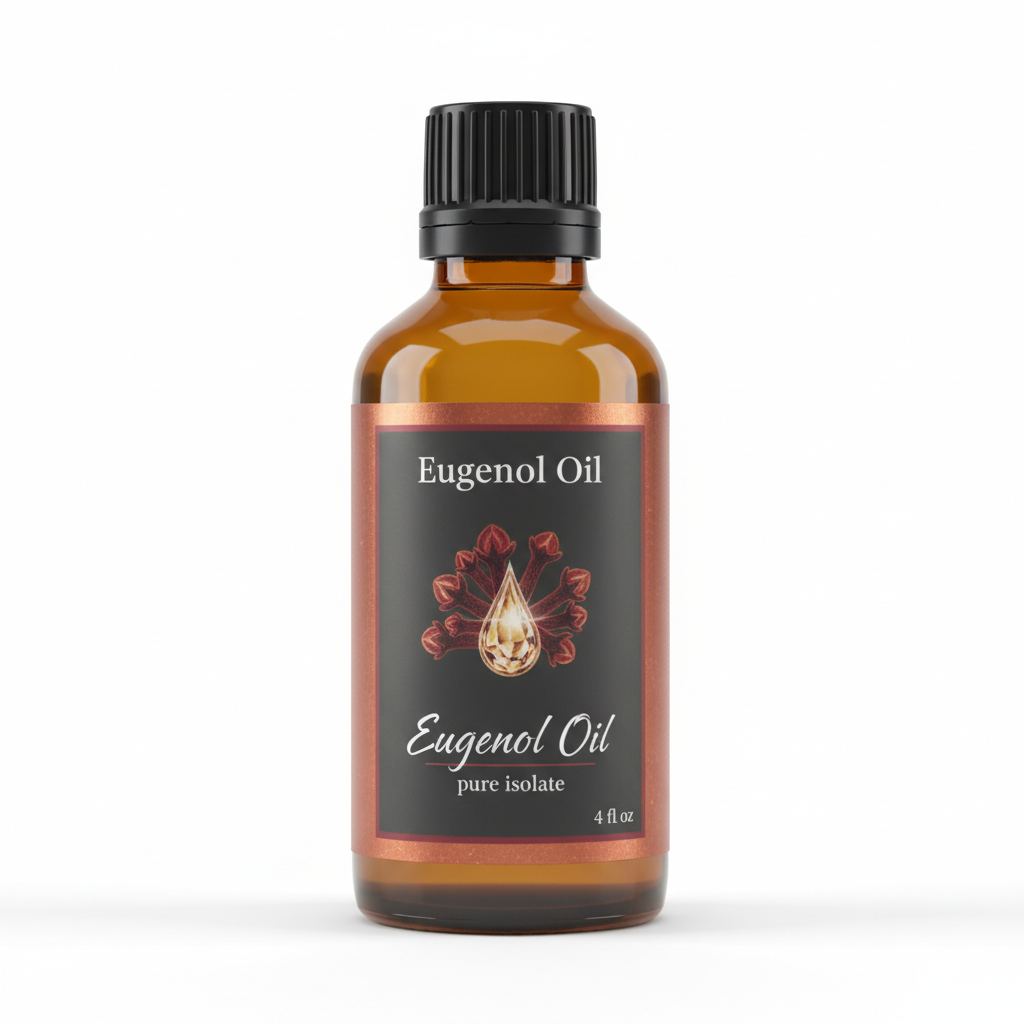
Skip hot process if you cannot manage a hot, caustic mass safely, and skip eugenol in any bar meant for children, for people with a fragrance allergy, or for skin conditions; a dermatologist or allergist is the right adviser there. If you sell bars, a regulatory specialist should check your limit and label. We sell only eugenol oil, undiluted, so the lye, the oils and the dilution are yours; handle the neat material in small amounts, wash your hands afterwards, and keep it away from eyes, children and pets.
The short version: let the cook finish, add the eugenol cool and late, count the eugenol in every oil, and use the portion design to find your own rate under your own ceiling.
Sources & Further Reading
- Voyageur Soap & Candle, n.d. Hot Process Soap Making. voyageursoapandcandle.com
- NCBI PubChem. Eugenol (CID 3314), flash point and dissociation constant records. pubchem.ncbi.nlm.nih.gov/compound/3314
- CDC/NIOSH. NIOSH Pocket Guide to Chemical Hazards: Sodium hydroxide. cdc.gov/niosh/npg/npgd0565
- CDC/NIOSH. Sodium hydroxide, IDLH documentation. cdc.gov/niosh/idlh/1310732
- Candle Science. Process for cold process soap fragrance testing. candlescience.com