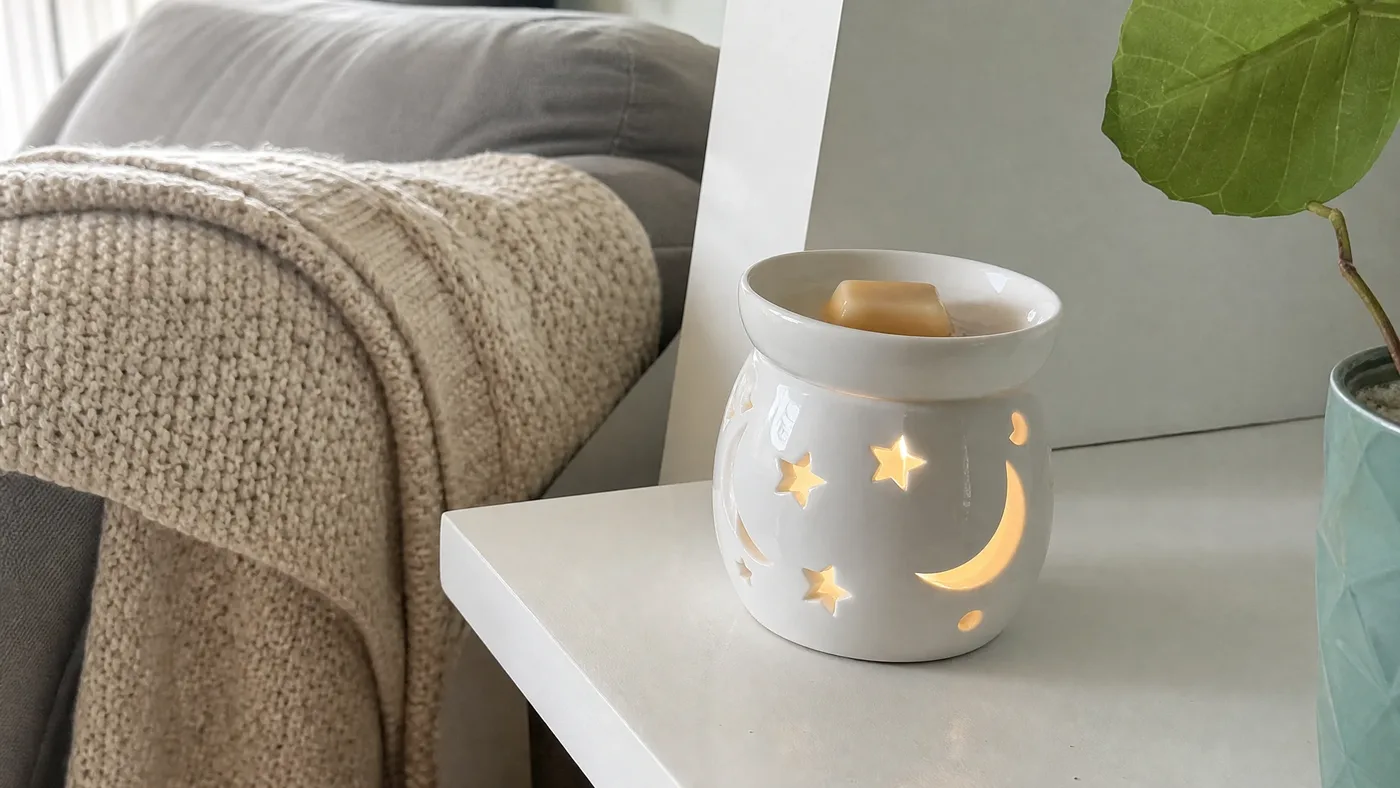
Using Eugenol in Wax Melts: Load, IFRA Category and Labels
A wax melt has no wick, so the soot and tunnelling questions disappear. A different set takes their place: how much oil the wax will hold, what the warmer does to the pool, which IFRA category and label rules apply, and who is in the room. We sell eugenol oil undiluted, so the numbers below are for you to adapt, and we have not made or tested any melt.
Step 1: pick a base and read its load limit
Melt makers use pillar, container or purpose-made melt waxes, and the load a wax will hold differs a lot by type. CandleScience's melt guide lists, for melts, up to 25% for CocoSol, 12% for EcoSoya PB, 9% for IGI 6028 and 6% for IGI 4625 (CandleScience). Its own tutorial uses a 10% load and says to adjust down to preference. These are totals of all fragrance in the wax and tell you nothing specific about eugenol. For arithmetic: a 200 g batch at 9% is 200 x 0.09 = 18 g of fragrance. If eugenol is 10% of that blend, 1.8 g goes in, 0.9% of the wax by weight.
Which base to pick is a comparison you run yourself; our wax comparison lays out the method and what is and is not documented for soy, paraffin and coconut blends.
Step 2: decide what the product is under IFRA
IFRA sets a maximum for eugenol per product category. In the 51st Amendment standard, 2023, Category 12 (products not intended for direct skin contact) reads "No restriction" for eugenol, while categories with skin contact carry numbers (for example 0.64% for body creams and lotions and 4.9% for Category 9 rinse-offs such as bar soap) (IFRA Standard, Eugenol). The IFRA guidance we read places "candles of all types (including encased)" in Category 12, and places "automated air fresheners and fragrancing of all types", which lists plug-ins, closed systems and solid substrate, in Category 12 as well (IFRA guidance, 51st Amendment). We did not find the words "wax melt" in the table rows we read. That makes the category a classification question: a regulatory specialist should say whether your product in its warmer belongs in 12. Two further cautions. The guidance's rationale for Category 12 is "negligible skin exposure"; a melt that gets handled, spilled or sold to be pressed by hand is not obviously that. And limits are revised with each amendment, so check the current one. The same guidance says a review of product types in Categories 10, 11 and 12 is foreseen in preparing the 52nd Amendment, so a category you rely on today could move.
Step 3: understand what the warmer does
Here we have no reliable source. CandleScience says to "use a wax warmer with a high-heat bulb" and to follow the warmer maker's directions, and gives no in-use pool temperature. Reasoning from the eugenol figures on PubChem (vapor pressure 0.0221 mmHg at 25 C, boiling point 252 to 256 C, flash point above 100 C closed cup), a warm pool is far below the boiling point, so eugenol will leave slowly and keep leaving as long as the pool is warm, which is the point of a melt. Whether the blend changes over hours of heating is untested for eugenol. The measurement worth making is simple: put a probe thermometer into the molten pool of a melt in the warmer you intend to recommend, after one hour, and write down the number. Then compare it to the lowest flash point on the SDS of every oil in your blend (see our flash point guide).
Warmers are products with their own hazards. The US Consumer Product Safety Commission recall of 12 November 2015 covered Family Dollar ceramic warmers that take a tea light, after 11 reports of high flames including two burn injuries and three reports of property damage (CPSC). That recall was about the warmer, not the wax, and it is a reason to tell customers to use a warmer made for melts rather than improvising.
Step 4: make it
From CandleScience's melt guide: weigh the fragrance, add it when the melted wax reaches 185 F (85 C), pour at 170 F (76.7 C), and let the melts rest 1 to 2 weeks before use for best throw. A rest period is a variable you control, so test it: smell one melt cold at 24 hours, one week and two weeks, in the same room, and write the timing down. We have not run that test and publish no throw results.
Step 5: staining and colour
For discoloration the documented case is vanillin, not eugenol. Supplier notes for a coconut-paraffin blend say a 12% load of a vanilla fragrance turned the wax "creamy yellow within 24 hours" and that fragrance appeared to separate in places (CandleScience lab notes), and another supplier says soy is more prone to vanillin browning than paraffin or coconut (SA Candle Supply). Neither mentions eugenol. Our own How We Test page says eugenol darkens toward amber with air, as phenols do. Reasoning from that, expect to check a clear or pale melt for yellowing over weeks. Photograph samples against a white card on day 1, day 7 and day 30.
Step 6: labelling and the claims you make
EU and UK rules treat the product as a mixture. The Northern Ireland regulator's candle guidance says a sensitising fragrance ingredient above 0.1% calls for the statement "Contains (name). May produce an allergic reaction", and that above 1% in total, sensitising fragrance ingredients call for the exclamation mark pictogram, the signal word WARNING and "May cause an allergic skin reaction" (HSENI, Candles and CLP). That page is about candles and does not mention wax melts; whether melts follow the same route is for your regulatory specialist. The ECHA summary in PubChem shows H317 (may cause an allergic skin reaction) in 99.8% of notifications for eugenol, from 27 notifications (PubChem, Eugenol). Worked example, hypothetical: a melt at a 9% load where eugenol is 10% of the fragrance contains 0.9% eugenol, above the 0.1% figure before any other sensitiser is counted. The US labelling rules for melts are not something we verified; ask an attorney.
Keep claims plain. A melt is a fragrance product. Nothing here supports a health or mood statement, and we make none for eugenol.
Air, pets and the "flame-free is safer" idea
A 2025 field study in a residential test house measured terpene release from scented wax melts and ozone reactions, and reported nanoparticle concentrations above 10^6 per cubic centimetre, "comparable" to combustion-based scented candles and gas stoves, so the authors argue melts should not be assumed safer than candles (Patra et al., Environ Sci Technol Lett, 2025). That study tracked terpenes; it did not report eugenol, so applying it to a eugenol blend is an inference. The practical lesson stands: ventilate, and do not market melts as "cleaner".
Pets are a separate question. Our own safety copy says to keep the oil away from children and pets. Whether a given blend in a warmer is acceptable in a home with cats, birds or small animals is for a veterinarian to answer; our pets post goes further. For eugenol's place in seasonal blends see autumn and holiday fragrances.
Who should skip this
If you plan to sell melts, ask an attorney and a regulatory specialist about labels, IFRA category and warmer safety before the first sale. We sell only eugenol oil, not wax bases, warmers or packaging. Patch test and wear gloves when handling the undiluted oil.
Start with one wax, one blend and one warmer, weigh everything in grams and write down every reading. A melt is a simple product, and a short log is what keeps it that way.
Sources & Further Reading
- CandleScience. How to make soy wax melts. candlescience.com/learning
- CandleScience. Lab notes: IGI 6046 coconut paraffin candle wax blend. candlescience.com/learning
- IFRA, 2023. Standard on Eugenol (51st Amendment) and Guidance for the use of IFRA Standards. ifrafragrance.org/IFRA_STD_035
- HSE Northern Ireland. Candles and CLP. hseni.gov.uk/articles/candles-and-clp
- PubChem, Eugenol (CID 3314): vapor pressure, boiling point, flash point and ECHA C&L summary. pubchem.ncbi.nlm.nih.gov/compound/Eugenol
- Patra SS et al., 2025. Flame-free candles are not pollution-free: scented wax melts as a significant source of atmospheric nanoparticles. Environ Sci Technol Lett. pubmed.ncbi.nlm.nih.gov/39957788
- US CPSC, 2015. Family Dollar recalls wax warmers. cpsc.gov/Recalls/2016
- SA Candle Supply. How vanilla affects wax. sacandlesupply.co.za