Eugenol in Reed Diffusers: How Much Is Too Much?
Most diffuser recipes are written in scent ratios, but with eugenol the number that counts is a ceiling. The IFRA Standard allows 4.0% eugenol in a finished reed diffuser, counting every ingredient that carries it. Once you hold that figure in your head, the rest of the job is pleasant arithmetic: a spicy, carnation-warm diffuser that stays inside its limit.

Why a diffuser has a limit at all
A reed diffuser looks like a no-contact product, so people expect it to sit in the unrestricted Category 12 with candles. IFRA's guidance places it in Category 10A instead, alongside lamp-ring oils, pot-pourri and liquid refills, to reflect "potential exposure during manual handling (flipping) of the soaked reeds and/or the refill" (IFRA Guidance, 51st Amendment, section 6.5.18). The eugenol Standard lists Category 10A at 4.0% (IFRA Standards, 51st Amendment, eugenol). The difference from a candle is in the hands, not the air: a wet reed is something people pick up and turn over. The same guidance foresees a review of Categories 10, 11 and 12 for the 52nd Amendment, so look up the current figure before you rely on this one.
Turning the ceiling into a share of the fragrance
A diffuser is a solvent base plus a fragrance load. CandleScience's published example is 25% fragrance in a 6 oz fill, 4.5 oz of base and 1.5 oz of fragrance, with 6 to 8 rattan reeds and a reed diffuser warning on the bottle (CandleScience). It describes a general fragrance oil, so it gives you the shape of a recipe and not a clove note.
The sum is simple: the largest eugenol share of the fragrance equals 4.0% divided by the fragrance load.
| Fragrance load | Largest eugenol share of the fragrance |
|---|---|
| 10% | 40% |
| 15% | 26.7% |
| 20% | 20% |
| 25% | 16% |
At the ceiling, every row holds the same 4.0 g of eugenol per 100 g of finished diffuser. A stronger load does not buy more clove; it shrinks the share eugenol may take. A fragrance that is mostly eugenol and loaded at 25% is about six times over.
Count the eugenol you did not add on purpose
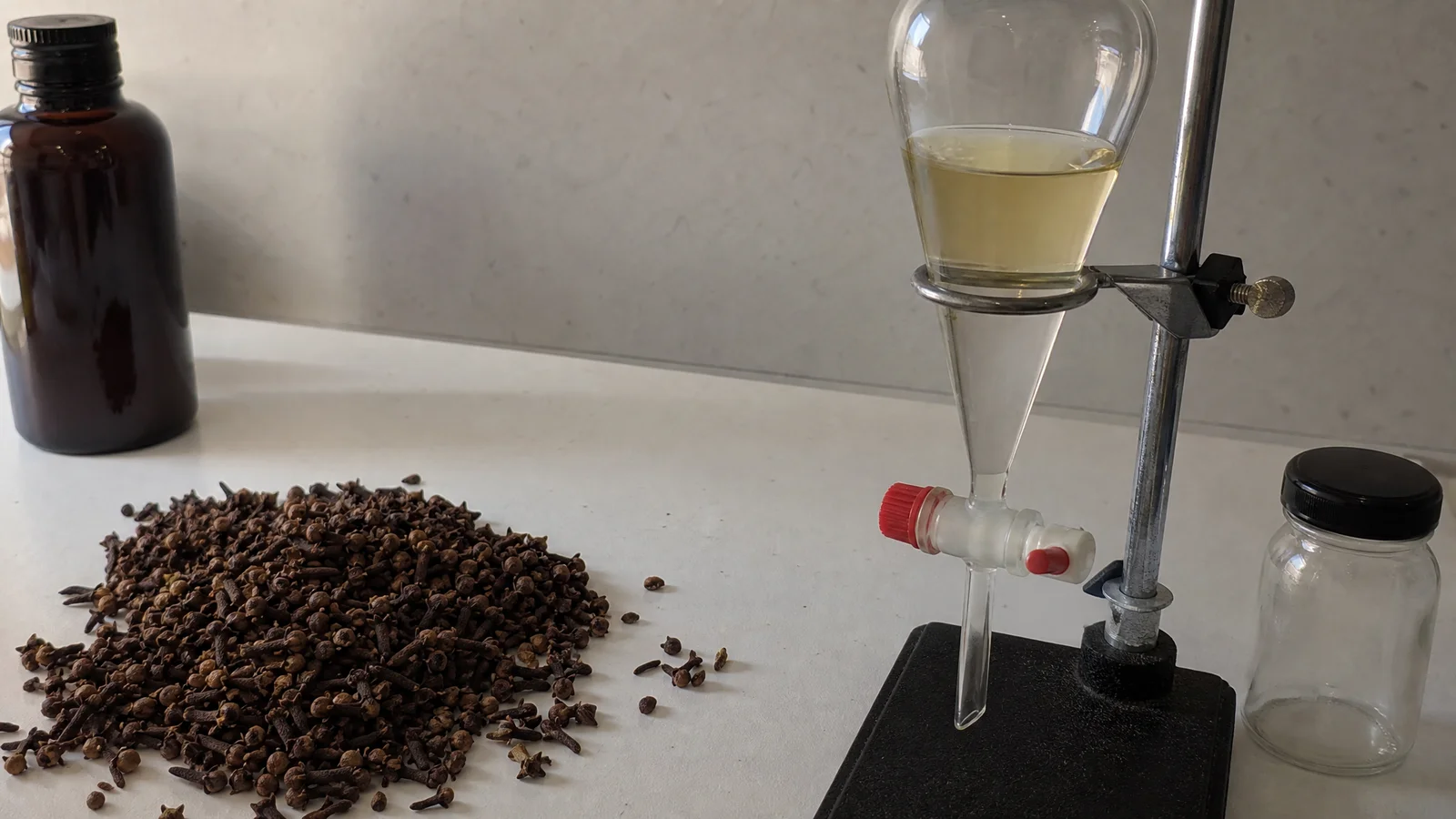
IFRA's guidance says natural complex substances must be counted toward a limit, and clove bud, clove leaf and cinnamon leaf oils are all rich in eugenol. In the EFSA feed-additive dossier, seven bud oil batches averaged 82.7% eugenol by GC-FID and 75.06% by GC-MS, and six leaf oil batches averaged 82.60% by GC-MS (EFSA FEEDAP Panel, 2023). Those are one applicant's samples, so use the figure on your own oil's paperwork.
Here is what that does to a typical rule of thumb. At those averages, 5 g of clove bud oil in 100 g of diffuser carries about 3.8 to 4.1 g of eugenol, right at the ceiling. At 8 g it is about 6.0 to 6.6 g, and at 10 g it is 7.5 to 8.3 g, roughly double. Anything else eugenol-bearing adds to the same total. Keep one line on paper next to the scale: total grams of eugenol divided by total grams of diffuser, below 0.04. Our blend calculation article works through an example.
Working with eugenol oil itself
The Certificate of Analysis we publish for one batch gives a relative density of 1.065 and no assay, so it does not state our oil's eugenol percentage. In the most generous case, where the oil is entirely eugenol, 100 g of diffuser can take 4.0 g of oil, about 3.8 ml at that density, or roughly 75 drops by the loose convention of 20 drops to the millilitre. Weigh it instead of counting drops, because droppers differ. If you need the assay for your lot, ask us in writing, because a real figure below 100% is what would let you adjust.
Eugenol is a single, spicy, carnation-like voice, and we pair it with rose, ylang ylang or vanilla. Each partner has its own IFRA limit, so check those too, and smell a strip of the finished blend at a lower load first: fragrance can be added later and cannot be taken out.
What to watch in the bottle
- The base has to carry it. Eugenol dissolves in water only to about 2,460 mg/L at 25 C, or roughly 0.25%, and mixes freely with alcohol and oils (PubChem, eugenol). Reasoning from that, a water-containing base will struggle near the ceiling, so check the base's data sheet and look for haze.
- It warms in colour. The same record says eugenol darkens in air and may decompose in light, which is ordinary for a phenol. A clear bottle on a sunny shelf shows it first.
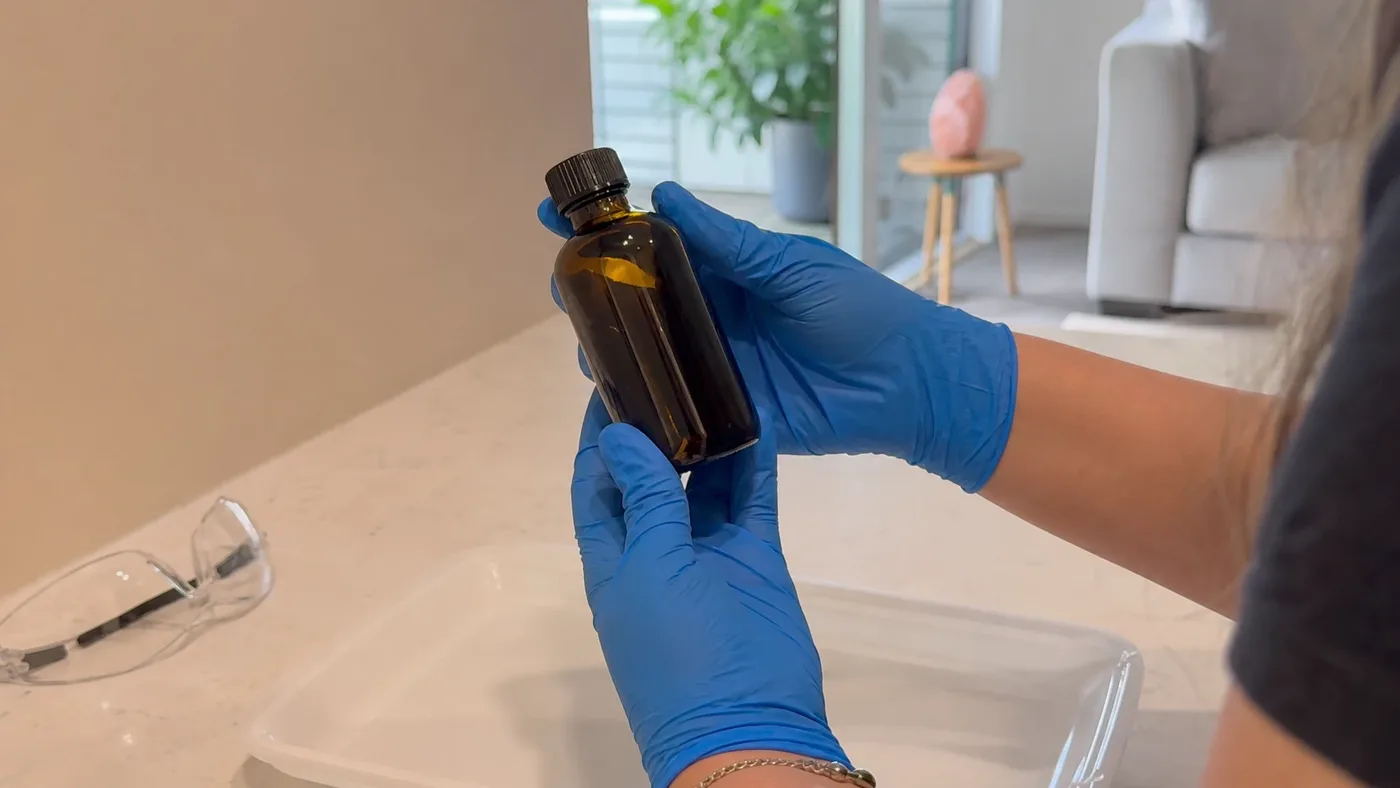
- The reeds are the point of contact. Wear gloves when you fill and flip them, put a warning label on the bottle and keep it out of children's reach. The lowest positive patch test among 34 eugenol-allergic subjects in a 2023 study was 0.031% (Ofenloch et al., Contact Dermatitis, 2023), so someone already sensitised does not need much. See our sensitisation article.
- Cats and birds. Pet Poison Helpline lists clove among oils that can poison animals and says cats and birds are at greatest risk (Pet Poison Helpline). It does not address diffusers specifically, so ask a veterinarian first, and read our pets article.
Where the diffuser sits matters too: put it on a stable surface, out of reach of children and pets, and away from direct sun and heat, which show up first as a darker liquid.
Selling a diffuser changes the job
IFRA is explicit that a Certificate of Conformity does not replace a safety assessment, and labelling depends on the market. Our allergen labelling article covers the EU and UK picture, and a qualified safety assessor should review any formula that goes out under your name. A batch for your own shelf is a gentler undertaking.
A well-judged eugenol diffuser is a small, quiet pleasure, and knowing exactly where the line sits is what lets you work right up to it with confidence. For documentation on a specific lot of our oil, ask us through the contact page and we will tell you what exists.
Sources & Further Reading
- IFRA, 2023. IFRA Standards, 51st Amendment, eugenol (CAS 97-53-0). ifra-standards-51st-amendment.pdf
- IFRA, 2023. Guidance for the use of IFRA Standards, 51st Amendment. ifra-51st-amendment-guidance.pdf
- EFSA FEEDAP Panel, 2023. Safety and efficacy of clove oils for use in food and feed. pmc.ncbi.nlm.nih.gov/articles/PMC10375362
- CandleScience. How to make reed diffusers. candlescience.com/learning/how-to-make-reed-diffusers
- PubChem, eugenol (CID 3314). pubchem.ncbi.nlm.nih.gov/compound/Eugenol
- Ofenloch RF et al., 2023. Allergic reactivity for different dilutions of eugenol in repeated open application test and patch testing. Contact Dermatitis 89(2):95-102. pubmed.ncbi.nlm.nih.gov/37218587
- Pet Poison Helpline. Essential oils. petpoisonhelpline.com/pet-poison/essential-oils