Eugenol Myths: 6 Common Beliefs Checked
Spend an evening in a maker forum and you will hear that eugenol is an essential oil, that it is just stronger clove oil, that it is banned, that it is unrestricted because it is natural. Most of these come from reading a clove oil fact as a eugenol fact, or the other way around. Clove oil is a complex mixture, and eugenol is one molecule taken out of it. Here is how the usual beliefs hold up.

"It's an essential oil" and "it's just stronger clove oil"
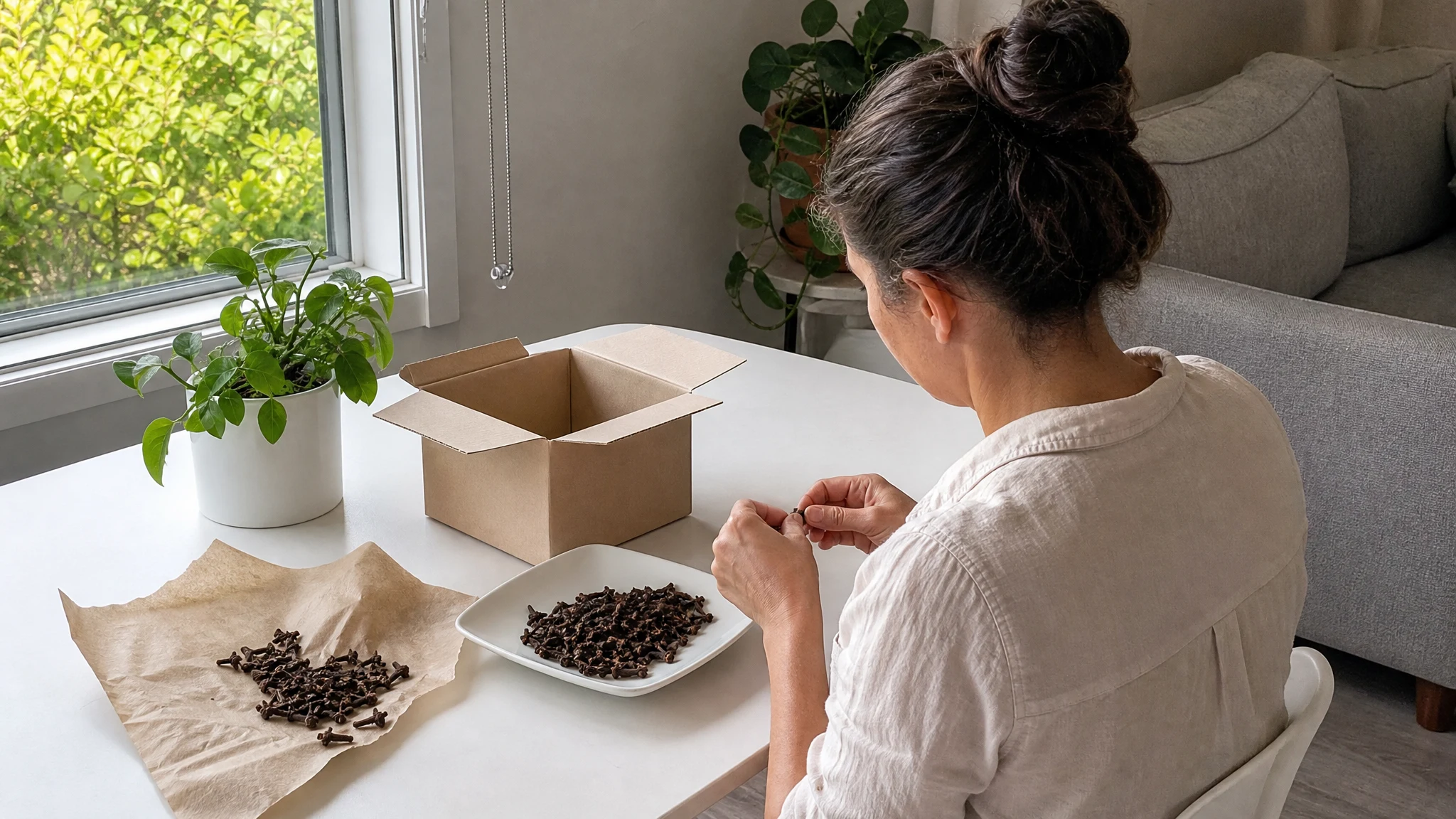
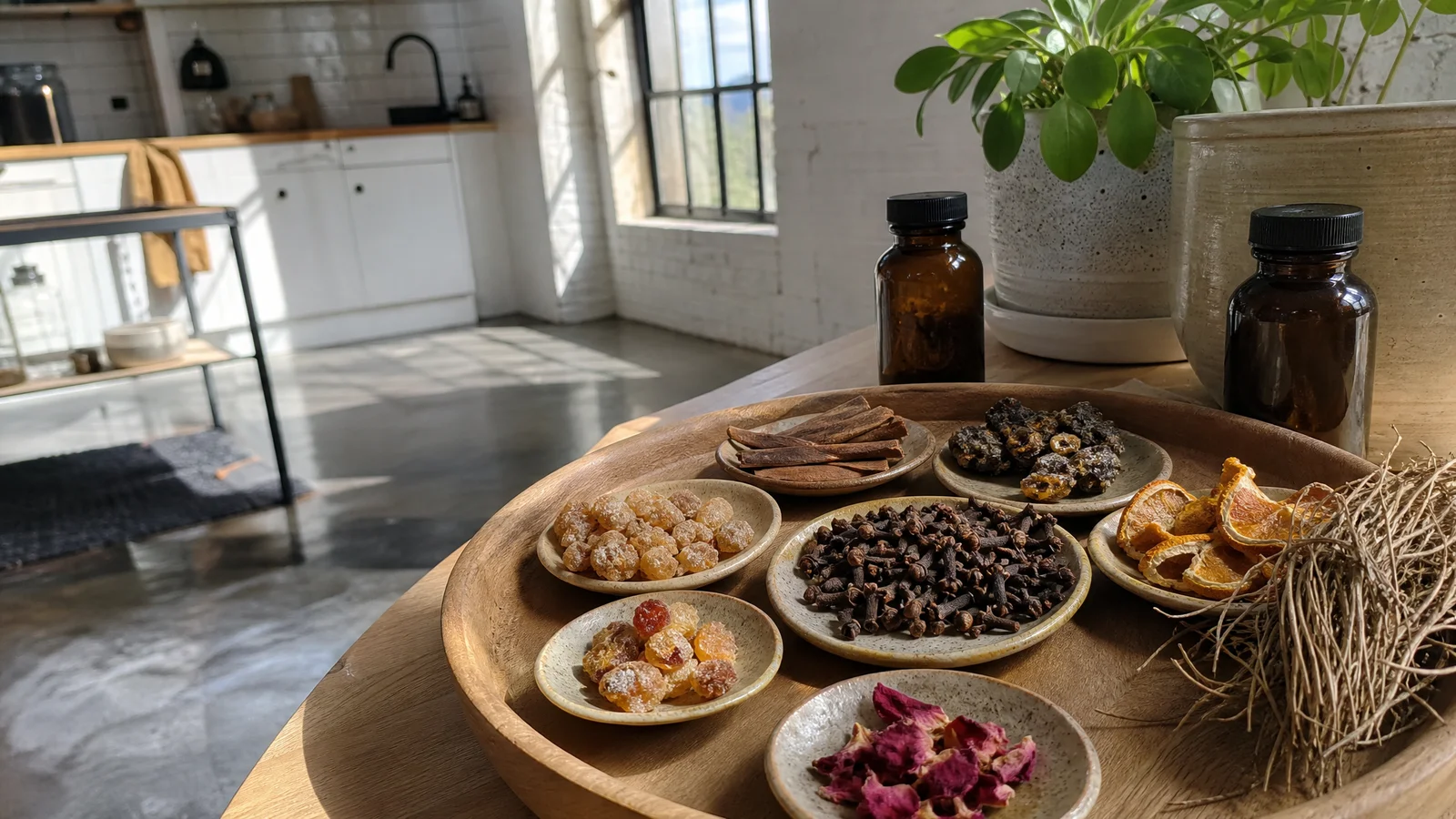
An essential oil is a distillate of a plant. Eugenol sold for fragrance work is made by starting with an oil rich in it and pulling the molecule out. A review of eugenol chemistry describes the usual commercial route: clove, cinnamon leaf or basil oil is mixed with excess aqueous sodium or potassium hydroxide, which turns the phenol into a water-soluble salt; the non-phenolic part is removed; the solution is acidified at low temperature; and the eugenol is purified by fractional distillation (Kamatou, Vermaak and Viljoen, Molecules, 2012). The same review puts eugenol at 45 to 90% of clove oil. So "stronger clove oil" has the relationship backwards. The isolate is narrower on purpose, and what you get is one clear note: warm, spicy and carnation-like. We would not call it an essential oil on a recipe card or a label. Our clove oil comparison shows the contrast.
"A 99% result proves it came from clove"
This one has the most commercial weight. Synthetic eugenol, made from guaiacol, and clove-derived eugenol are the same molecule above 99% purity, and GC/MS cannot tell them apart. Carbon-isotope analysis can. The ASTM standard for this kind of work, D6866-22, measures biobased carbon by radiocarbon methods and states that it does not address geographical origin (ASTM D6866-22). So a purity figure tells you how much of the bottle is eugenol, not where it came from, and even a biobased result would not say "clove", since cinnamon leaf and basil oil are other natural sources. If "natural" matters on your label, ask any supplier in writing for the assay and any isotope report for your lot. Our adulteration article shows what a chromatogram does and does not reveal.
"It's natural, so it has no limits" and "it's banned"
Both are wrong, and they are opposites. The IFRA Standard for eugenol is a restriction, not a prohibition, with a maximum for each product category: for example 2.5% in fine fragrance (Category 4), 0.64% in body lotion and oil (5A), 0.21% in baby products (5D), 4.9% in bar soap (9) and "no restriction" for candles and incense in Category 12 (IFRA Standards, 51st Amendment). The stated drivers are dermal sensitization and systemic toxicity, and the text is about the molecule whatever its source. So an oil that is 80% eugenol brings that eugenol into your formula and the limit counts it, while the same Standard leaves plenty of room to work. Our limits article lays out the table and our compliance guide separates labeling from limits.
"No candle limit means no care needed"
IFRA places candles in Category 12 because expected skin exposure from them is negligible (IFRA Guidance, p. 53). That is a decision about a finished candle and how it is used. It does not cover the person pouring neat eugenol, the hot wax or an animal in the room, and Pet Poison Helpline lists clove among the oils that can poison animals, with cats and birds at greatest risk (Pet Poison Helpline). Our candle arithmetic and pets article take those in turn.
"A clean patch test clears me"
A negative forearm test feels like a pass. In a 2023 study of 67 people, 13 of the 34 with confirmed eugenol allergy had patch tests that did not reproduce on repeat, and 4 of those 13 still reacted in a 21-day open application test. The lowest concentration giving a positive patch among allergic participants was 0.031% (Ofenloch et al., Contact Dermatitis, 2023). The study looked at people already allergic, so it does not describe the risk for someone who has never reacted, but it does show that one clean test is thin evidence for a person who may be sensitized. A later reaction is a reason to stop and see a dermatologist.
"The dentist uses it, so it suits any use"
Clove and eugenol have a long history in dentistry, which is where much of the folklore comes from. That history is about dental materials chosen by dentists, and it does not travel to a bottle of fragrance isolate. Our eugenol oil is offered for fragrance work and for no dental or therapeutic use, and it is not for internal use. For a toothache or a sore mouth, see a dentist or physician. Our dentistry history article separates what is documented from what is repeated.
If a claim about eugenol sounds too neat, pause before you repeat it. A forum post that says "natural means unrestricted" or "stronger clove oil" is easy to remember precisely because it is simple, and the simple version is the one that tends to be wrong.
Every one of these myths treats a property of a source, a category or another product as a property of the bottle in front of you, and the cure is the same each time: find the document that covers this material in this use and read what it says. When no document does, a qualified person is the answer, such as a dermatologist for skin, a veterinarian for pets and a safety assessor for anything you sell.
Sources & Further Reading
- Kamatou GP, Vermaak I, Viljoen AM, 2012. Eugenol: from the remote Maluku Islands to the international market place. Molecules 17(6):6953-6981: pmc.ncbi.nlm.nih.gov/articles/PMC6268661
- ASTM International, D6866-22 (radiocarbon biobased content): store.astm.org/d6866-22
- IFRA Standards, 51st Amendment (eugenol): ifra-standards-51st-amendment.pdf
- IFRA, Guidance for the use of IFRA Standards, 51st Amendment: ifra-51st-amendment-guidance.pdf
- Ofenloch RF, et al., 2023, Contact Dermatitis 89(2):95-102: pubmed.ncbi.nlm.nih.gov/37218587
- Pet Poison Helpline, essential oils: petpoisonhelpline.com