What Blends With Eugenol? Partners by Their Limits
What blends well with eugenol? Your nose gets the final vote, but it cannot see the limits. A partner changes your formula in two ways: it either leaves the eugenol budget untouched, or it brings some eugenol of its own. Choosing partners with that in mind makes the later work a lot easier.

Our short list
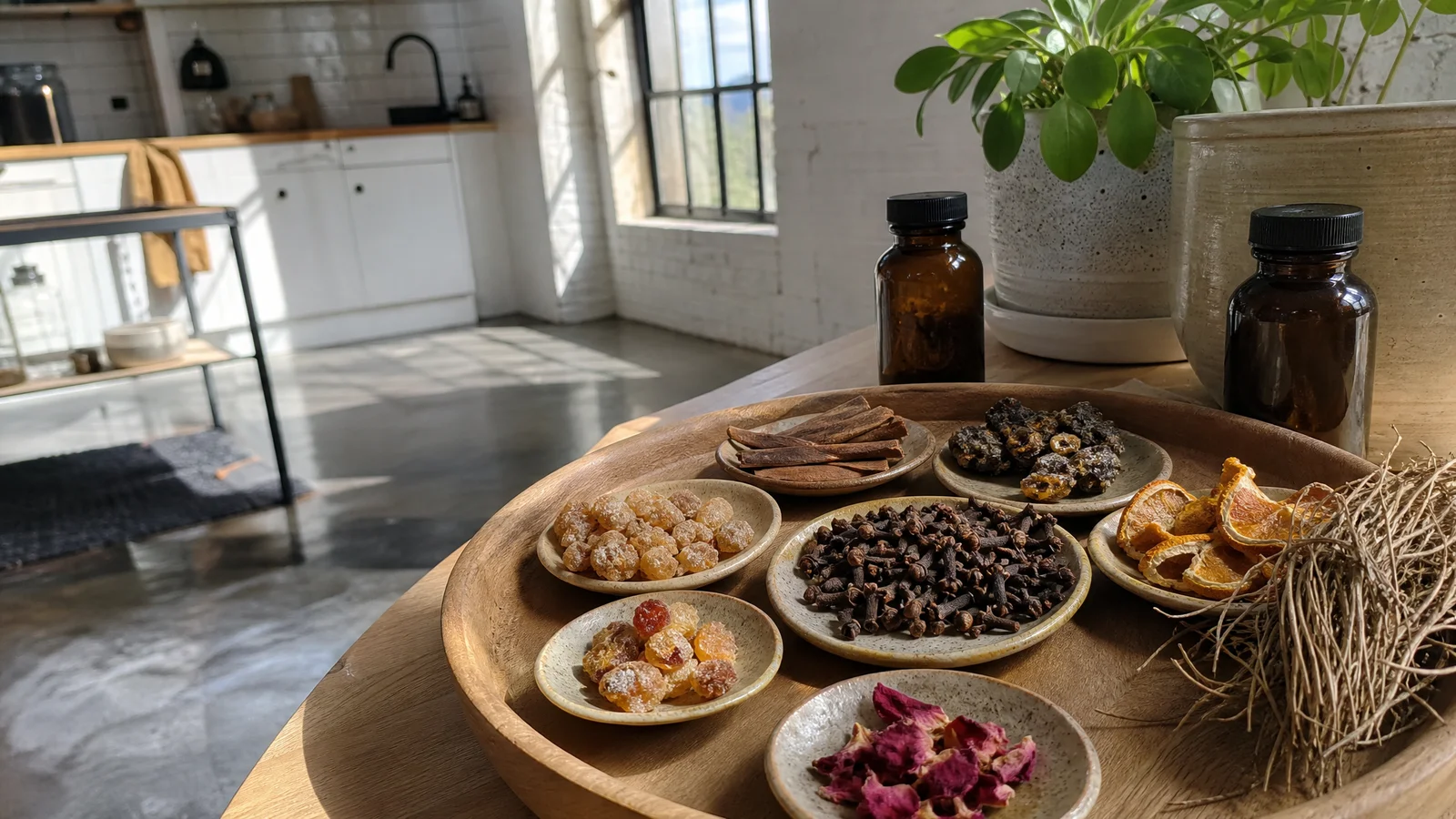
We recommend starting with rose, ylang ylang and vanilla, and cinnamon leaf, sweet orange and patchouli are also on our list of partners for eugenol oil. We sell eugenol oil only, so you will find those partners at a perfumery supplier. Rose, ylang and vanilla are worth a closer look, because each treats the eugenol budget differently.
Partners that leave the budget alone
Several classic perfumery materials contain no eugenol at all, but each has its own limit. These are IFRA Category 4 maximums in the finished product (IFRA Standards, 51st Amendment):
| Partner | Category 4 limit | Role in a carnation build |
|---|---|---|
| Benzyl salicylate | 7.3% | Powdery diffusion |
| Benzyl benzoate | 4.8% | Main component of carnation absolute |
| Cinnamic alcohol | 1.2% | Balsamic warmth |
| Coumarin | 1.5% | No role given; listed for its limit |
The role descriptions come from a commercial perfumery glossary (Première Peau), which says carnation is rebuilt from eugenol for the spicy core, isoeugenol for fruity refinement, benzyl salicylate and cinnamic alcohol for the rest. Take them as one retailer's description. What the limits add is practical: benzyl salicylate and benzyl benzoate leave wide room, while cinnamic alcohol and coumarin are tighter than they look, so a coumarin ceiling of 1.5% sits well under eugenol's 2.5%.
Vanilla, and a bit of history
Vanillin is the reason vanilla is such a natural partner. A review in Molecules reports that eugenol "was the first natural compound used in the synthesis of vanillin during the late 19th and early 20th century" (Kamatou et al., 2012). That is a good story rather than proof of the result, but the two share the same warm, rounded family. Vanillin is a solid melting at 81 to 83 C (PubChem), so dissolve it in ethanol before weighing it into a blend.
Partners that bring some eugenol
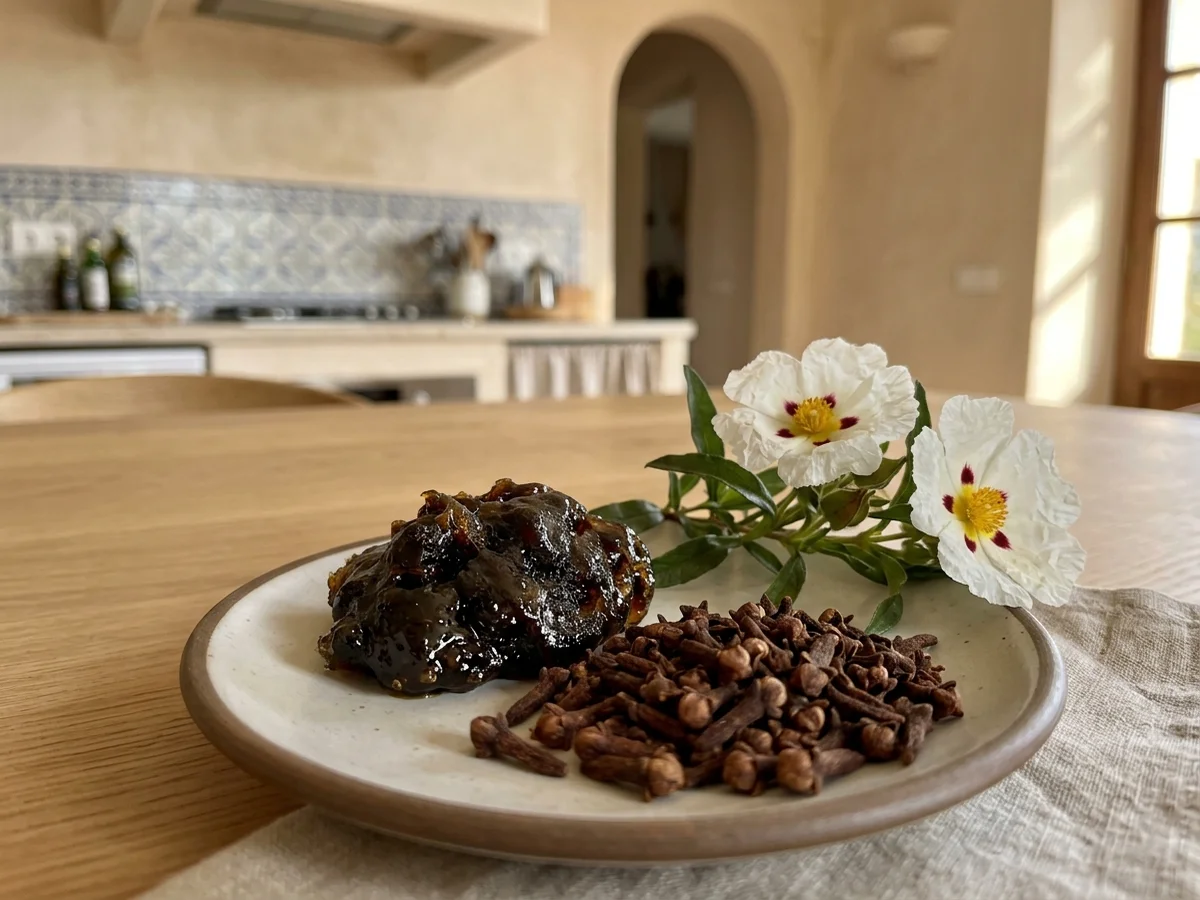
From IFRA's list of natural materials (Annex I to the eugenol Standard), indicative values are rose oil 1.2%, rose absolute 2.3%, ylang ylang oils 0.5%, jasmine absolute 2% and cinnamon leaf oil 74%. These numbers are a guide; your own GC data wins.
- Rose adds a little eugenol and a much tighter limit on its own methyl eugenol (0.011% in Category 4). Our clove and rose guide works through it.
- Ylang ylang has its own ceiling in IFRA's ylang ylang extracts standard, 0.73% in Category 4. Its eugenol contribution is negligible next to the isolate; its own limit is the one to watch.
- Jasmine absolute at 8 g per 100 g of concentrate adds about 0.16 g of eugenol, more than rose or ylang at similar weights.
- Cinnamon leaf oil is a partner we list, and at 74% it is a second eugenol source in its own right. Three grams per 100 g adds about 2.2 g, nearly as much as 2.5 g of our isolate. Use it for its character and count it as eugenol when you add up.
The close relative that competes
Isoeugenol is eugenol's nearest relative and is often paired with it in carnation builds. Its Category 4 limit is 0.11% against 2.5% for eugenol, a ratio of roughly 23. At a 1:1 ratio the isoeugenol limit caps both materials at about 0.11%, and at 10:1 it allows 1.1% eugenol. We do not sell isoeugenol; our eugenol versus isoeugenol guide covers the pair.
A worked pairing check
Per 100 g of concentrate for a 20% perfume, take 2.5 g eugenol oil, 10 g benzyl salicylate, 3 g cinnamic alcohol and 3 g ylang ylang oil. In the finished perfume (one fifth of those figures) that is eugenol oil 0.50%, benzyl salicylate 2.0%, cinnamic alcohol 0.60% and ylang 0.60%. Against their limits, benzyl salicylate uses 27% of its 7.3%, eugenol oil 20% of its 2.5%, cinnamic alcohol 50% of 1.2%, and ylang 82% of 0.73%. The ylang is the line closest to its ceiling, not the spice, and at 4 g it would tip over. Add the ylang's own eugenol (about 0.015 g) and the total is roughly 2.5 g per 100 g, or 0.50% of the perfume.
Let your nose lead, then check the sums
All of this arithmetic can make blending sound dry, and it is not. The best way to meet a partner is to smell it beside eugenol oil on two strips, one with a little and one with a lot, and notice how the character changes. Rose gets deeper, vanilla gets warmer and rounder, sweet orange brightens the front of the spice. Write down the one you loved, then go and check the limits.

Choosing in a sensible order
- Name the product category and note the eugenol limit and each partner's own limit.
- Subtract the eugenol the naturals already carry.
- Pick the partner that leaves the most room for the role you want.
- Add eugenol oil last, from a weighed stock, and judge it on a smelling strip over several hours; our smelling strip guide shows how.
Eugenol is a recognised contact sensitiser. In a 2023 study of 34 people with eugenol allergy, the lowest positive patch test concentration was 0.031% (Ofenloch et al., Contact Dermatitis). Anyone with known fragrance allergy should ask a dermatologist or allergist before wearing a blend, and anyone selling one should have a regulatory specialist check the category and label. For any partner not covered here, find its own IFRA Standard before choosing a dose, and ask the supplier for its safety data sheet and IFRA certificate.
The best partner is the one that leaves your budget intact, so the nose has room to do the rest.
Sources & Further Reading
- IFRA Standards, 51st Amendment (benzyl salicylate, benzyl benzoate, cinnamic alcohol, coumarin, ylang ylang extracts, isoeugenol, methyl eugenol)
- IFRA Eugenol Standard, Amendment 49, Annex I
- Premiere Peau, Carnation (glossary)
- PubChem, vanillin (CID 1183)
- Kamatou, Vermaak, Viljoen, 2012. Eugenol: from the remote Maluku Islands to the international market place. Molecules
- Ofenloch et al., 2023. Allergic reactivity for different dilutions of eugenol. Contact Dermatitis