Buying Eugenol Oil Online: How to Read the Listing
Search for eugenol online and you will find a refined single molecule, a whole clove oil and a ready-made clove fragrance, often sitting under near-identical names. They behave differently on a bench and on paper, so most of the work in buying well happens before the price enters the picture. This is the order in which we would read a listing.
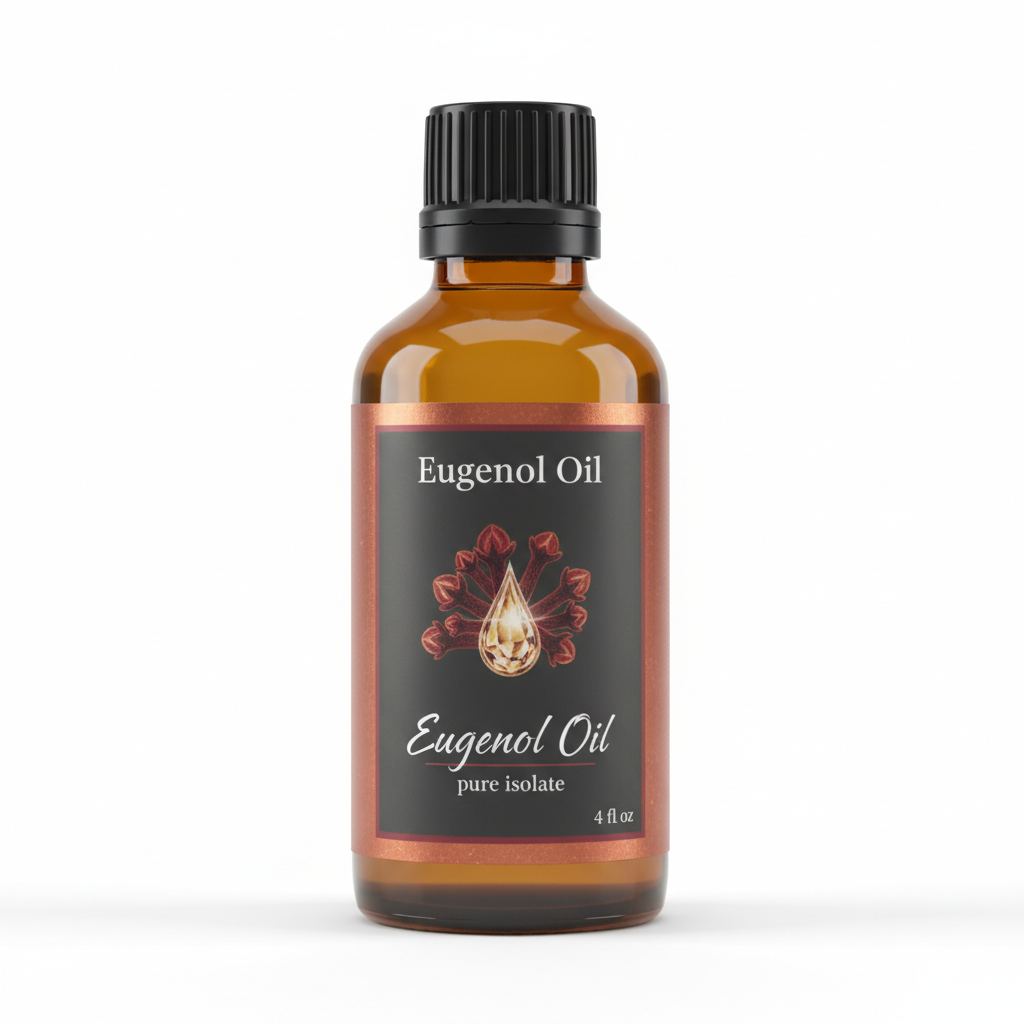
First, which material is it?
Eugenol is CAS 97-53-0. Clove oil is a different substance with its own number, 8000-34-8, a mixture in which eugenol is the major component alongside beta-caryophyllene and eugenyl acetate. A listing with no CAS number, or one that treats "eugenol" and "clove oil" as synonyms, deserves a question before payment. Our clove oil comparison sets the two side by side.
Names are loose. Our How We Test page says plainly that what we sell is not an essential oil but one molecule pulled out of a distillate, so we call it eugenol oil or eugenol isolate. When you see "eugenol essential oil" elsewhere, read it as a label rather than a description of how the material was made.
Then, the three documents
A safety data sheet. In the US, the Hazard Communication Standard requires the manufacturer, distributor or importer to give downstream users an SDS for each hazardous chemical, in a 16-section format. Section 2 has the hazard statements, Section 3 the composition, Section 9 properties such as relative density and flash point.
A certificate of analysis for the lot. It should show the lot number that is on your bottle, a date and the methods used.
An IFRA statement, if you make fragrance. IFRA's Guidance describes the Certificate of Conformity as made by the fragrance mixture maker, based on a trusting relationship, with no responsibility taken by IFRA, and not a replacement for a safety assessment. Ask which Amendment a supplier's statement refers to.
We do not publish an SDS or an IFRA statement on our site, so for those, write to us as you would to any supplier.
Does the hazard section sound right?
PubChem's roll-up of ECHA notifications for eugenol covers 2,820 reports. H317, "may cause an allergic skin reaction", appears in 99.8%, H319 (serious eye irritation) in 80.4%, H315 (skin irritation) in 20.6% and H302 (harmful if swallowed) in 17.3%. So an SDS for eugenol with no sensitiser statement at all is worth a question, because nearly everyone lists one. Our SDS reading guide goes section by section.
What a certificate can and cannot show
Pure eugenol sits at a density of about 1.0652 and a refractive index of about 1.5405 at 20 C, and is optically inactive. The clove bud oil in EFSA's opinion measured a specific gravity of 1.0559 to 1.0593 and a refractive index of 1.534 to 1.537. So density and refractive index will usually reveal a whole clove oil sold as an isolate. They cannot show an assay, a synthetic origin or a small amount of diluent, which is why our adulteration article asks for a GC report and, if "natural" is claimed, an isotope report. Look at the date as well: a lapsed best-by date does not make a material unusable, but it tells you the paper is old, so ask for the current lot.
A listing, read line by line
Take an invented listing: "Eugenol essential oil, 99%, pharmacopoeia grade, natural". Four questions fall out of it. Ninety-nine percent by which method, given that one oil can read seven points apart between GC-FID and GC-MS? Which pharmacopoeia, since the phrase names none? "Natural" on what evidence, since GC cannot tell clove eugenol from synthetic and only isotope or radiocarbon testing can? And does the lot number on the certificate match the one on the bottle? A listing that answers all four in writing is one you can buy from with your eyes open.
Slow down on purpose
Online buying makes it easy to click on the first bottle that looks right. With a material like this, a few quiet minutes with the listing pays back many times over. Read the name, then the description, then the photos of the label if there are any. If the words on the bottle and the words on the page do not match, that is worth a message before you pay.
It also helps to decide what you are making before you shop. A small trial bottle for a first perfume is a very different purchase from a larger quantity for a soap line, and a supplier who asks what you plan to do with it is usually one worth talking to.
Where each kind of buyer goes
- A small bottle to try in a perfume or soap: our shop, which lists bottles from 0.5 oz upward.
- Pounds of it, or private label: our bulk page (up to 400 lb) and wholesale page.
- Carrier oils, waxes, wicks, soap base or solubilisers: a soap-supply or candle-supply seller, since we sell none of these.
- Isoeugenol, methyl eugenol, whole clove oils or other aroma chemicals: an aroma-chemical or essential-oil supplier.
- Anything for dental or medical use: a dentist or physician. Our eugenol oil is not offered for dental or therapeutic use.
What to put in the email
- The lot number on the bottle you would receive, and the certificate for that lot.
- The purity figure, the method (GC-FID or GC-MS) and the chromatogram.
- Clove-derived or synthetic, and if "natural" is claimed, the isotope or biobased-carbon report and the lab behind it.
- The SDS with its revision date, and the IFRA Amendment any statement refers to.
- How it ships; our shipping and customs FAQ covers carrier questions.
The Certificate of Analysis we publish covers one batch and gives appearance, smell, relative density 1.065 and refractive index 1.541. For an assay, chromatogram or isotope result on your lot, ask us in writing through the contact page.
Eugenol is a recognised skin sensitiser, so the paperwork is no optional extra, and a cosmetic chemist or regulatory specialist should review anything you plan to sell. Read the listing, ask the questions, and the rest of the decision gets much easier.
Sources & Further Reading
- NCBI PubChem. Eugenol (CID 3314): identifiers, properties and GHS classification (ECHA C&L Inventory notifications). pubchem.ncbi.nlm.nih.gov/compound/Eugenol
- EFSA FEEDAP Panel, 2023. Safety and efficacy of feed additives consisting of essential oils derived from the flower buds or the leaves of Syzygium aromaticum. EFSA Journal. PMC10375362
- OSHA. Hazard Communication Standard: Safety Data Sheets (OSHA 3514 brief). osha.gov/OSHA3514
- IFRA, 2023. Guidance for the use of IFRA Standards, 51st Amendment (sections 7.14 and 7.15). IFRA Guidance PDF