Resting a Eugenol Blend: Does Waiting Really Help?
Ask ten perfumers how long to rest a blend and you will hear "overnight", "a week", "a month", and a few firm opinions about each. There is no published rule for eugenol in particular. What a rest period can honestly give you is time to notice things: whether the blend has hazed, whether it is changing colour, and how the smell reads once the sharp opening has faded. Think of it as a calendar for looking closely.

What is on the record
A general reference on perfume manufacture says compounded fragrance oils are "aged in tanks for several weeks" and filtered to remove sediment before bottling (Wikipedia, Perfume). That is a summary of industry habit and says nothing about any one material. We found no controlled study of what resting does to a eugenol blend, so the idea that it makes eugenol "integrate" has nothing behind it.
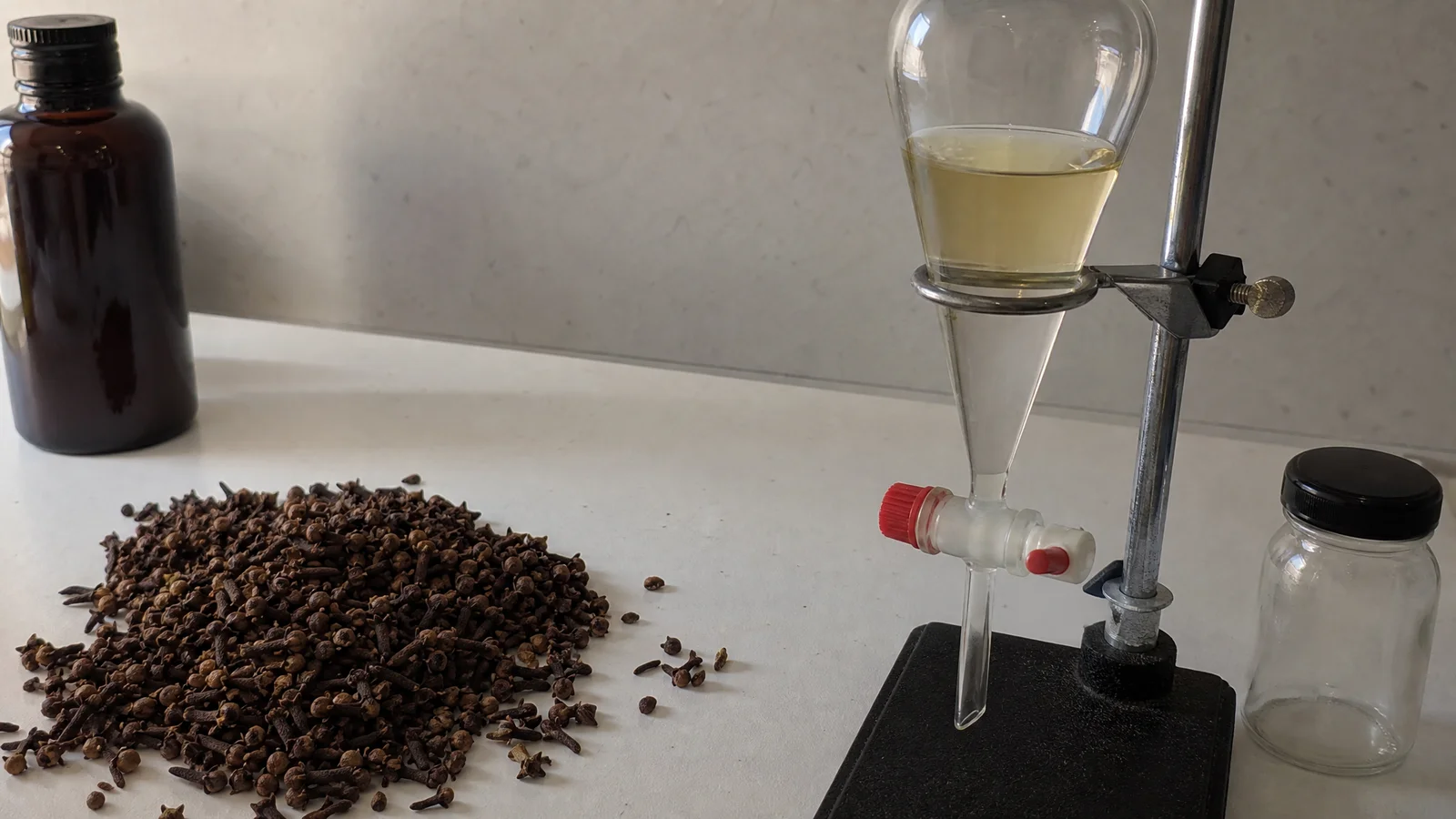
How eugenol behaves on its own is better documented. PubChem says it darkens and thickens on exposure to air, darkens with age and may decompose in light (PubChem, eugenol), and we describe that amber drift as ordinary behaviour for a phenol. The chemistry behind it is worth a read.
Four reasons people rest, weighed up
Reasoning from those properties, the usual reasons hold up unevenly.
- "The materials marry." Miscible liquids are mixed within minutes of stirring, and nothing we found says days improve that. What changes is your nose, once the opening has settled.
- "The sharp edges soften." Plausible, and mostly a matter of the most volatile parts leaving the surface. That is evaporation, not integration, and a sealed bottle loses little.
- "Haze or sediment shows up." Real and easy to check. Solvent mixtures can turn cloudy, and a rest lets you see it before the blend is in a bottle you are selling.
- "The colour settles." Eugenol only moves one way, toward amber, and it moves faster with air and light. A rest shows you the rate.
So resting is worth doing for what it lets you learn about your blend in your container, and not worth treating as a recipe step with a mandatory length.
A schedule you can follow
- Weigh, never count. Build by weight so every later sum is exact. The batch on our Certificate of Analysis has a relative density of 1.065, so 1 ml is about 1.065 g, and our blend calculation article shows the arithmetic.
- Do the IFRA sum first. Resting does not change how much eugenol is in the blend. For fine fragrance (Category 4) the eugenol Standard allows 2.5% in the finished product, and 0.64% for body creams and lotions (Category 5A), counting any clove or cinnamon leaf oil you add (IFRA Standards, 51st Amendment). Our IFRA limits article covers the categories.
- Match the bottle to the liquid. A 30 ml blend in a 100 ml bottle sits under about 70 ml of air, more than twice its own volume. Fill dark glass to the shoulder, or move the blend into a smaller bottle.
- Label it. Date, formula weights and the lot of each material.
- Look at fixed intervals. Day 1, day 7, day 14 and day 28 is a reasonable set. At each, compare colour against a retained drop on a white card, check for haze, and smell a strip, using the method in our smelling strip article. Write one line each time.
- Decide in advance what a stop looks like. A visible colour shift, cloudiness that stays at room temperature, or a smell moving toward something you did not add. Each tells you about the formula or the container, so address it before bottling.
The intervals are arbitrary. If day 7 and day 14 look and smell the same, the blend is telling you longer rests change nothing you can detect, and the next batch can rest for less.
A word on patience, because that is what resting really trains. When a blend smells a little sharp on the day you mix it, the temptation is to add something. Resist it. Put the blend in the cupboard, write the date on the label, and let your nose come back to it fresh. Sniffing the same strip over and over makes every blend smell the same; coming back after a week gives you a clean read.
One small experiment about air
The claim most worth testing for yourself is whether headspace matters. Split one batch between two bottles of the same dark glass, one filled to the neck and one half full. Keep both in the same cupboard, shut, and open them only on the check dates. At day 28 compare colour on a white card and smell both on strips. If the half-full bottle is darker, you have measured, for your own blend, what we say about part-used bottles aging faster, and you know to decant into smaller bottles. If they match, you have learned that too. Keep a third small, sealed sample in the dark that you never open, as the reference for the starting colour.
Make the notebook pleasant to use
The notes only help if you actually write them. Keep the notebook and a pencil right beside the shelf where the blends rest, with a few white cards clipped to the cover. A one-line entry such as "paler than the reference, still smells spicy, no haze" takes ten seconds and is worth more than a long entry you never get round to.
Two habits to retire
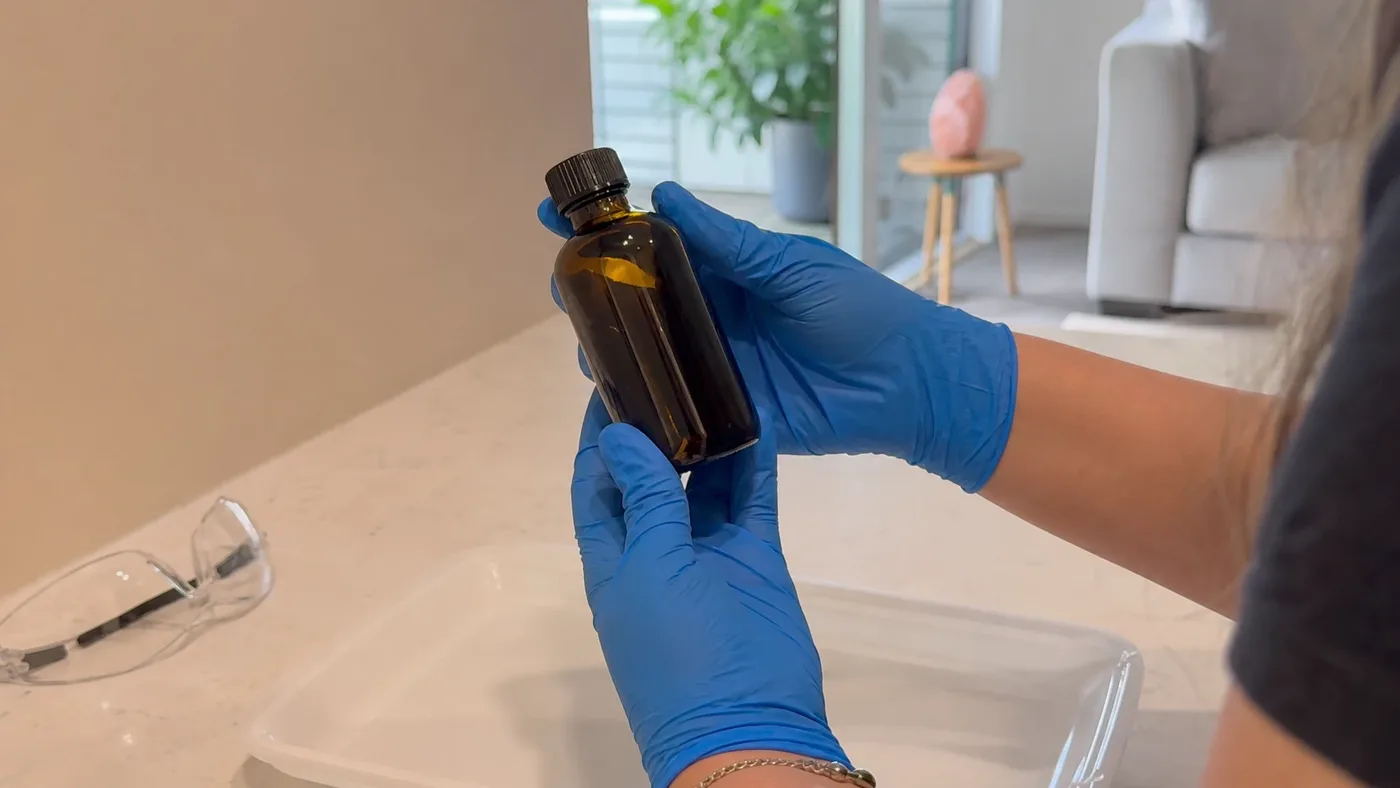
Shaking or opening the bottle "to let it breathe" admits the same air that darkens eugenol, so open it only to sample. And a few weeks on the shelf does not make a leave-on product kinder to skin. A 2023 repeated-open-application study found the lowest positive patch test among eugenol-allergic people at 0.031%, and 13 of 34 allergic subjects had a patch result that did not reproduce (Ofenloch et al., Contact Dermatitis, 2023). Patch test any leave-on blend, wear gloves while compounding, and start from the lower dilution figures in the IFRA tables. Our solid perfume article works through a roll-on version.
Carriers, perfumer's alcohol and the other materials in a blend come from other suppliers, since we sell eugenol oil only. Once the blend is finished, our storage guide applies to it as much as to the oil. If you are planning a larger run, the sample bottles on our wholesale page let you work through this schedule before you commit to a bigger size.
A rest is a cheap way to find out how your blend behaves, and a short notebook entry on each check date turns it into knowledge you keep.
Sources & Further Reading
- PubChem, eugenol (CID 3314). pubchem.ncbi.nlm.nih.gov/compound/Eugenol
- Wikipedia. Perfume, section on the basic framework. en.wikipedia.org/wiki/Perfume
- IFRA, 2023. IFRA Standards, 51st Amendment, eugenol. ifra-standards-51st-amendment.pdf
- Ofenloch RF et al., 2023. Allergic reactivity for different dilutions of eugenol in repeated open application test and patch testing. Contact Dermatitis 89(2):95-102. pubmed.ncbi.nlm.nih.gov/37218587