Eugenol in Solid Perfume: What Percentage to Use
A solid perfume sits on skin and stays there, which makes it a lovely thing to make and a good reason to do the arithmetic first. The number that matters is the total eugenol in the finished balm, counted from every material in it, not just the line labeled "eugenol oil".

Three numbers worth lining up
Our guidance for diluting eugenol oil in a carrier for skin is 0.5% to 2%, and we would start at the lower end. Standard fragrance-industry guidance, as we describe it in How We Test, puts the ceiling for leave-on products around half a percent. The IFRA eugenol Standard (Amendment 51, 2023) is more specific because it depends on product type: 2.5% in the finished product for Category 4, and 0.64% for Categories 5A to 5C (IFRA Standards, 51st Amendment). IFRA's guidance files solid perfume and fine fragrance of all kinds under Category 4 (IFRA Guidance). Which category your own product falls into is a classification question for a regulatory specialist, and the limits are updated between amendments. We would use 0.5% as a starting point and treat the category figure as your ceiling, not your target. Our IFRA explainer goes through how the Standard is built.
Choosing the base
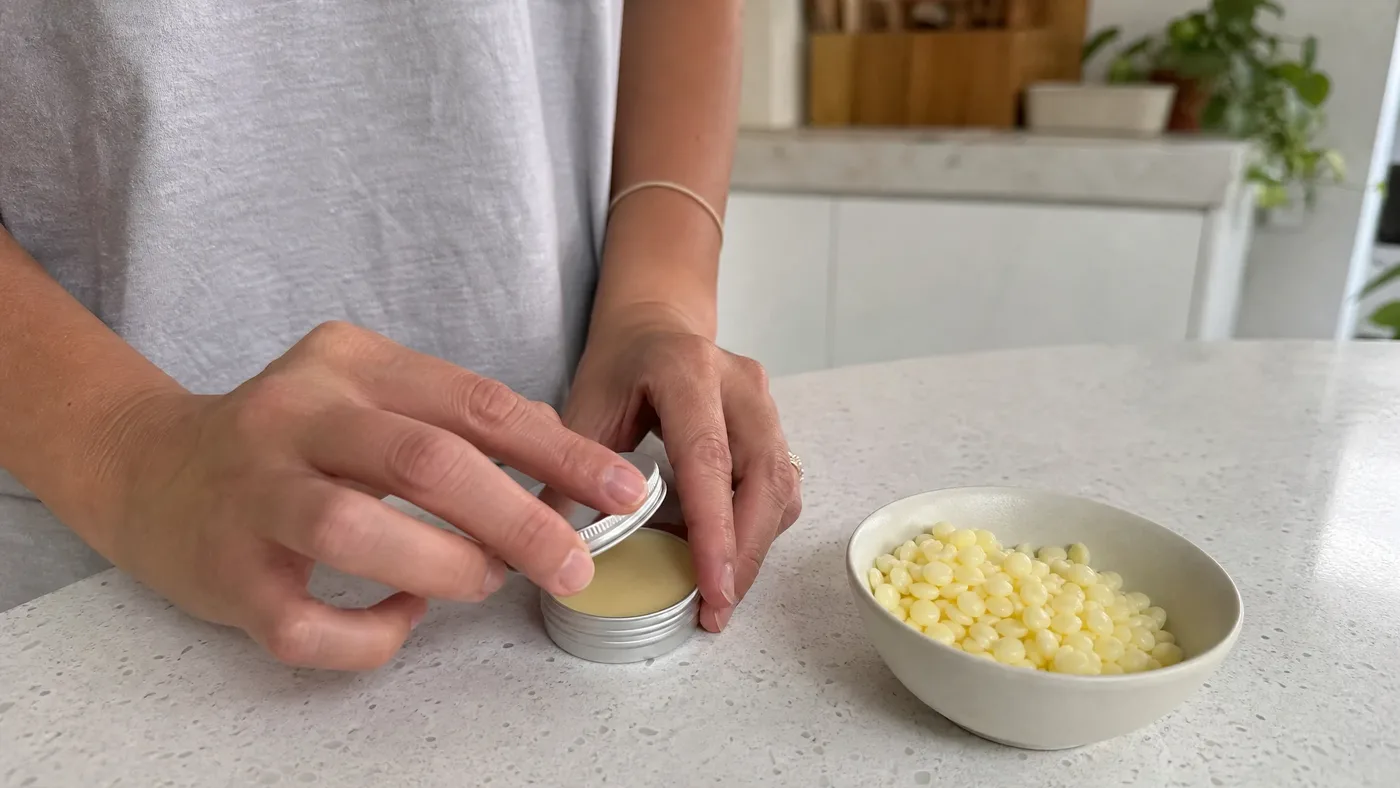
The balm itself is simple: a wax, a soft butter or oil, and the fragrance. Those come from a craft or cosmetic supplier, since we sell eugenol oil only. Choose a base that feels good in the tin, because that is what you will notice every time you open it: firm enough to hold its shape, soft enough to swipe without effort.
The batch arithmetic
Work in grams, not drops. The batch on our published Certificate of Analysis has a relative density of 1.065, so a gram of oil is about 0.94 ml.
| Eugenol oil as % of product | In a 10 g roller | In a 15 g solid |
|---|---|---|
| 0.5% | 0.050 g | 0.075 g |
| 0.64% | 0.064 g | 0.096 g |
| 2.5% | 0.250 g | 0.375 g |
Fifty milligrams is hard to weigh on a kitchen scale, which can swing by 10% at that size. A stock dilution solves it: mix 1.00 g of eugenol oil into 9.00 g of carrier for a 10% stock, then 0.50 g of that stock in a 10 g roller carries 0.050 g of eugenol, the 0.5% case, using an amount an ordinary scale can handle.
Counting what else carries eugenol
IFRA's rule is that a restricted ingredient counts "regardless of whether the restricted substance is added directly or indirectly." Its annex of indicative natural contributions lists typical eugenol levels, including cinnamon leaf oil at about 74%, rose absolute at 2.3% and ylang ylang oils at 0.5%. Here is how a 10 g roller adds up as an illustration:
- 0.050 g eugenol oil, counted as all eugenol to stay on the cautious side.
- 0.200 g cinnamon leaf oil at 74% contributes 0.148 g.
- 0.100 g rose absolute at 2.3% contributes 0.0023 g.
- 0.300 g ylang ylang oil at 0.5% contributes 0.0015 g.
The total is about 0.202 g in 10 g, or roughly 2.0%. Cinnamon leaf supplies about three quarters of it. That sits under the Category 4 figure and well over 0.64%, so the category you choose decides everything. If you have a GC report for an ingredient, IFRA says to use it in place of the indicative figure.
Pairing ideas
Eugenol sits in the middle to base of a scent, and it is happiest with rose, ylang ylang and vanilla, where it deepens the florals and adds a carnation-like spice. A little goes a long way, so think of it as the shadow behind the flower and not the flower itself.
Smelling it in stages
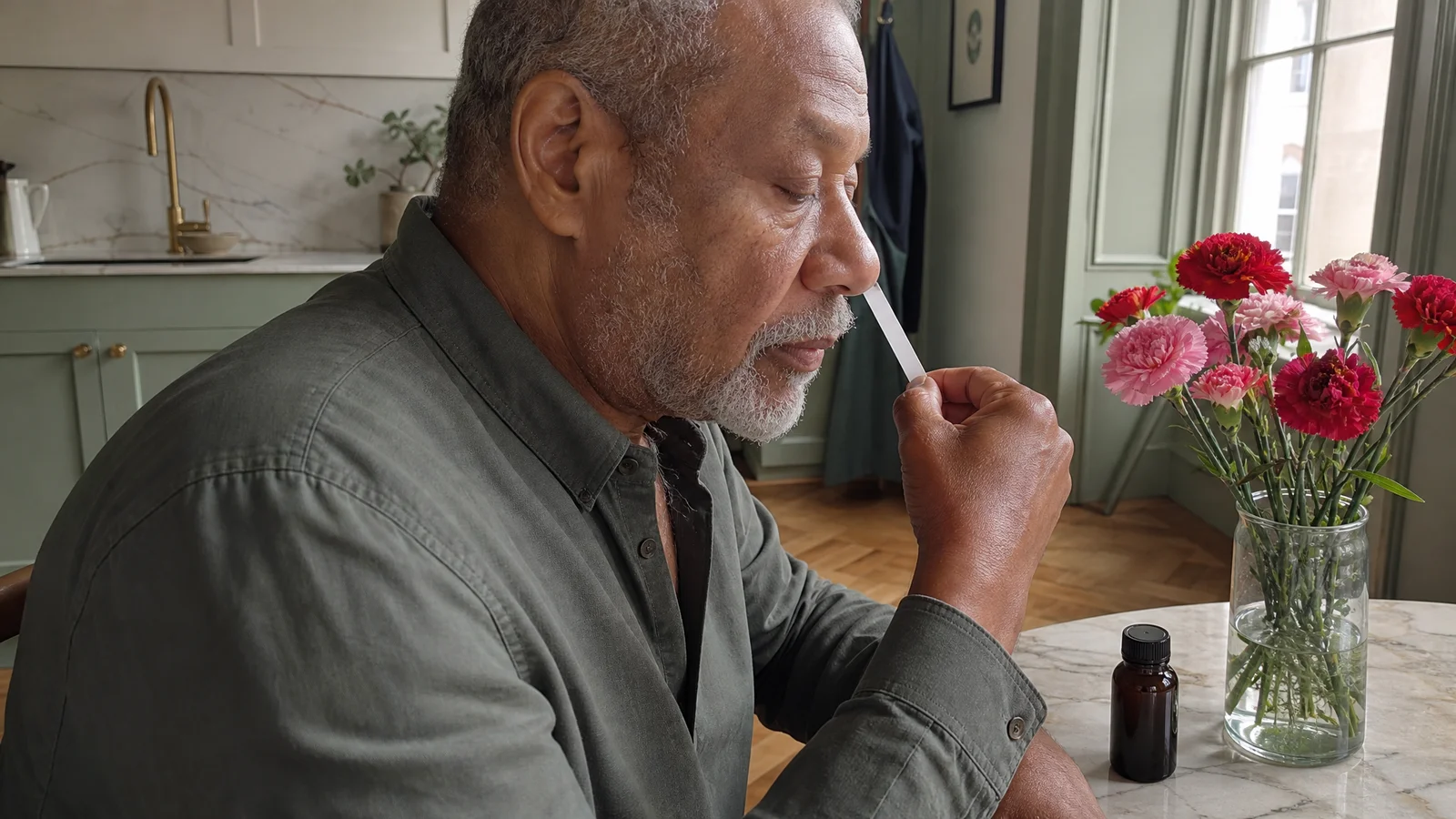
A solid perfume warms against skin, so judge the scent the way it will be worn, in stages. Dip a paper strip, smell it right away, set it down, and smell it again after a few minutes and once more after an hour. Because eugenol is unhurried, you will notice the heart of the blend arriving after the first impression has faded. Write down what you notice each time.
Labels and color
In the US, the FDA notes that fragrance ingredients may be listed simply as "Fragrance" (FDA, fragrances in cosmetics), while eugenol is a fragrance allergen that must be declared on EU and UK labels above set thresholds. Our labeling guide compares the regimes. Eugenol also darkens toward amber with air, which shows in a pale balm, so amber glass or an opaque tin is worth considering. Our posts on why it darkens and on aging a blend cover the details.
The patch test question
A clean forearm test is weaker evidence than it feels. In a 2023 study of 67 people, 13 of 34 eugenol-allergic participants had patch tests that did not reproduce on repeat, and 4 of those 13 still reacted in a 21-day open application test (Ofenloch et al., Contact Dermatitis, 2023). Anyone with a fragrance or balsam allergy should ask a dermatologist before starting, and the balm should stay away from eyes, children and pets. We sell eugenol oil only, so the carrier, wax, rollers and tins come from a craft or cosmetic supplier.
Weigh once, write it down, and let the stock dilution do the careful work for you.
Sources & Further Reading
- IFRA Standards, 51st Amendment (eugenol): ifra-standards-51st-amendment.pdf
- IFRA, Guidance for the use of IFRA Standards, 51st Amendment: ifra-51st-amendment-guidance.pdf
- IFRA Eugenol Standard, Amendment 49 text with Annex of natural contributions: perfumersworld.com copy of the IFRA Eugenol Standard
- FDA, Fragrances in Cosmetics: fda.gov
- Ofenloch et al., Contact Dermatitis 2023;89(2):95-102: pubmed.ncbi.nlm.nih.gov/37218587