How to Smell Eugenol on a Strip Without Fooling Your Nose
Dip a strip into neat eugenol and the first thing you smell is volume. Clove, carnation, a warm spicy wall of it, and then, a minute later, not much at all, because your nose has stopped reporting. Judging this material well means making it quieter first, smelling it on a schedule, and finishing before your own nose becomes the thing you are measuring.

Keep the neat oil off your fingers
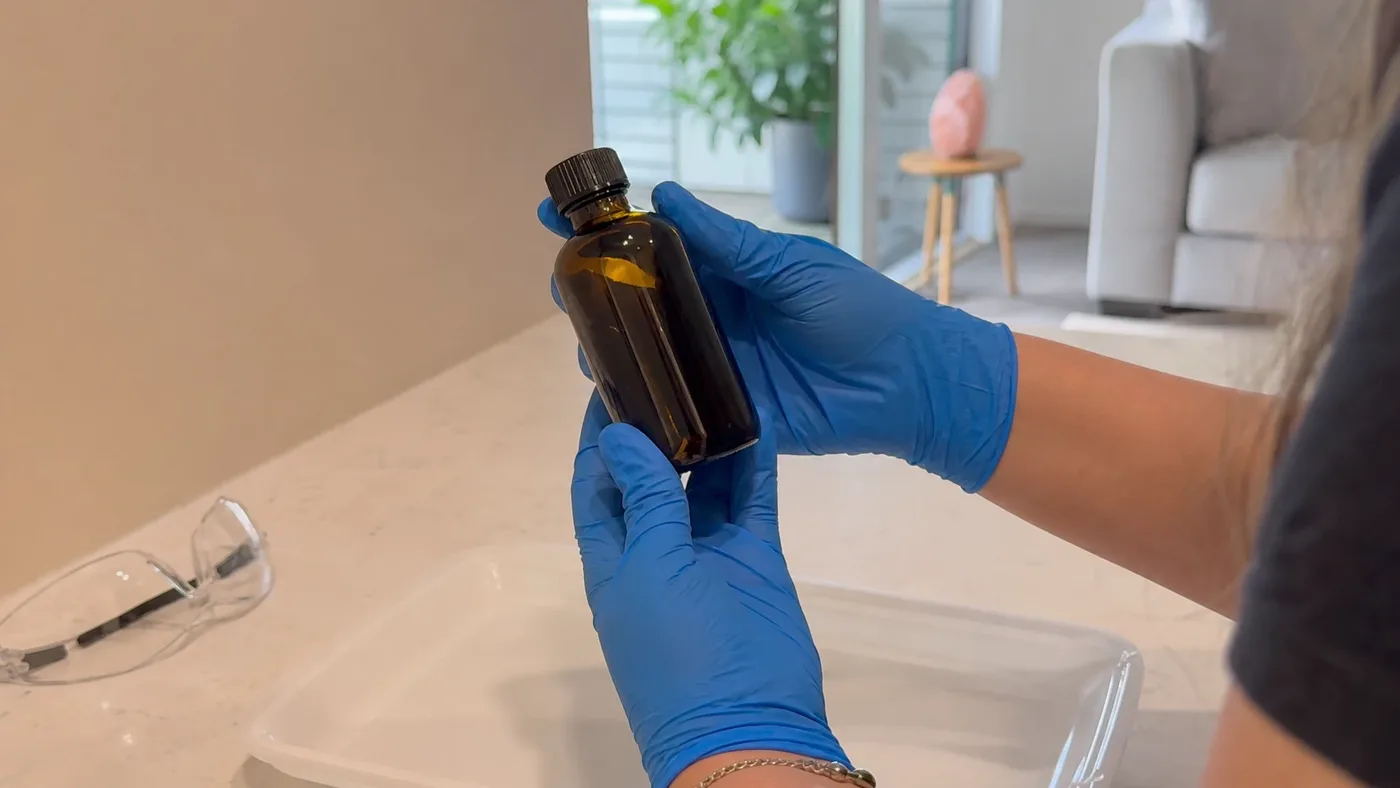
Eugenol is a recognised skin sensitiser. PubChem's summary of the European Chemicals Agency inventory shows the allergic skin reaction statement (H317) on 99.8% of notifications, so the sensible habit is simple: the neat oil should touch a strip, a pipette and a weighing vial, and nothing else. Hold strips by the dry end, wear gloves of the type your supplier's safety data sheet names, wash your hands afterwards and bin used strips in a closed container. If you have ever reacted to a fragrance or a balsam, ask an allergist before you start. Our skin sensitisation guide explains the mechanism.
Two dilutions, made by weight
- Weigh 1.00 g of eugenol oil into a clean glass vial and add 9.00 g of solvent. That is a 10% dilution by weight.
- For 1%, weigh 1.00 g of that 10% solution into 9.00 g of solvent.
- Use one solvent for the whole session. Ethanol and dipropylene glycol are common choices, and changing solvent mid-session changes two things at once.
Weigh instead of counting drops, because drop size varies with the pipette. The 10% and 1% steps are working conventions among fragrance people, not a standard. If you start from a volume, remember that the batch on our Certificate of Analysis has a relative density of 1.065 at 20 C, so 1.00 g is about 0.94 ml. A little oil goes a long way for this job: even our smallest bottle holds enough for a dozen or more 10 g dilutions at 10%. Our COA reading guide explains what that density line tells you.
Strips, in order
Label each strip in pencil with the material, dilution, solvent and the time you dipped it. Dip to the same depth every time, a fixed centimetre works well, and let the solvent leave before the first sniff. The timings below are our suggestion; they are a convention, not a rule.
- Once the solvent has gone: the top impression.
- 5 minutes, 30 minutes and 2 hours: how the smell moves.
- 24 hours: what is left on the strip.
Put a blank strip of solvent next to the sample, and always go from the 1% strip to the 10% one. If you own isoeugenol or a clove oil, put them alongside; our comparison of the two molecules and eugenol oil versus clove oil say what to expect. We sell eugenol oil only, so those references come from another supplier.
We describe our oil as warm, spicy and carnation-like, sweeter and more focused than whole clove, sitting in the middle to base of a composition. Write down whether your strips agree. If you want more vocabulary for what you smell, our scent profile is a good companion.
It also helps to set the scene before you start. Choose a room without cooking smells, candles or a freshly brewed coffee, and keep a window cracked if you can. Pour a glass of water and keep your hands unscented. Perfume on your wrist will join the conversation whether you invite it or not.
Why you should stop early
Noses tire quickly. In a 2024 study of 80 adults with normal smell, a nasal clip delivered a rose-like odorant to one nostril for 10 minutes and, separately, for 2 hours. Odour thresholds were significantly higher after just 10 minutes, more so after 2 hours, and more so again in the older group (Hintschich et al., The Laryngoscope, 2024). That was continuous exposure to one odour, so it cannot tell you how many strips is too many. What it does say is that adaptation arrives fast, grows with exposure and varies between people, so strip eight and strip one are not read by the same nose.
The coffee-bean trick that perfume counters use fares no better. In a small exploratory study, students smelled three fragrances nine times, then sniffed coffee beans, lemon slices or plain air before picking out which of four fragrances was new, and the beans did no better than the lemon or the air (Grosofsky, Haupert and Versteeg, Perceptual and Motor Skills, 2011). It is a small study and does not prove the beans do nothing, but it is no reason to lean on them. Reasoning from both, a pause in clean air and a cap on strips per sitting are the resets worth trusting. Pick your own numbers and watch for drift late in the session.
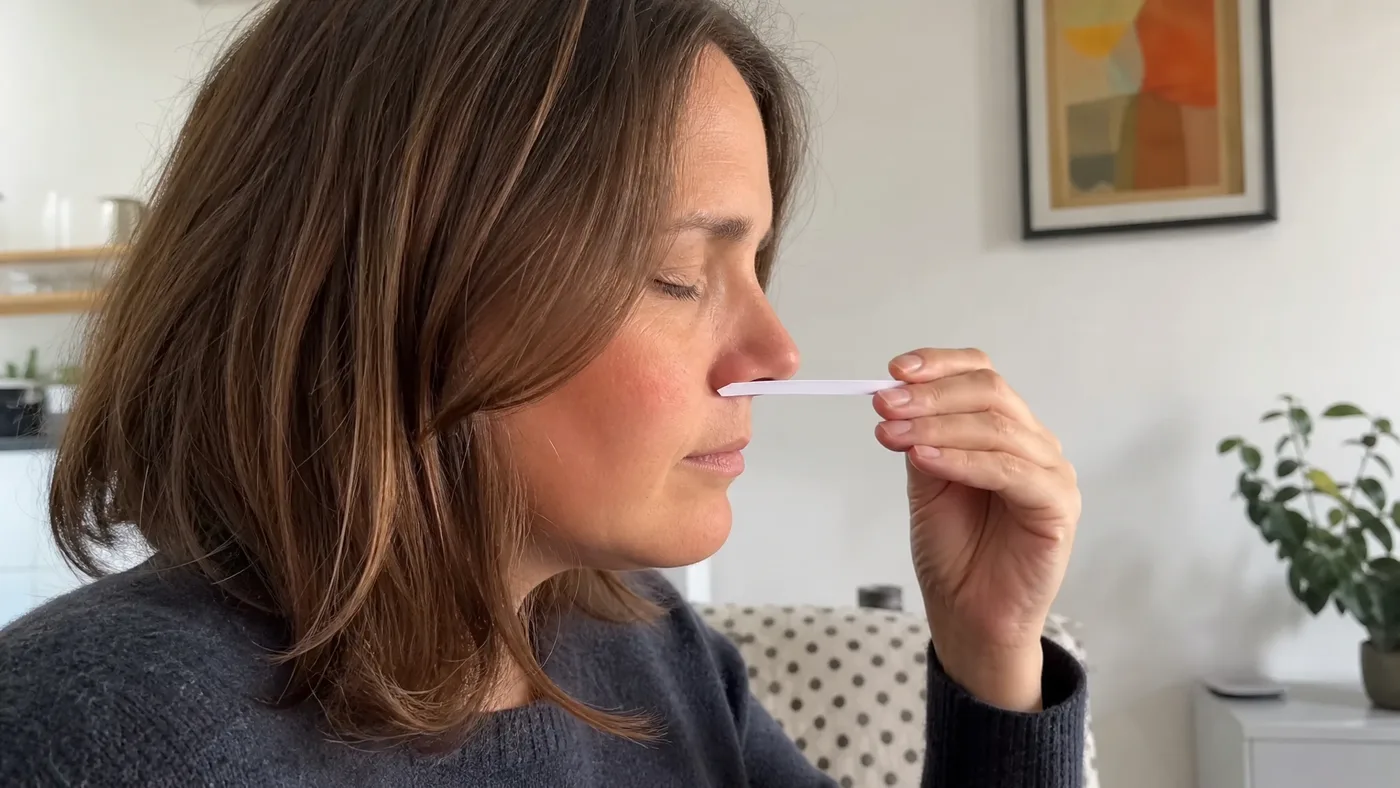
When you do smell a strip, take short, gentle sniffs rather than one long inhale, and hold the strip a few centimetres below your nose, not touching it. You will notice that the opening is the loudest part and that the interesting detail, the sweetness behind the clove, shows up a little later on the 1% strip. Many people find the weaker strip the more useful one, and that is a good reason to start there on a tired day.
A log that catches nose drift
Columns are enough: date, material and lot, dilution and solvent, strip number and dip time, time smelled, impression, how many strips you had already smelled that day, and what you compared it with. The strips-so-far column is the one most logs lack, and it is the one that shows you drifting. When a new lot arrives, smell it beside a retained vial of the old one at the same dilution on the same day. A change in colour on its own is not a smell result: we describe darkening toward amber as ordinary behaviour for a phenol. Once you move from strips to a formula, our bench guide to IFRA limits covers dilution and ceilings.
A strip tells you about aroma. It cannot give you an assay, an origin or what the material will do in wax or soap, which a GC report and a small trial can. If a GC report matters for your work, ask any supplier for one for the lot you are buying, and ask us in writing through the contact page if you want to know what exists for ours.
Sources & Further Reading
- Hintschich CA, Ma C, Hahner A, Hummel T, 2024. Pronounced olfactory habituation with age. The Laryngoscope. pubmed.ncbi.nlm.nih.gov/38597777
- Grosofsky A, Haupert ML, Versteeg SW, 2011. An exploratory investigation of coffee and lemon scents and odor identification. Perceptual and Motor Skills. pubmed.ncbi.nlm.nih.gov/21667761
- PubChem, eugenol (CID 3314), GHS classification summary of ECHA C&L Inventory notifications. pubchem.ncbi.nlm.nih.gov/compound/Eugenol