How to Store Eugenol Oil So It Stays Fresh Longer
The bottle that goes amber first is rarely the sealed one. It is the half-used one that has been opened a dozen times, with a lot of air inside and a cap that does not quite close. Looking after eugenol oil comes down to managing that air, along with light and heat, and none of it is difficult once you see the arithmetic.

What eugenol does when left to itself
PubChem's record, drawing on Fenaroli's flavour handbook and a National Toxicology Program entry, says the liquid "darkens and thickens on exposure to air", "also darkens with age" and "may decompose on exposure to light" (PubChem, eugenol). The same record lists it as incompatible with strong oxidisers, reactive with strong alkalis and incompatible with iron and zinc. We say much the same in plainer words: the oil darkens toward amber once air has been at it, which is ordinary for a phenol, and a part-used bottle ages faster than a sealed one.
That is the documented picture. No source we found gives a rate, so any precise shelf-life promise would be a guess. Our guidance is typically 2 to 4 years kept tightly capped in a cool, dark place, and our eugenol oil ships in dark glass in every size. The chemistry of the darkening is a good read if you are curious why.
What two safety data sheets say
Supplier SDSs for the compound are the best public statement of how a manufacturer stores it. We read two, and they differ.
| Item | ChemScene SDS (eugenol 98%, stabilised) | CDH Fine Chemical SDS |
|---|---|---|
| Storage | Tightly sealed, cool, well ventilated, away from direct sunlight; recommended 2-8 C | Cool place, tightly closed, "Store under inert gas. Air sensitive." |
| Conditions to avoid | No data | Air |
| Incompatible with | Strong acids and alkalis, strong oxidising and reducing agents | Strong oxidising agents |
The sheets are ChemScene CS-7807 and CDH. One asks for refrigerator temperatures; the other says "cool" and puts its weight on keeping air out. The common ground is plain enough: sealed, out of light and with as little air touching the liquid as possible. Whether a fridge adds anything for a working bottle is not settled by these documents. If you do chill it, let the bottle come to room temperature before opening so moisture does not condense inside, a general precaution and not something either sheet says. The ChemScene product is described as stabilised, so do not assume its advice transfers to an unstabilised bottle, or the other way round.
Air is the variable you control
Take a bottle that holds 1 fl oz (29.57 ml). Filled with oil, it holds only a few millilitres of air. Use half of it and the same bottle now holds about 15 ml of air, several times as much, and every opening swaps in a fresh supply. Since air is the agent, the plan follows from the arithmetic.
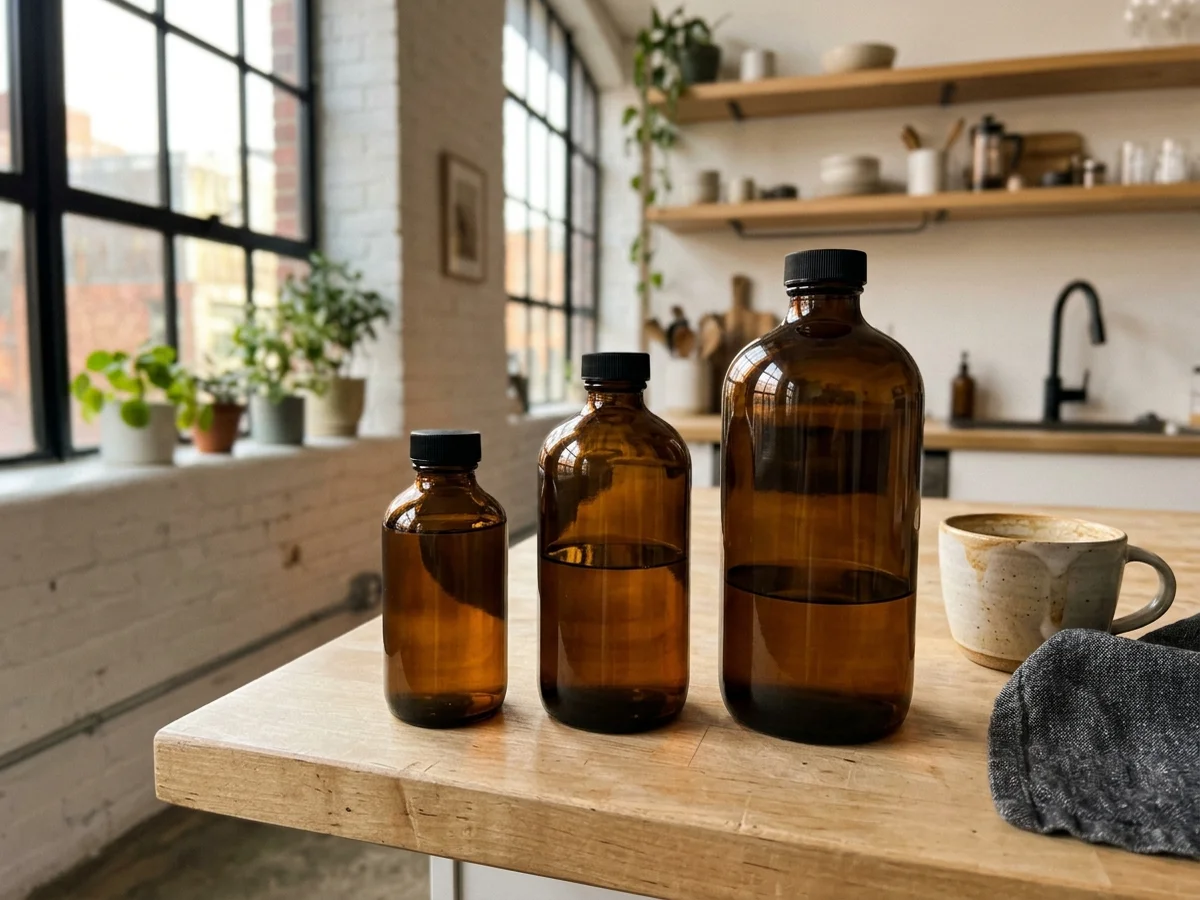
- Decant working amounts into small bottles. We suggest this for bulk especially: a 400 lb order is roughly 170 L at the density of the batch on our Certificate of Analysis (1.065), and reopening a drum is the biggest headspace of all.
- Match bottle to volume. Pour the rest of a half-used 4 fl oz bottle into a 2 fl oz bottle so the liquid reaches the shoulder. Do the same for finished blends.
- Keep caps tight and threads clean. Wipe the neck; residue in the threads is how a bottle ends up not quite closed.
Producers sometimes blanket the headspace with inert gas, as the CDH sheet asks, and whether that is worth the cost at workshop scale is your call, since nothing we found tested it with eugenol.
Light, heat and the right closure
Dark glass is the cheap answer to light, but amber glass does not stop all of it, so keep the bottle in a drawer or box and not on a windowsill. PubChem gives a closed-cup flash point above 100 C, so heat is a quality matter in the workroom, not a fire concern at ordinary temperatures; the candle side is in our flash point article.
Because the NTP entry lists incompatibility with iron and zinc, reasoning from that, glass, PTFE or polyethylene liners and lined caps are the sensible choices, and a liner that came with the bottle is a good default. The alkali incompatibility also argues for shelving it away from lye and soap-making chemicals, for storage and for spills. Our handling article has the safety side.
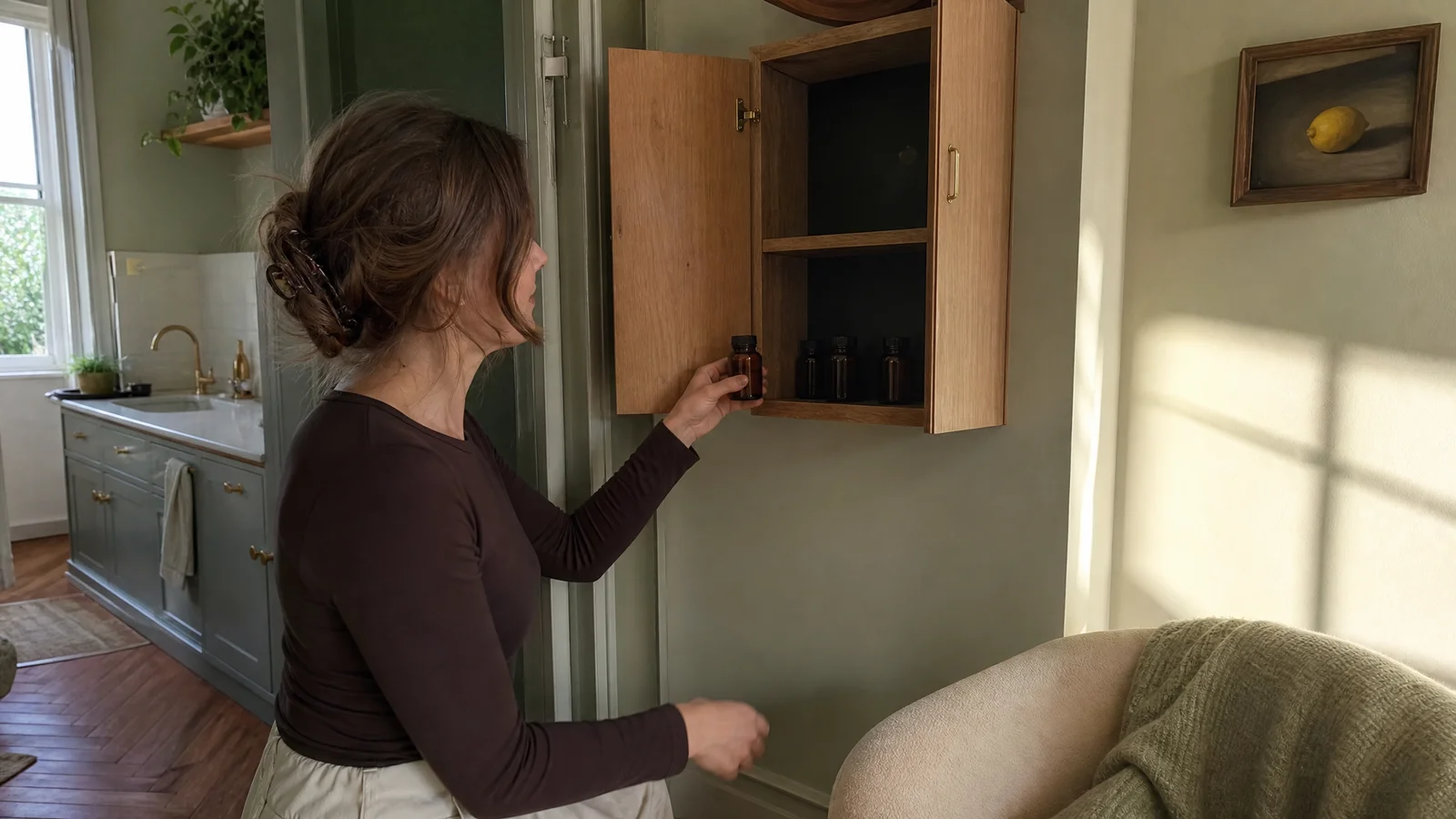
A tidy shelf is half the battle. We like the idea of a single labelled box for the oil and its small decanted bottles, kept in a cupboard that does not sit next to the oven or the hot-water pipe. Open the box and everything is in one place, dated, with the reference bottle in a corner. It takes a few minutes to set up and saves a lot of squinting later.
Date it and keep a reference
Write the date received and the date first opened on the bottle. The best-by date printed on the Certificate of Analysis we publish for one batch is 07/21/2026, and your own dates will teach you more than anyone's guess. Keep one small sealed reference bottle from a lot. When a working bottle looks darker or thicker than the reference, or smells different on a strip, retire it from critical work and run a trial before it goes into anything you sell.
Does darker mean unsafe? We found no source linking air-darkened eugenol to stronger skin sensitisation. A 2026 comparison of sensitisation methods noted that oxidised tea tree oil is more sensitising than fresh, but that concerns tea tree oil (Dawson et al., Toxics, 2026). Take it as a reason to patch test and not as a finding about eugenol. The lowest positive patch test among eugenol-allergic people in a 2023 study was 0.031% (Ofenloch et al., Contact Dermatitis, 2023), so gloves are sensible with any eugenol bottle or blend. See our sensitisation article.
Store it out of casual reach, away from eyes, children and pets. If anyone swallows it or has a bad exposure, call poison control or a physician, and a veterinarian for an animal.
The short version fits on a label: small bottles, full to the shoulder, tight caps, dark and cool, dated, with a sealed reference alongside.
Sources & Further Reading
- PubChem, eugenol (CID 3314): stability, incompatibilities, flash point. pubchem.ncbi.nlm.nih.gov/compound/Eugenol
- ChemScene. Safety data sheet, Eugenol 98% (stabilized with TBC), CS-7807. file.chemscene.com/pdf/UsaMSDS/MSDSUSACS-7807.pdf
- CDH Fine Chemical. Safety data sheet, eugenol (CAS 97-53-0). cdhfinechemical.com eugenol SDS
- Dawson et al., 2026. Toxics. pmc.ncbi.nlm.nih.gov/articles/PMC13611667
- Ofenloch RF et al., 2023. Allergic reactivity for different dilutions of eugenol in repeated open application test and patch testing. Contact Dermatitis 89(2):95-102. pubmed.ncbi.nlm.nih.gov/37218587