Why Does Eugenol Turn Amber? What Is Happening
A bottle of eugenol that arrived pale yellow can turn amber after a year, and it is natural to wonder what happened. The short answer is that this is ordinary behaviour for the material, and it comes down to chemistry that is easy to picture once you know eugenol is a phenol.

What the references say
PubChem, quoting the Hazardous Substances Data Bank, says eugenol "darkens and thickens on exposure to air" (PubChem, eugenol). Two words in that sentence are worth keeping apart: darkens and thickens. Colour alone is a loose signal, because fresh clove oils already span a range. EFSA describes bud oil as a clear yellow to light amber, slightly viscous liquid and leaf oil as clear yellow to amber (EFSA FEEDAP Panel, 2023), while a review calls eugenol clear to pale yellow (Kamatou et al., 2012).
We describe it the same way on our How We Test page: eugenol darkens toward amber once air has been at it, which is ordinary for a phenol, and a part-used bottle ages faster than a sealed one. The Certificate of Analysis we publish for one batch lists the appearance as a pale yellow liquid.
Why phenols change colour
A phenol has a hydroxyl group sitting on a benzene ring, and that group gives up an electron fairly easily. Laboratory studies of eugenol oxidation, done with enzymes and cells rather than in a bottle on a shelf, show the pattern. With a peroxidase enzyme, eugenol loses one electron to form a reactive phenoxyl radical and then a short-lived quinone methide, and these go on to form insoluble polymeric material (Thompson et al., Journal of Biological Chemistry, 1989).
Reasoning from that, a slowly darkening and thickening bottle is consistent with radicals joining molecules into larger, more coloured, more viscous ones. That is an inference, since we know of no study that analysed an air-darkened bottle of commercial eugenol. So we cannot list what is in an old bottle, which is the reason we suggest fresh material for anything that touches skin.
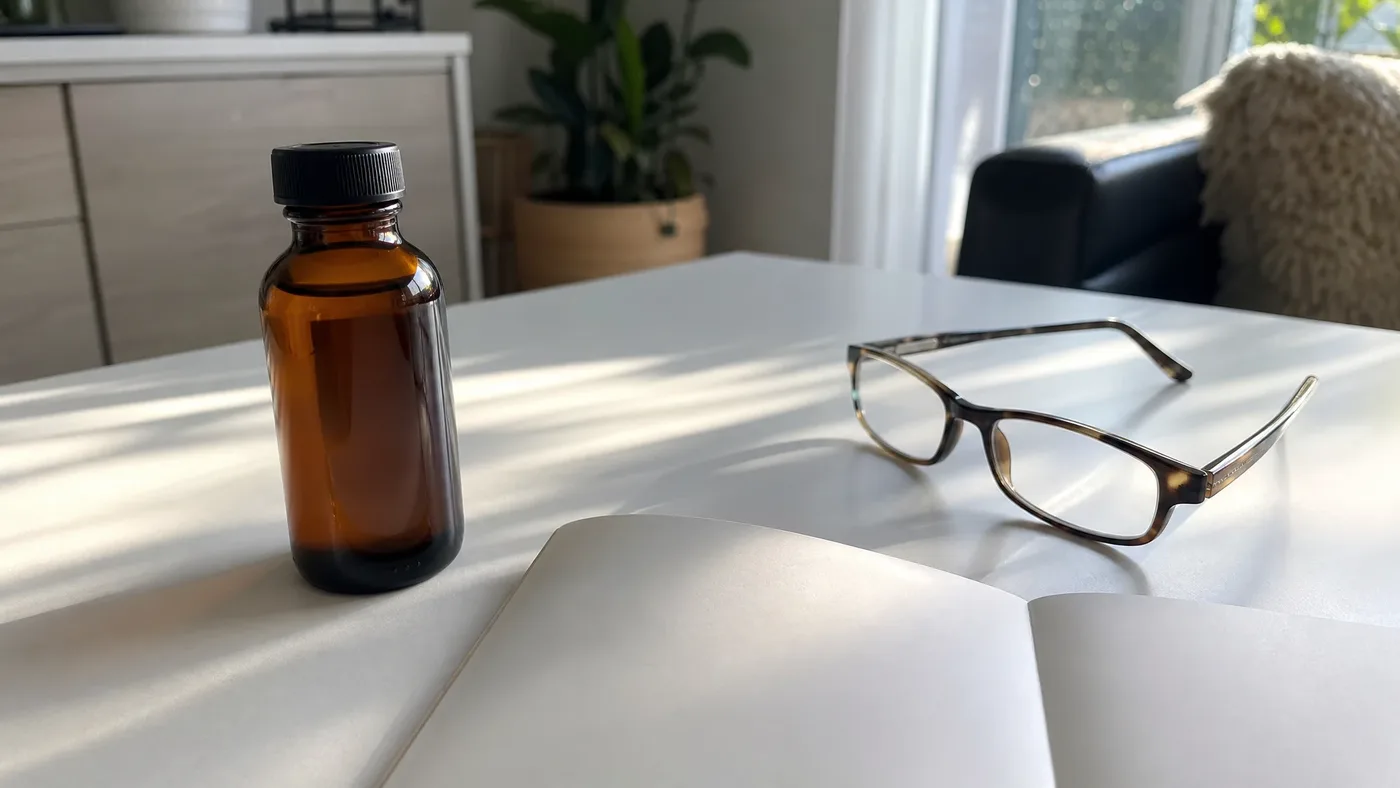
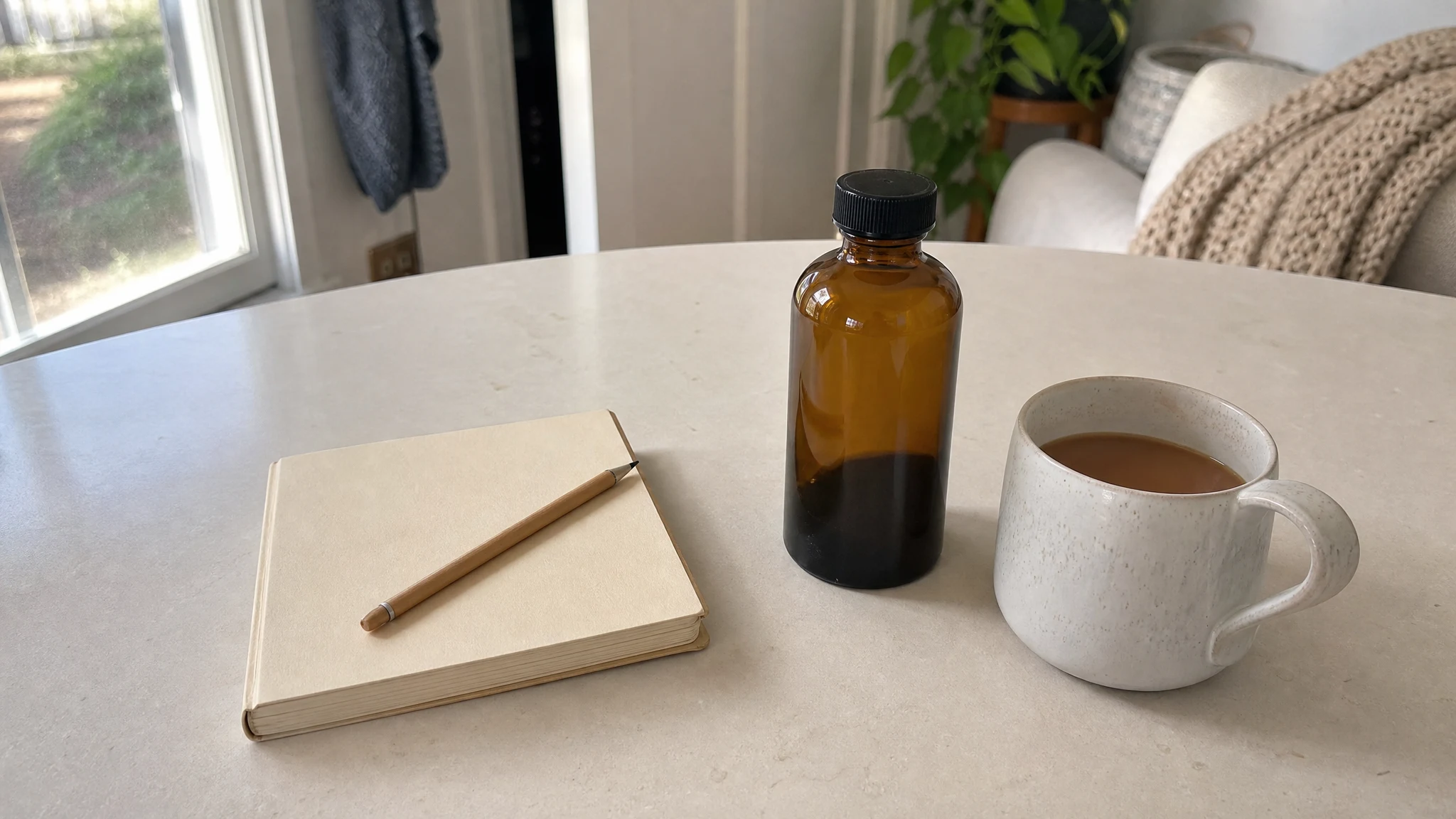
It is a small shock to open a favourite bottle and find it a shade darker than you remember, and it is natural to worry. Hold the bottle up to a window and look through the side, next to a white card, and the colour is easier to judge than from above. A shift from pale yellow toward amber is gradual, and you will rarely see it from one week to the next.
A different kind of dark: soap
Eugenol also goes dark in soap, for a related reason. Kamatou and colleagues note that large quantities of eugenol are used in soaps for their spicy aroma but can cause discolouration because of the phenol structure. With a pKa of 10.19 at 25 C per PubChem, eugenol in a fresh soap at pH 11 to 12 is mostly the phenolate form, a different species from the neutral phenol in the bottle. Our piece on cold process soap and colour covers that case. A dark bottle and a brown bar can have unrelated causes.
Keeping a bottle looking its best
Air, light and warmth are the levers, so our storage advice is to keep it tightly capped in a cool, dark place. We say it typically keeps 2 to 4 years that way, and every size comes in dark glass. A few habits help:
- Decant working amounts into smaller airtight dark bottles instead of opening a large one repeatedly. Less headspace means less air. Our storage guide covers this in detail.
- Check flow as well as colour. Amber is normal. Noticeably thicker eugenol, or anything with specks, is a good reason to replace the bottle.
- Keep a small dated reference sample from the first opening, so you can compare colour and scent against something real instead of memory.
- Match the use to the bottle. IFRA's guidance puts candles, incense and fragrancing sachets in Category 12 because of expected negligible skin exposure, so an older bottle is a question of colour and scent there. For leave-on skin products, or anything you sell, use fresh material (IFRA Guidance, 51st Amendment).
Using an older bottle sensibly
An amber bottle still has plenty of life in it for craft work where colour is not the point, such as a bowl of potpourri or a rustic spiced candle in a dark jar. Use the paler bottle for pale soap or pale wax, where a warm tint would show, and keep the darker one for the jobs that will hide it. That way nothing goes to waste, and each bottle ends up where it suits the work.
What colour cannot tell you
A pale bottle is not a purity test. A colourless diluent leaves colour unchanged, and a dark bottle may simply have started dark. Colour cannot give you an assay, and even a chromatogram cannot separate natural from synthetic eugenol (see what GC misses and how to read a certificate). The certificate we publish carries a best-by date of 07/21/2026 and lists density, refractive index, smell and appearance for one batch. If you need figures beyond that, ask us in writing through the contact page.
Eugenol is a lovely material that rewards a little care: closed tightly, kept cool and dark, and used while it is fresh. Any question about swallowing or skin contact from an old bottle belongs with a physician or, for pets, a veterinarian.
Sources & Further Reading
- PubChem, Eugenol, CID 3314: stability and pKa entries. pubchem.ncbi.nlm.nih.gov/compound/Eugenol
- EFSA FEEDAP Panel, 2023. Clove bud oil and clove leaf oils for all animal species. PMC10375362
- Kamatou GP, Vermaak I, Viljoen AM, 2012. Eugenol: from the remote Maluku Islands to the international market place. Molecules 17(6). PMC6268661
- Thompson D, et al., 1989. Peroxidase-catalyzed oxidation of eugenol: formation of a cytotoxic metabolite(s). J Biol Chem. PMID 2536013
- IFRA, 2023. Guidance for the use of IFRA Standards, 51st Amendment. ifra-51st-amendment-guidance.pdf