Eugenol vs Isoeugenol: Why the Limits Differ So Much
Eugenol and isoeugenol have the same chemical formula, turn up in the same sentences of perfumery books, and cannot be swapped on a formula sheet. For most product categories, IFRA allows roughly twenty times less isoeugenol than eugenol. Substitute one for the other without redoing the arithmetic and a formula can sail past its limit. We sell eugenol oil only, so this is our explanation of why we would never treat isoeugenol as a stronger or cheaper cousin of it.
The limits tell the story
The clearest difference is regulatory rather than olfactory. Both sit in IFRA's "restriction" class, both are driven by dermal sensitisation and systemic toxicity, and the numbers below are the finished-product maximums from the 51st Amendment compilation.
| IFRA category (example) | Eugenol | Isoeugenol |
|---|---|---|
| 3 (face products applied by fingertip) | 1.0% | 0.12% |
| 4 (fine fragrance) | 2.5% | 0.11% |
| 5A (body lotion, oil) | 0.64% | 0.027% |
| 9 (rinse-off, bar soap) | 4.9% | 0.21% |
| 10A (household care, hand contact) | 4.0% | 0.21% |
| 12 (candles, incense) | No restriction | No restriction |
Our arithmetic across the categories where both have numbers puts the ratio between about 8 and 25, with most sitting near 23. In practice that looks like this. Take an invented concentrate holding 5% of the material in question. In fine fragrance, the ceiling dose is the limit divided by 5%. For eugenol that is 2.5 divided by 5, or 50% of the product; for isoeugenol, 0.11 divided by 5, or 2.2%. Same concentration, a twenty-three-fold gap in how much you can use. The two agree only on Category 12, which is a statement about one document and not a safety finding. Our IFRA limits article prints the full eugenol table.
A shifted double bond
Both are C10H12O2 with a molecular weight of 164.20, and both keep the same free phenolic hydroxyl and methoxy groups, which is why they share a family character. The difference is the three-carbon tail. Eugenol carries an allyl chain, with the double bond at the far end. Isoeugenol carries a propenyl chain, with the bond moved up against the ring, so it comes in E and Z forms, and IFRA lists two CAS numbers for it (97-54-1 and 5932-68-3). That small shift is what the regulatory table reflects.
Telling them apart on a certificate
If you hold a bottle labelled either name and want a rough physical check, density and refractive index separate them clearly. PubChem's experimental ranges, drawn from the JECFA flavouring specifications, run like this.
| Property | Eugenol | Isoeugenol |
|---|---|---|
| Density | 1.064 to 1.070 | 1.079 to 1.085 |
| Refractive index | 1.540 to 1.542 | 1.572 to 1.577 |
The batch on the Certificate of Analysis we publish reads 1.065 and 1.541, squarely in the eugenol column. That tells you the batch is not mostly isoeugenol; it does not give an assay, and the certificate has none. Our certificate guide covers the rest.
How they smell, and why a perfumer reaches for each
Published descriptions overlap and then part ways. PubChem quotes the Merck Index for eugenol as "odor of cloves" and Kirk-Othmer as "warm, spicy, floral"; for isoeugenol it quotes Hawley as "spice-clove" and JECFA as "floral, carnation-like". Reading them together, isoeugenol is the one a perfumer would reach for when the carnation facet is the goal, at the very low levels the table allows, while eugenol carries the clove facet at far higher ones. That is reasoning from descriptions, so confirm it on a smelling strip. We describe our eugenol oil as warm, spicy and carnation-like, and it works nicely in carnation accords, as our accord article shows.
The cancer classification, in context
In June 2023 an IARC working group meeting in Lyon classified isoeugenol as Group 2B, possibly carcinogenic to humans, based on sufficient evidence in experimental animals and inadequate mechanistic and human evidence. A group number describes the strength of evidence that something can cause cancer, not the likelihood at a given exposure. That announcement says nothing about eugenol, so the label does not carry across to it.
Trace isoeugenol in clove-derived material
Isoeugenol is a trace companion of clove. The EFSA opinion's leaf-oil exposure data lists (Z)-isoeugenol at 0.04% of the GC area. A eugenol isolated from clove oil may therefore carry a trace of it, and a buyer who needs to know can ask any supplier for a GC report that names minor components for the lot. For ours, write to us through the contact page. If a formula sits near a Category 4 or 5 limit, the isoeugenol line on that report matters more than the eugenol line. Our GC-MS article explains why.
Keep the two bottles apart
Names that differ by two letters are easy to mix up on a busy day. If both ever share your bench, give them separate shelves, write the full name on every label and every batch sheet, and never rely on the smell alone to tell you which is which.
Who should reach for which
- Candle and soap makers who want clove warmth: eugenol, which carries far higher limits. Our soap usage-rate article works backward from the limit.
- Perfumers chasing a carnation facet: isoeugenol, from an aroma-chemical supplier since we do not sell it, used as a trace tool.
- Anyone selling a leave-on skin product: read the category row first, because both are sensitisers.
- Dental or oral questions: neither. Our eugenol oil is not for internal use or dental use; ask a dentist or physician.
If isoeugenol is what your formula needs, buy it from a supplier who lists it and ask for the SDS and IFRA certificate. And for clove warmth you can dose with confidence, the higher limits on eugenol make it the easier molecule to plan around.
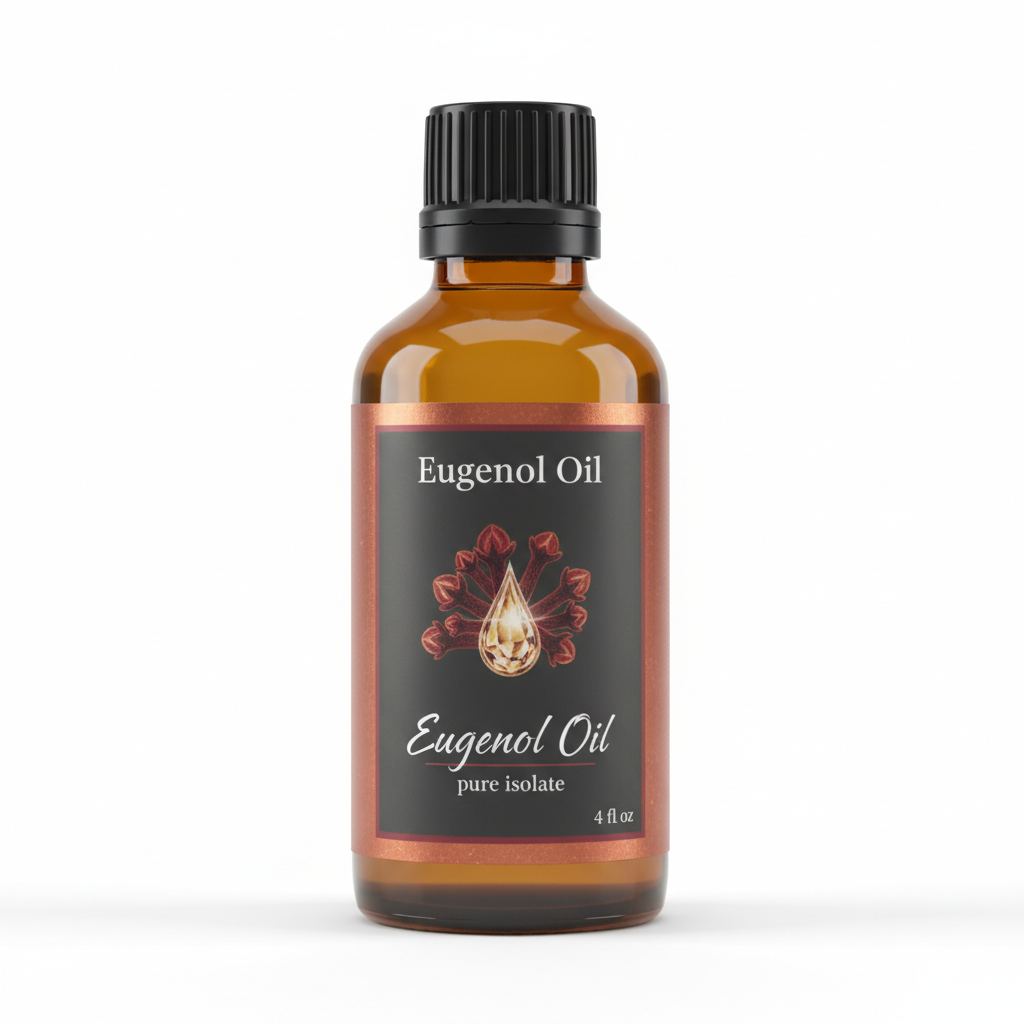
Two small molecules, two very different rulebooks: knowing which one is in the bottle is half the job. Our eugenol oil is in the shop, larger sizes are on our bulk page, and our guide to buying eugenol oil in bulk covers the paperwork to ask for.
Sources & Further Reading
- IFRA. The complete IFRA Standards, 51st Amendment (eugenol, pp. 103-105; isoeugenol, pp. 142-144). IFRA Standards PDF
- IARC, 2023. IARC Monographs evaluation of the carcinogenicity of aspartame, methyleugenol and isoeugenol. iarc.who.int
- NCBI PubChem. Eugenol (CID 3314): properties and odor descriptions. pubchem.ncbi.nlm.nih.gov/compound/Eugenol
- EFSA FEEDAP Panel, 2023. Safety and efficacy of feed additives consisting of essential oils derived from the flower buds or the leaves of Syzygium aromaticum. EFSA Journal. PMC10375362