Cinnamon Clove Soap: Why You Count the Eugenol Twice
A "cinnamon clove" soap is often the same molecule twice. Cinnamon leaf oil is mostly eugenol, so a blend of clove-type material and cinnamon leaf can carry a good deal more eugenol than the bottle labeled eugenol suggests. That is not a warning, just a sum worth doing before you pour, and it is a fun one, because it shows how a blend really works.

The fact that drives the sum
Cantó Catalá and Blázquez Ferrer ran GC-MS on seven commercial cinnamon oils and found eugenol at 81.51 +/- 0.21% in the one commercial leaf oil, bought from a pharmacy (Nereis, 2017). That is one sample, so lots will differ, and the 81.5% below is there so the arithmetic is visible. Replace it with the figure on your own lot's GC report, and do the same for the other oils. The sums assume sweet orange and patchouli add no eugenol, which you should confirm on their reports.
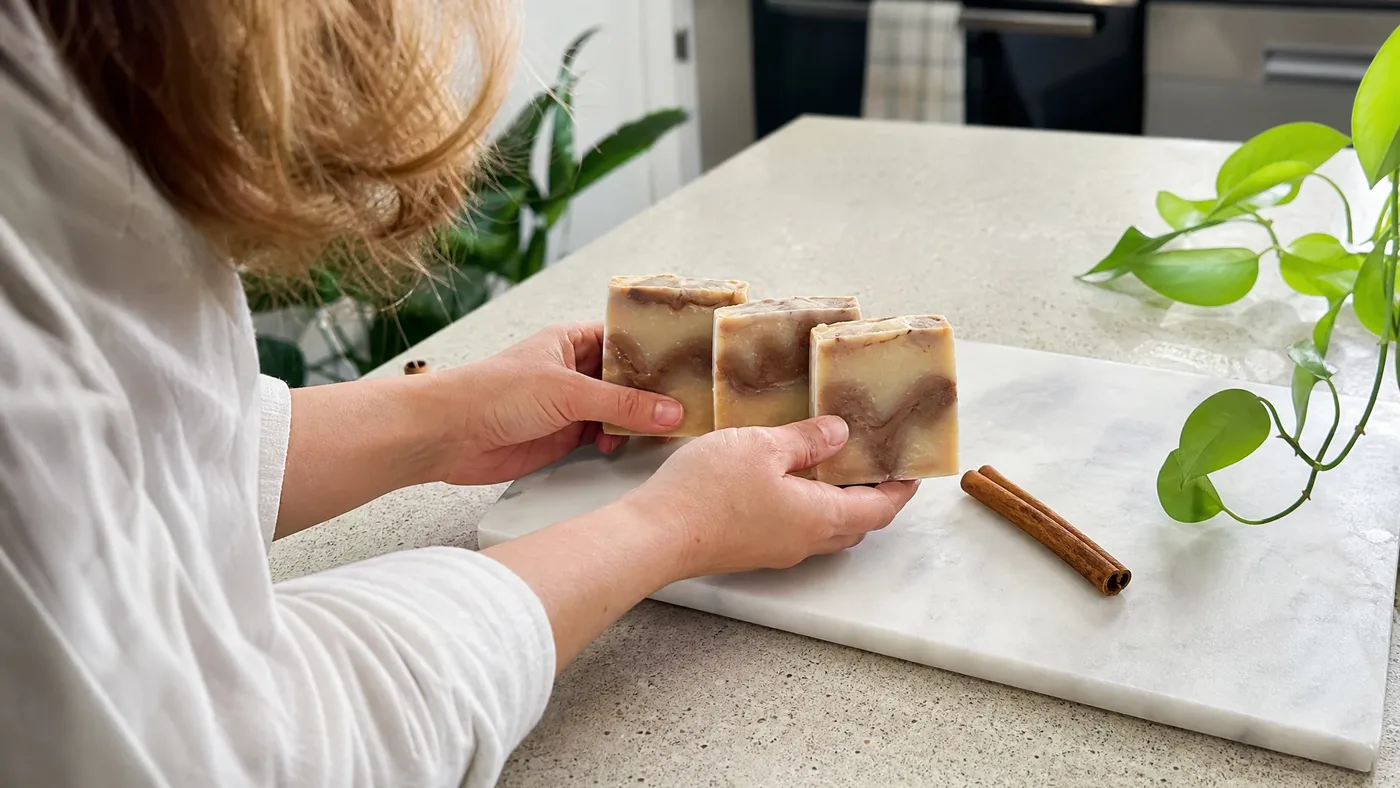
Cinnamon and clove soaps have a cosy reputation, and a lot of that comes from how they look as much as how they smell. A bar the colour of cocoa with a few flecks of spice feels like a winter gift before anyone has picked it up. That is part of the fun, and it is why this combination is worth the extra bit of arithmetic.
Two structures
Both use a 1,000 g batch of oils and an example 5% fragrance load, which is 50 g of fragrance. Treat that load as an illustration. There are no lye or oil amounts here: use any lye calculator and a base recipe you trust, and treat the fragrance as its own calculation.
| Component | A: orange and clove | A in grams | B: cinnamon and clove | B in grams |
|---|---|---|---|---|
| Sweet orange | 80% | 40.0 g | 50% | 25.0 g |
| Eugenol oil | 8% | 4.0 g | 5% | 2.5 g |
| Patchouli | 12% | 6.0 g | 15% | 7.5 g |
| Cinnamon leaf oil | 0% | 0 g | 20% | 10.0 g |
| Vanilla | 0% | 0 g | 10% | 5.0 g |
The roles are scent reasoning. Orange is the bright top that makes the bar smell like soap and not a spice jar, eugenol is the carnation-clove center, and patchouli is the earthy base that our anchoring post explains. In B, cinnamon leaf adds a second spice voice and vanilla rounds it out. We sell eugenol oil only, so the rest comes from your aroma supplier.
The sum
Total eugenol is the eugenol oil grams plus cinnamon leaf grams times 0.815. In A that is 4.0 g, or 0.40% of the 1,000 g of oils. In B it is 2.5 g plus 10.0 times 0.815, so 10.65 g, or 1.07%, with the leaf oil supplying about three quarters of it in a blend where eugenol is listed at 5%. If the leaf oil on your next lot reads 75% and not 85%, B moves by about a gram.
The IFRA eugenol Standard allows 4.9% in the finished product for bar soap, Category 9 (IFRA Standards, 51st Amendment). Counted against the oil weight, which overstates it because the finished bar also holds lye and water, both structures sit well under that. The ceiling starts to matter only when a blend leans heavily on eugenol-rich material at a high load. If you ever need to bring a blend down, lower the fragrance load, trim the cinnamon, or shift weight to the other ingredients. With the bottle eugenol at zero, 4.0 g of total eugenol would allow at most 4.9 g of cinnamon leaf, about 9.8% of a 50 g fragrance portion. Our blend calculation post carries several eugenol-bearing oils through one sheet, and the usage rate post works backward from the limit.
Colour and cure
A review of eugenol chemistry notes that large quantities of eugenol in soaps and detergents cause discoloration because of the phenol structure (Kamatou et al., Molecules, 2012). So expect a spiced bar to drift warmer, and design for it: tan, cocoa, ochre and brown colorants will read as intended, while a white or pastel bar will show the shift. Our cold process post covers the process side. A sensible way to compare structures is a small control batch with no fragrance and one batch per structure, judged at unmolding and after a four-week cure, which is the cure window Wholesale Supplies Plus gives for cold process (Wholesale Supplies Plus). For partners that suit eugenol, see what blends well with eugenol.
Making it a gift
If you are making these bars for friends, wrap them in plain paper and write the main scent on a small tag. A spiced bar has a real presence, and some people simply do not love clove. A tag helps them choose, and it means nobody is surprised by the smell when they open the box.
It also helps to sniff a finished bar at arm's length first. A good spiced bar should smell warm and rounded, with the orange up front and the clove sitting behind it. If the clove arrives first and loudest, that is useful information for your next batch.
Who should sit this one out
Eugenol is a recognized skin sensitizer. Skip spiced bars if you have a fragrance allergy or skin condition, and patch test a finished bar on yourself before anyone else uses it. If you sell soap, a regulatory specialist should check limits and labeling. Handle the neat oil in small amounts, wash up afterward and keep it from eyes, children and pets.
Do the total-eugenol sum on the lot in your hands, and your spiced soap will come out the way you planned it.
Sources & Further Reading
- Cantó Catalá A, Blázquez Ferrer MA, 2017. Standardization of commercial cinnamon essential oils by gas chromatography-mass spectrometry analysis. Nereis 9: revistas.ucv.es/nereis/86
- IFRA Standards, 51st Amendment (eugenol): ifra-standards-51st-amendment.pdf
- Kamatou GP, Vermaak I, Viljoen AM, 2012. Eugenol: from the remote Maluku Islands to the international market place. Molecules 17(6):6953-6981: pmc.ncbi.nlm.nih.gov/articles/PMC6268661
- Wholesale Supplies Plus, Testing fragrances in cold process soap: wholesalesuppliesplus.com