Refresh Potpourri With Eugenol Oil: A Dilution Guide
Potpourri fades because the volatile parts of its scent drift away from petals that were dried and dressed just once. A refresher puts fresh fragrance back on the same surfaces, and eugenol is a natural candidate: it leaves slowly, so it is the warm clove-and-carnation note still hanging around after the lighter notes are gone. The one thing to avoid is dripping the neat oil onto the bowl.

Why dilute first
Neat oil lands on one chip and stays there, so the scent is lumpy rather than even. Eugenol's vapor pressure is about 0.022 mmHg at 25 C (PubChem), which is why a heavy hand leaves a strong, lasting smell on a few petals. Color matters too: eugenol darkens toward amber with air, which we describe as ordinary phenol behavior, and a concentrated spot on pale petals or paper is where it would show. And the concentrate is the strongest form of the material to have near your skin: PubChem's summary of notifications to the European Chemicals Agency lists the hazard statement H317, "may cause an allergic skin reaction", in 99.8% of 2,820 reports. A measured refresher oil solves all three at once.
Picking a diluent
We sell eugenol oil only, so the diluent comes from your usual supplier, and there are two sensible choices.
- A carrier oil stays put, so the dose you weigh is the dose that remains. It can go rancid over time and will mark paper, fabric and wooden bowls.
- Ethanol carries the oil into the material and then leaves. It is flammable, with a flash point below room temperature, so keep it away from flames, candles and warm bulbs.
Skip water: eugenol dissolves to only about 0.25% there (2,460 mg/L at 25 C), so it would separate. Our linen spray article explains what getting oil into water takes.
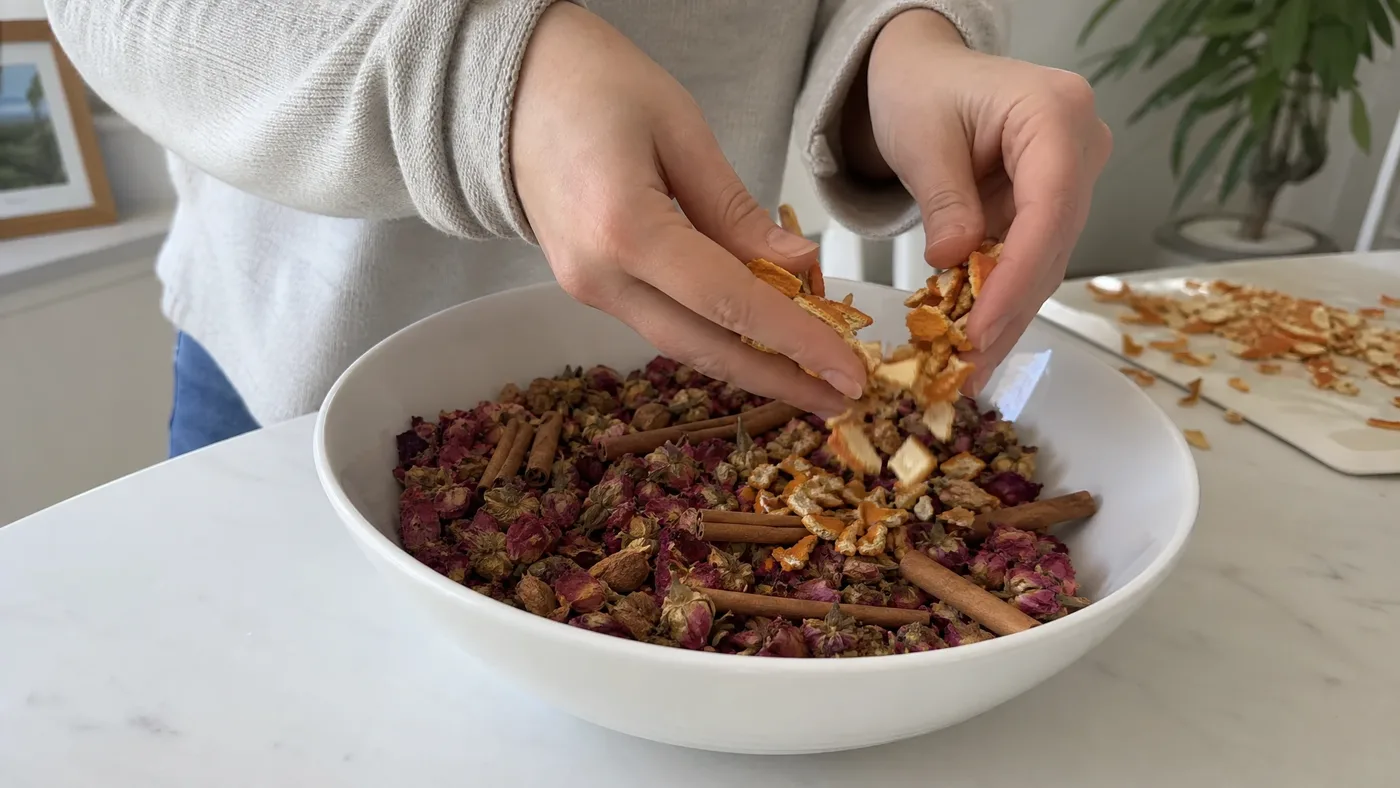
Here is how we would think about the bowl itself. Tired potpourri tends to smell flat and dusty, the way a spice cupboard does when the jars have been open too long. What you want back is that first-day warmth. Stir the bowl with a spoon before you add anything, so the surfaces are loose and every chip gets a fair share of the refresher.
Checking the limit
The IFRA Standard for eugenol (51st Amendment, 2023) allows 4.0% in the finished product for Category 10A, which IFRA's guidance uses for pot-pourri, reed diffuser oil and similar household fragrance products. It puts them in 10A because of the handling of the soaked material (IFRA Standards; IFRA Guidance). Amendments change, so check the current one, and ask a regulatory specialist before selling anything.
A worked 50 g batch
- The ceiling: 4.0% of 50 g is 2.00 g of eugenol, counting every source of eugenol in the blend.
- A comfortable working blend at 1%: 0.50 g eugenol oil plus 49.50 g diluent. On the batch of our published Certificate of Analysis, 0.50 g is about 0.47 ml, but weigh it, because drop size depends on the bottle.
- Per bowl: 1.0 g of that refresher on 100 g of potpourri delivers 10 mg of eugenol, and the batch covers about 50 top-ups.
If your blend adds cinnamon leaf or clove-type oils, they carry their own eugenol, so take the percentage from the GC report and add it in. A refresher built as a 10% eugenol accord would already be 2.5 times the 4.0% ceiling before anything else was counted.
Finding your strength
Make three small 20 g batches at 0.5%, 1.0% and 2.0% eugenol, which need 0.10 g, 0.20 g and 0.40 g and a scale reading to 0.01 g. Add 1.0 g of one batch to each of three 100 g portions of the same potpourri in glass jars, seal and shake. Smell them on opening, then at a day, a week and four weeks, keeping a jar of plain potpourri as a control, and press a few petals on white card to check for marks. Choose the lowest batch that still reads clearly at week four.
What you will notice
Right after a top-up the bowl smells louder than it will tomorrow, because the diluent is still leaving. Give it a few hours before you judge. A warm, spicy, carnation-like note should come up as you stir, and it should read as sweet spice and not as a sharp wall of clove. If it smells harsh, the blend was too strong, and the fix is a weaker batch next time, not a second round on top of the first.
Where the bowl lives matters
Our recommendation is a spot away from direct sun and radiators. Warmth pushes scent out fast and then it is gone, while a cooler shelf lets the bowl hold its character for longer. A shallow dish with a wide mouth gives you more scent per stir than a deep jar.
Hands, pets and who should skip it
Wear gloves or use a spoon, wash your hands afterward and keep the oil away from eyes, children and pets. Pet Poison Helpline lists clove among the oils that can poison animals (Pet Poison Helpline), so a bowl a cat can reach is a bowl it can lick. Our pets article goes through placement. For scent in drawers rather than a bowl, see the sachet guide, and our storage guide keeps the bottle in good shape between top-ups. Skip this if anyone in the home reacts to fragrance.
A gram of refresher oil on a bowl is often all it takes to bring last season's potpourri back to life.
Sources & Further Reading
- IFRA Standards, 51st Amendment (eugenol): ifra-standards-51st-amendment.pdf
- IFRA, Guidance for the use of IFRA Standards, 51st Amendment: ifra-51st-amendment-guidance.pdf
- NCBI PubChem, eugenol (CID 3314): pubchem.ncbi.nlm.nih.gov/compound/Eugenol
- Pet Poison Helpline, essential oils: petpoisonhelpline.com