Wick Size for Spiced Candles: How to Read the Flame
Light a new spiced candle and the flame tells you almost everything about the wick within the first couple of burns. A flame that sputters and leaves a wall of wax is asking for more wick. A tall, sooty one is asking for less. Learning to read those signals matters more than any chart, and it works the same way whether the fragrance is clove-forward or lemon.

Start from what you see
One UK supplier's wick-testing guide organises everything by symptom (Supplies for Candles). If tunnelling begins, you may need to wick up. If heavy mushrooming forms or soot appears on the vessel, you may need to wick down. That is a supplier's rule of thumb and not a standard, but it is a good one because it never asks what is in the jar. It only asks how the candle behaves.
Spice oils sit in the middle of that picture. The same guide says higher fragrance loads often require wicking up, and that heavy vanillin or resinous oils can clog a wick. Eugenol is not named there, so we would not claim it belongs in the clogging group. What we can say is why fragrance matters at all: the wick draws melted wax upward, and whatever is dissolved in that wax changes what reaches the flame. A change in the blend is a reason to re-run your wick series, even if the total fragrance load stays put.
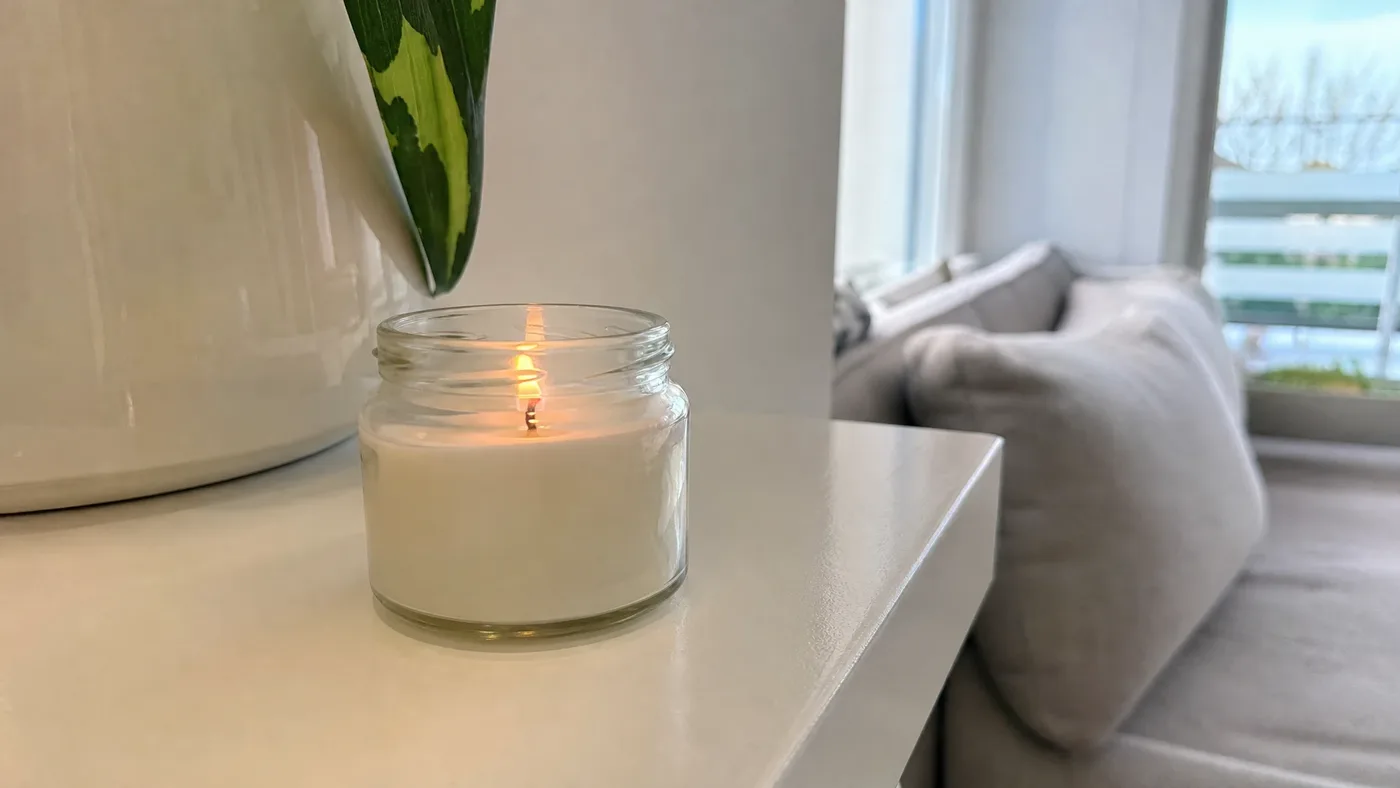
The flame is a surprisingly good teacher. A healthy flame is steady, about the size of a thumbnail or a little taller, and quiet. You can watch it for a while and see the melt pool slowly widening toward the edge of the jar. That calm, even picture is what you are chasing through all the testing.
The share of one material moves faster than you think
Here is a bit of arithmetic that makes the point. Pour 300 g of wax at an 8% fragrance load and you add 24 g of blend. If eugenol is 10% of that blend, you are adding 2.4 g, or 0.8% of the wax weight. Raise eugenol to 20% of the same blend and the total load has not changed, yet eugenol now makes up 4.8 g, or 1.6% of the wax. Those numbers are illustrations, not a recipe. They show why a quick blend swap deserves a fresh set of test candles.
A simple wick series
- Pick three wicks: your best estimate, one size down and one size up.
- Change only the wick. Same wax batch, same fragrance percentage, same vessel, same pour temperature.
- Label and rest. Record container, wick, date and load, then wait as long as the wax maker recommends before the first burn.
- Burn in sessions with a full cool-down between, and keep going through the life of the candle, not just the first night.
- Write down what you see after each burn: melt pool, flame height, mushrooming, soot and how hot the container gets.
- Pick the smallest wick that gives a full melt pool without soot or a hot vessel.
Wax matters just as much as fragrance. A wick sized for paraffin is not automatically right for soy, so run the series separately in each wax. Our wax comparison lays out how to set that up.
Still air first, then a draught
Soot is the part worth testing for twice. In a laboratory chamber study of five pillar candles, the authors found that wax and wick composition strongly influenced soot, particle-bound PAH and PM2.5 emissions, and that short-lived strong soot peaks appeared directly above the flame when air movement made the burn unstable (Andersen et al., Indoor Air, 2021). Their conclusion is that the whole burn matters and that avoiding unstable burning can lower exposure. The practical takeaway is easy: run your tests in still air, then do one more burn in a mild draught to see how the flame copes.
What you will notice, session by session
On the first burn a candle often looks better than it will later, because the wick is fresh and the jar is cold. Later burns are more honest: the jar is warmer, the pool is deeper, and any trouble with soot or mushrooming becomes easier to see. Keep a small mirror or a white card nearby to look at the flame from the side, and write down what you see before you forget it.
Give each session a clean start. Trim the wick short before you light it, let the candle cool completely, and choose a spot away from open windows. Those small steps make a series of results far easier to compare.
Burn tests need supervision
A wick test means candles burning for hours. Put them on a non-combustible surface, keep them away from anything that can catch, never leave them unattended and keep a way to put out a fire nearby. The fire side of the wax pot is covered in our flash point guide. If you plan to sell candles, how you test, label and document them is a question for a product-safety specialist.
Wicks, waxes and containers come from candle suppliers, who can often hand you a starting wick chart for their wax. For loads and rest times see our spiced candle post, and for a flame-free format see the wax melts guide. Weigh everything, write it down, and let the flame make the final call.
Sources & Further Reading
- Supplies for Candles. Wick Testing for Candle Makers, Complete Guide. suppliesforcandles.co.uk
- Andersen C et al., 2021. Emissions of soot, PAHs, ultrafine particles, NOx, and other health relevant compounds from stressed burning of candles in indoor air. Indoor Air. pubmed.ncbi.nlm.nih.gov/34297865