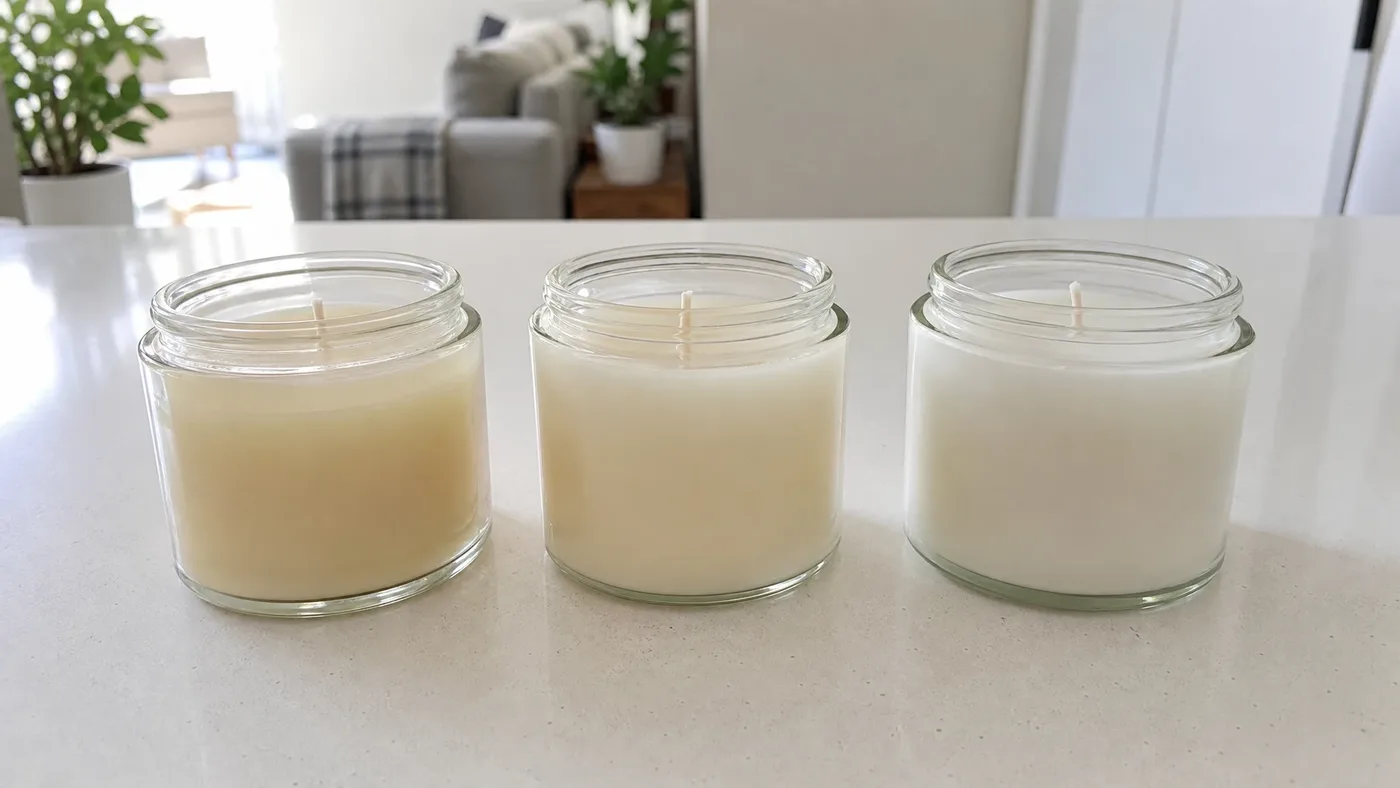
Eugenol in Soy, Paraffin and Coconut Wax: How to Compare
No published comparison tells you which wax is best for eugenol, and anyone who names a winner without a pour sheet is guessing. What the record does give you is a short list of wax-side facts (composition, load capacity, what soy does with vanilla-type materials) and a way to run the comparison on your own bench in a week. Our eugenol oil is a refined isolate sold undiluted, so every load calculation below is yours to make.

Start with what the wax is
Soy candle wax is hydrogenated soybean oil. Rezaei, Wang and Johnson, Journal of the American Oil Chemists' Society, 2002 describe it exactly that way ("referred to as soywax by candle makers") and burned it against paraffin and beeswax reference candles. Paraffin is a refined petroleum wax, a mixture of hydrocarbon molecules of roughly 20 to 40 carbons, per the encyclopedia entry we read (a secondary source; we could not fetch a primary one that states it plainly). Coconut waxes sold for candles are usually blends, and the blends differ: one supplier page we read describes IGI 6046 as "a proprietary blend of coconut wax and paraffin wax" (CandleScience lab notes), while a soy container wax such as Golden Brands GW 464 is described by its reseller as "an advanced blend of soy bean oil and specialized soy-based additives" (Voyageur Soap and Candle). The word "coconut" or "soy" on a label does not tell you what is in the pot. Ask the supplier for the technical data sheet.
Why a phenol might not behave like a hydrocarbon fragrance
This section is reasoning, not a measurement. Eugenol is 2-methoxy-4-prop-2-enylphenol (C10H12O2, molecular weight 164.20 in the PubChem record). The same record lists its pKa as 10.19, a log Kow of 2.49 and a miscibility with "oils" in the Merck Index entry it cites. So it has a free phenolic hydroxyl, a weak acid that can donate a hydrogen bond, on a moderately fat-loving molecule. Reasoning from that structure, a triglyceride wax (esters, with carbonyl oxygens that accept hydrogen bonds) offers eugenol something to hold on to that a straight-chain hydrocarbon wax does not. Whether that shows up as better retention, worse throw, or nothing you can measure is not something we found tested for eugenol in any wax. Treat it as the hypothesis your side-by-side is meant to check, not as a rule.
The discoloration question, and what is actually documented
The documented case is vanillin. A South African supplier's article says vanillin "oxidizes and undergoes a chemical reaction known as 'vanillin browning'" and that "soy wax is more prone to discoloration compared to other options like paraffin or coconut wax" (SA Candle Supply). That article does not mention eugenol. A second supplier page shows the dose effect: in CandleScience's IGI 6046 notes, a 12% load of a vanilla fragrance turned the wax "creamy yellow within 24 hours" and the wax showed areas where the fragrance seemed to separate, while a teakwood fragrance at the same wax caused no discoloration.
Why mention vanillin at all? PubChem gives vanillin as 4-hydroxy-3-methoxybenzaldehyde. Eugenol and vanillin both carry the same hydroxy-methoxy-benzene ring. Reasoning from that shared ring, and from our own How We Test page, which says eugenol darkens toward amber with air as "ordinary behaviour for a phenol", the practical consequence is to watch for yellowing in pale soy rather than assume it will not happen. No source we fetched says it will. Our darkening chemistry post and soap discoloration post cover the molecule's side of this; here the only point is that wax choice is one more variable.
What the wax maker's load limit does and does not tell you
Supplier load figures are totals for all fragrance in the wax, set by how much oil the wax will hold before it sweats or pools. The ones we read: GW 464, "about 9% max" with 7% to 9% recommended; IGI 6046, 6% to 8% recommended and up to 10% possible, with 12% needing "extra stirring"; and for wax melts CandleScience lists 25% for CocoSol, 12% for EcoSoya PB, 9% for IGI 6028 and 6% for IGI 4625 (CandleScience melt guide). None of these is a figure for eugenol, and the regulatory side is different again. In the IFRA Standard on eugenol, 51st Amendment, candles of all types fall in Category 12, which carries "No restriction" for eugenol (IFRA Standard, Eugenol, 2023; category assignment from the IFRA guidance). No restriction means IFRA does not cap it, not that the wax will carry it. The wax's own capacity is the practical ceiling. Limits change with amendments, so check the current one with your supplier or a regulatory specialist. For how much of a spice blend a candle usually carries, use our candle loads and rest times post; this one only picks the wax.
Run the side-by-side yourself
We publish no burn data, pour logs or throw ratings for eugenol in any wax, so what follows is a method, not a result. Use it before you commit to a pallet.
- Fix everything but the wax. Same container, same wick series and size per container, same fragrance blend by weight, same pour temperature band (your supplier's range for each wax, which will differ), same room.
- Weigh in grams to 0.1 g. Worked example, using a 300 g pour at a 7% total load: 300 x 0.07 = 21.0 g of fragrance. If eugenol is 10% of that blend, it is 2.1 g, which is 0.7% of the wax by weight. Record all three numbers every time.
- Add fragrance the way each supplier says. The two suppliers we read agree on melting to 185 F (85 C), removing from heat, adding fragrance and stirring about two minutes (flash point post covers why that temperature matters).
- Rest them. The suppliers' rest advice differs by wax: IGI 6046 at least three days, melts 1 to 2 weeks. Use each wax's own number and write it down.
- Judge cold throw, then hot throw. Cold throw is what you smell from the unlit candle; hot throw is what you smell with a melt pool formed. Score both at fixed times (for example 24 hours and one week cold; hour 1, 2 and 4 hot) with the same person, the same room and a blank for comparison.
- Look at the surface. Photograph each candle against a white card on day 1, day 7 and day 30. You are looking for yellowing, wet spots, beads of oil and frosting, which suppliers of some soy waxes say their additives reduce.
- Wick it separately. A candle that tunnels in one wax and soots in another is a wick result, not a scent result. See wicking and soot.
What soot data say about the wax decision
If soot matters to the people who burn your candles, two studies are worth knowing, both on candles that did not contain eugenol. The 2002 soy-versus-paraffin work reported that paraffin candles produced "a considerable amount of soot" while soywax candles produced little or none, and burned more slowly. A 2021 chamber study of five pillar candles with different waxes and wicks found that "the wax and wick composition strongly influenced emissions of BC, PM2.5, and particle-phase PAHs" (Andersen et al., Indoor Air, 2021). A 2021 Environment International study that combined four waxes with five fragrances in 24 chamber runs found most calculated indoor concentrations below guidance values, with exceptions for nitrogen dioxide, acrolein and benzo[a]pyrene in some cases (Salthammer et al., Environment International, 2021). Wax choice matters; wick choice matters at least as much; and none of it is eugenol data.
Who should skip this decision
If you sell candles, the wax, wick and fragrance system is a product you are responsible for. We sell only eugenol oil, not waxes, wicks or containers, so get those from a wax supplier and ask for the SDS and IFRA documentation for everything. For labelling, flame safety standards (see ASTM F2417 in the flash point post) and any commercial claim, talk to a regulatory specialist or attorney. Patch test anything that will touch skin and wash your hands after handling the undiluted oil.
Our eugenol oil is sold undiluted, to makers, so the wax choice is yours to prove on your own pour sheet. A week of side-by-side tests with weights written down will tell you more than any ranking of waxes can.
Sources & Further Reading
- Rezaei K, Wang T, Johnson LA, 2002. Combustion characteristics of candles made from hydrogenated soybean oil. J Am Oil Chem Soc. europepmc.org/AGR/IND500743523
- Andersen C et al., 2021. Emissions of soot, PAHs, ultrafine particles, NOx and other health relevant compounds from stressed burning of candles in indoor air. Indoor Air. pubmed.ncbi.nlm.nih.gov/34297865
- Salthammer T et al., 2021. Measurement and evaluation of gaseous and particulate emissions from burning scented and unscented candles. Environ Int. pubmed.ncbi.nlm.nih.gov/33964641
- PubChem, Eugenol (CID 3314), including vanillin (CID 1183) identifiers. pubchem.ncbi.nlm.nih.gov/compound/Eugenol
- IFRA, 2023. Standard on Eugenol, 51st Amendment, and Guidance for the use of IFRA Standards. ifrafragrance.org/IFRA_STD_035
- CandleScience. Lab notes: IGI 6046 coconut paraffin blend; How to make soy wax melts. candlescience.com/learning
- Voyageur Soap and Candle. Golden Brands GW 464 product page. voyageursoapandcandle.com
- SA Candle Supply. How vanilla affects wax. sacandlesupply.co.za
- Wikipedia. Paraffin wax (secondary source, composition only). en.wikipedia.org/wiki/Paraffin_wax