Eugenol Flash Point and Candle-Making Safety Margins
The number everyone asks for, eugenol's flash point, is not the number that sets how hot you can run a candle pot. The reference value is above 100 C (212 F) in a closed cup, and the usual wax-and-fragrance steps happen well under that. What decides your safety margin is the hot wax itself, the other oils in your blend, and whether anyone is watching the pot. This guide lays the temperatures side by side so you can see the margins, and it names who to ask for the judgment calls.
The temperature ladder
These are figures we read this session, converted to one scale. The conversion is plain arithmetic: C = (F - 32) x 5/9.
| What | F | C | Source |
|---|---|---|---|
| GW 464 soy wax, manufacturer pour range | 125 to 145 | 52 to 63 | Voyageur listing of the wax maker's range |
| Wax melt pour, one supplier | 170 | 77 | CandleScience melt guide |
| Fragrance addition, both suppliers | 185 | 85 | Voyageur, CandleScience |
| Eugenol flash point, NTP 1992 (method not stated) | 219 | 104 | PubChem |
| Eugenol flash point, closed cup | above 212 | above 100 | PubChem, citing the NFPA Fire Protection Guide to Hazardous Materials, 2010 |
| Eugenol boiling point | about 486 to 493 | 252 to 256 | PubChem records |
So at the 185 F (85 C) addition step, the cited flash point of the pure material sits at least 15 C above the wax. That is a margin on paper for eugenol alone. It does not describe your blend, which is where most of the trouble lives.
What a flash point is, and is not
An ILPI reference page defines flash point as the lowest temperature at which a liquid gives off vapor that forms an ignitable mixture in air, and fire point as the temperature at which the flame becomes self-sustained and keeps burning the liquid, usually a few degrees higher. The same page says a closed-cup test "usually results in a flash point that is a few degrees lower than in an open cup", so a flash point without its method is half a number. The PubChem record gives closed cup for one value and no method for the other, which is why we quote both. OSHA's rule at 29 CFR 1910.106 defines a flammable liquid as one with a flashpoint at or below 199.4 F (93 C). Reasoning from the cited closed-cup value of above 100 C, undiluted eugenol falls outside that definition. That is a workplace-regulation boundary, not a promise that it cannot burn.
We did not find an autoignition figure for eugenol in the sources we read, so we do not state one.
Why your blend is not eugenol
Reasoning from how mixtures behave, a fragrance blend can ignite at a lower temperature than its highest-flash ingredient, because the lighter components set the vapor. If the blend contains citrus or terpene oils, alcohols or other volatile materials, the number you need is on that blend's SDS, section 9, not eugenol's. The Voyageur page for GW 464 says to adjust the wax temperature if a fragrance has a low flash point. Ask every supplier for the SDS (we do not publish one on this site, so ask whoever sells you each ingredient) and learn how to read section 9 in our SDS reading guide.
Vapor pressure points the same way. PubChem's record lists 0.0221 mmHg at 25 C for eugenol (an HSDB entry citing van Roon et al., 2005), a low value. A material that evaporates slowly is not the part of your pour that releases ignitable vapor first. The wax pot, the heating source and the lighter components are.
Hazard classification, read from the record
The ECHA classification and labelling inventory summary in PubChem lists, for eugenol, signal word "Warning" and the irritant pictogram, with these hazard statements by share of notifiers: H317 (may cause an allergic skin reaction) 99.8%, H319 (serious eye irritation) 80.4%, H315 (skin irritation) 20.6% and H302 (harmful if swallowed) 17.3%, from 27 notifications covering 2,820 company reports. Notifiers do not all agree: a Japanese NITE-CMC entry from FY2025 on the same page adds statements for drowsiness, suspected carcinogenicity and aquatic toxicity. None of the statements in either list is a flammability statement. The takeaway is that your supplier's SDS is the document that governs your product, and the classification can differ between suppliers. Eugenol is also a recognised skin sensitiser: wear gloves, keep it off skin and out of eyes, and wash hands after handling, as our own safety copy says. See safe handling for the bench routine.
Hot wax: where the fire risk actually is
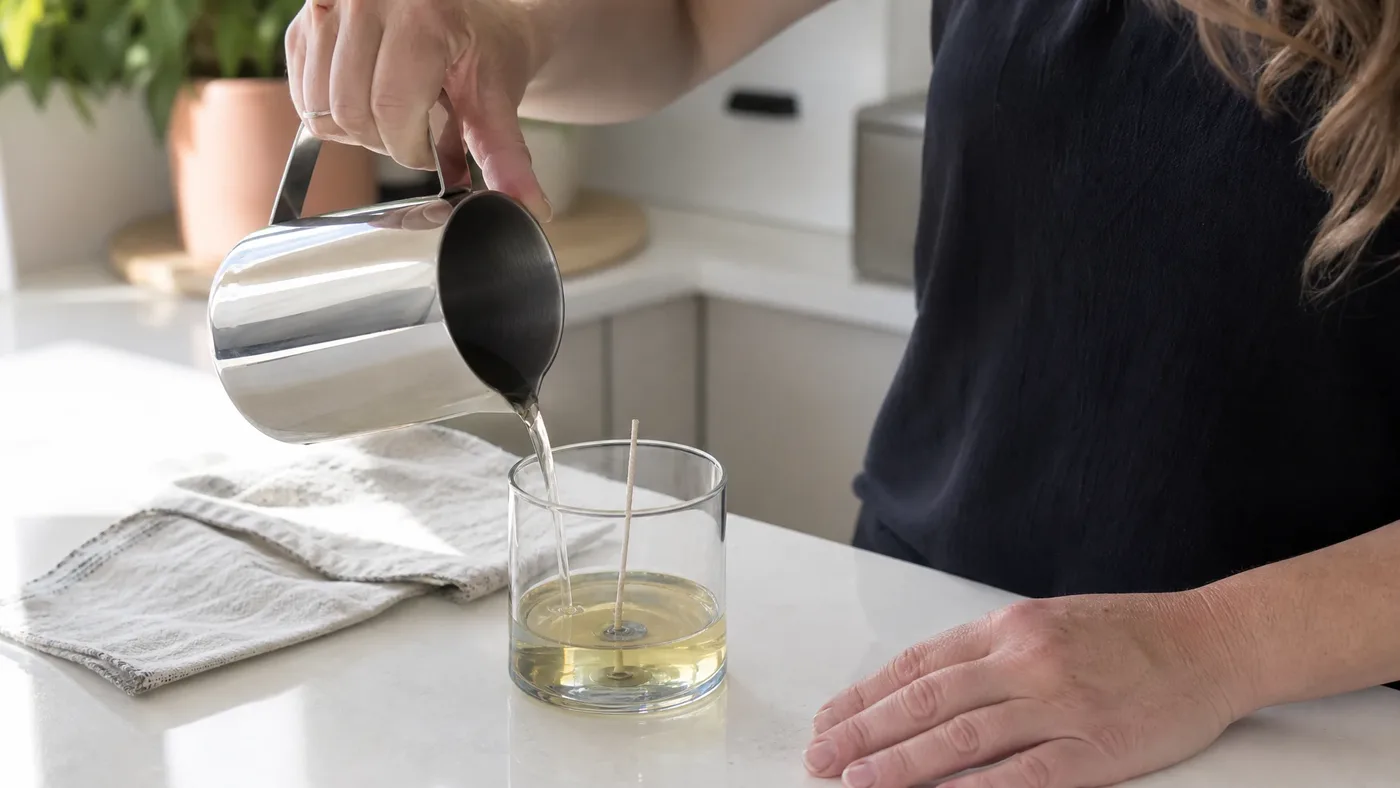
Wax is the fuel. The practical rules from the sources we read:
- Melt in a double boiler. SA Candle Supply's safety page says a double boiler "will help with not overheating or burning your wax."
- Keep an extinguisher within reach, and do not use water on a wax fire. The same page says to handle melted wax like cooking oil, because water on grease fires "can lead to splattering and burning." The page does not state an extinguisher class, so ask your local fire authority which type suits your setup.
- Remove from heat, then add fragrance. The Voyageur instruction for GW 464 is to melt to 185 F, take the pot off the heat, add fragrance and stir gently for about two minutes.
- Ventilate. The same safety page says to open doors and windows.
Wax temperature limits, wax flash points and extinguisher choices are on the wax supplier's SDS. We did not find one authoritative wax flash point in the pages we read, so we do not quote one.
The finished candle is a different standard
ASTM F2417, the fire-safety specification for candles, states its purpose as prescribing "minimum safety requirements for candles and candle ensembles" and says it does not replace "adult supervision, close monitoring, fire detection, alarm or suppression systems, and use of candles away from combustible materials" (ASTM F2417-24 scope page; the full requirements are paywalled and we have not read them). If you sell candles, whether and how you test to it is a question for a product-safety specialist or attorney, not something a blog can settle. Burn behaviour, including wick choice and soot, is covered in our wicking guide.
A check you can run before every pour
This is a procedure, not test data; we publish no burn or flash testing of our own.
- Write down the flash point and test method (open or closed cup) for the wax and for every oil in the blend from each SDS.
- Take the lowest figure. Compare it with your fragrance addition temperature, in the same units.
- If the margin is under whatever your safety adviser sets, cool the wax before adding fragrance rather than hoping.
- Measure with a thermometer, not by feel, and record it.
- Stay in the room while wax is above room temperature.
Who should skip DIY judgment here
Home hobby pours are small and the double-boiler rule covers most of the risk. Anyone making candles for sale, storing wax in quantity or working with open flame in a shared building should ask an industrial hygienist or fire-safety specialist and read their insurance terms. We sell only eugenol oil, not waxes, wicks or heating equipment. Nothing here is legal or safety advice. Standards and regulations change; check the current text.
Our eugenol oil is sold undiluted for fragrance work by makers. The flash point is one line on a data sheet; your habits at the pot are what keep a pour from becoming a fire.
Sources & Further Reading
- PubChem, Eugenol (CID 3314): flash point, boiling point, vapor pressure, and ECHA C&L summary. pubchem.ncbi.nlm.nih.gov/compound/Eugenol
- ILPI. Flash point and fire point reference page. ilpi.com/msds/ref/flashpoint
- US eCFR, 29 CFR 1910.106, Flammable liquids. ecfr.gov/1910.106
- ASTM International. F2417-24, Standard Specification for Fire Safety for Candles (scope page). store.astm.org/f2417-24
- Voyageur Soap and Candle. Golden Brands GW 464 product page. voyageursoapandcandle.com
- CandleScience. How to make soy wax melts. candlescience.com/learning
- SA Candle Supply. Candle making safety. sacandlesupply.co.za