
Calculating Total Eugenol in a Blend: A Worked Example
If a fragrance blend contains our eugenol oil, clove bud oil and a bay or cinnamon leaf oil, the eugenol in the finished product comes from all of them, and the only way to know the total is to multiply and add. The arithmetic is short. The hard part is the input numbers, because the eugenol share of a natural oil moves by 10 percentage points or more depending on the batch and on the instrument that measured it.
The formula, then a 100 g example
Total eugenol in the concentrate = the sum, over every ingredient, of (grams of ingredient) x (eugenol fraction of that ingredient). Divide by the total grams to get a percentage. Eugenol in the finished product = that percentage x the fragrance load of the product. Every number below is an illustration chosen to show the method. None is a recommended rate, and none is tied to a legal limit.
The invented blend is 100 g. The eugenol fractions for the natural oils come from papers we read for this article (sources below); the 98.0% for the eugenol oil is a placeholder, because our published COA reports no assay and we will not state one for our lot.
| Ingredient | Grams | Eugenol fraction used | Eugenol (g) |
|---|---|---|---|
| Eugenol oil (placeholder assay) | 4.0 | 0.980 | 3.920 |
| Clove bud oil (GC-MS mean of 7 batches) | 6.0 | 0.7506 | 4.504 |
| Clove leaf oil (GC-MS mean of 6 batches) | 2.0 | 0.8260 | 1.652 |
| West Indian bay leaf oil (one Egyptian oil) | 3.0 | 0.7087 | 2.126 |
| Everything else (citrus, patchouli, base) | 85.0 | 0 (assumed) | 0 |
| Total | 100.0 | 12.202 |
So this concentrate is 12.2% eugenol, even though only 15 g of it is a eugenol-bearing material by name. Mixed into a product at a 3% fragrance load (also a placeholder), the finished product carries 12.202 x 0.03 = 0.366 g of eugenol per 100 g, or 0.37% after rounding.
The reverse calculation is the one you use against a limit. Suppose a limit of L% eugenol in the finished product applied to your product category. The most concentrate you may use is L divided by the eugenol fraction of the concentrate. With a placeholder L of 0.10%, that is 0.10 / 0.122 = 0.82% concentrate in the product. We used 0.10% only so the division is easy to follow. Real category limits are set in the IFRA Standards, they change with each amendment, and IFRA's own page points to the 51st Amendment at the time we read it. Take the number for your category from the current Standard, or from a regulatory specialist, not from this table. For the rules themselves, see our IFRA explainer.
Where the input numbers come from, and how far they move
The clove figures above are from the EFSA feed-additive opinion on clove oils (EFSA FEEDAP Panel, EFSA Journal, 2023). It characterised seven batches of clove bud oil and six of clove leaf oil. For the bud oil it reports two different averages for the same seven batches: 82.7% eugenol by GC-FID (the specification method, range 81.78 to 84.00) and 75.06% by GC-MS (range 73.03 to 75.96). Leaf oil, six batches by GC-MS, averaged 82.60% (range 78.68 to 86.01). The panel's specification for bud oil is 67 to 85% eugenol, so a batch can sit well below the batch averages and still be in specification.
Three more data points show how loose a "typical eugenol percentage" is:
- A 2026 paper that distilled a Madagascan clove bud lot in a Clevenger apparatus reported 55.0% eugenol and 32.9% beta-caryophyllene by GC-MS peak area (Sytykiewicz et al., Molecules, 2026). One batch, a research lab, hydrodistillation of dried buds.
- A 2020 review states that eugenol is "about 85% to 92% of total clove oil content" (Batiha et al., Biomolecules, 2020), but we could not match that range to the reference the review attributes it to. The two sources disagree by about 30 points and neither is wrong about the sample it measured.
- One Egyptian West Indian bay leaf oil: 70.87% eugenol across 14 compounds (Eldahshan et al., Scientific Reports, 2025). That is the figure in the table.
Cinnamon leaf oil shows the opposite trap. A 2023 paper profiling a "Cinnamomum zeylanicum" leaf oil reported (E)-cinnamaldehyde at 72.98% as the main component, with benzyl benzoate and cinnamyl acetate next, not eugenol (Mutlu et al., Life, 2023). A review of alkenylbenzenes in plants describes eugenol as the main constituent of cinnamon leaf oil (Gotz et al., Plants, 2023). Same trade name, opposite chemistry. Reasoning from those two papers: never carry a textbook figure for "cinnamon leaf" into a spreadsheet. Use the lot's own analysis.
Percent of what? Most of these figures are GC area percent, which is not automatically weight percent. Area and weight agree only when the detector responds equally to every compound, and the EFSA bud-oil gap (82.7 against 75.06) shows what instrument choice alone can do. The calculation below inherits that uncertainty, so treat the result as an estimate with a range, not a point.
Sensitivity: change one input and watch the total
Keep the same 100 g recipe and change only the 6.0 g of clove bud oil:
- At the GC-FID mean (82.7%): 4.962 g, so the concentrate is 12.66% eugenol.
- At the GC-MS mean (75.06%): the original 12.20%.
- At the bottom of the specification (67%): 4.02 g, so 11.72%.
- At the Madagascan research lot (55.0%): 3.30 g, so 11.00%.
A spread of 11.0% to 12.7% is about 15% relative, from one ingredient. If your compliance margin is thinner than that, the answer is a batch analysis of the oil you actually bought, or a GC quantification of the finished concentrate from an analytical lab, not a better average. If you are checking against a ceiling, the conservative direction is to use the highest plausible eugenol fraction for each ingredient and to round the final dose down.
What else rides along: methyl eugenol and eugenyl acetate
The same table can be run for any constituent. The EFSA batches carried methyl eugenol: all seven bud batches at 0.039 to 0.128% (average 0.078%), and four of six leaf batches at 0.010 to 0.030%. Run the calculation for 6 g of bud oil and 2 g of leaf oil and that is under 0.01 g in 100 g. Now add the bay oil. The alkenylbenzene review lists methyl eugenol in West Indian bay leaf oil from 0 to 64%, with 43% in one oil and 0 to 12% in commercial bay oil. At 43%, the 3 g of bay in the example brings 1.29 g of methyl eugenol, which is about 99.6% of the blend's total of 1.295 g. At the 12% commercial top end it is still 0.36 g. The point is not that bay is a bad ingredient. It is that the ingredient you chose for its eugenol can dominate a different constituent you were not tracking. Our comparison, eugenol vs methyl eugenol, covers why that constituent is regulated.
Eugenyl acetate, a clove constituent, was added to the EU labelling list by a 2023 amendment, according to a 2024 dermatology review (Sukakul et al., Acta Dermato-Venereologica, 2024). If you sell in the EU or UK, a clove-heavy blend may need an allergen line you did not have before. Our labelling post goes through it. We read the dermatology review, not the regulation itself, so confirm the wording with a regulatory specialist.
Build it as a spreadsheet
One row per ingredient. Columns: name, supplier lot, grams, eugenol fraction, source of that fraction (certificate, GC report, or "paper"), eugenol grams (= grams x fraction), then a total row. Add a second block of columns for each other constituent you track. Rules that save you from errors:
- Work in grams, not drops or millilitres. If you start from volume, convert with density. The COA on our shop page reports a relative density of 1.065 at 20 C for the batch it covers, so 1.00 g is about 0.94 mL for that material.
- Keep the fraction cell separate from the gram cell, so changing a lot updates one cell.
- Do not round until the last step, then round the dose down.
- Store the certificate with the row. A fraction with no document behind it is a guess.
- If a product has two uses (a candle that is also a wax melt, say), run the calculation against the stricter of the two category limits.
We have not run this sheet against a real formula, and we have no customer or bench data to publish. What is here is the arithmetic plus published composition data. A cosmetic chemist or regulatory specialist should sign off a formula that you intend to sell.
Where our eugenol oil fits
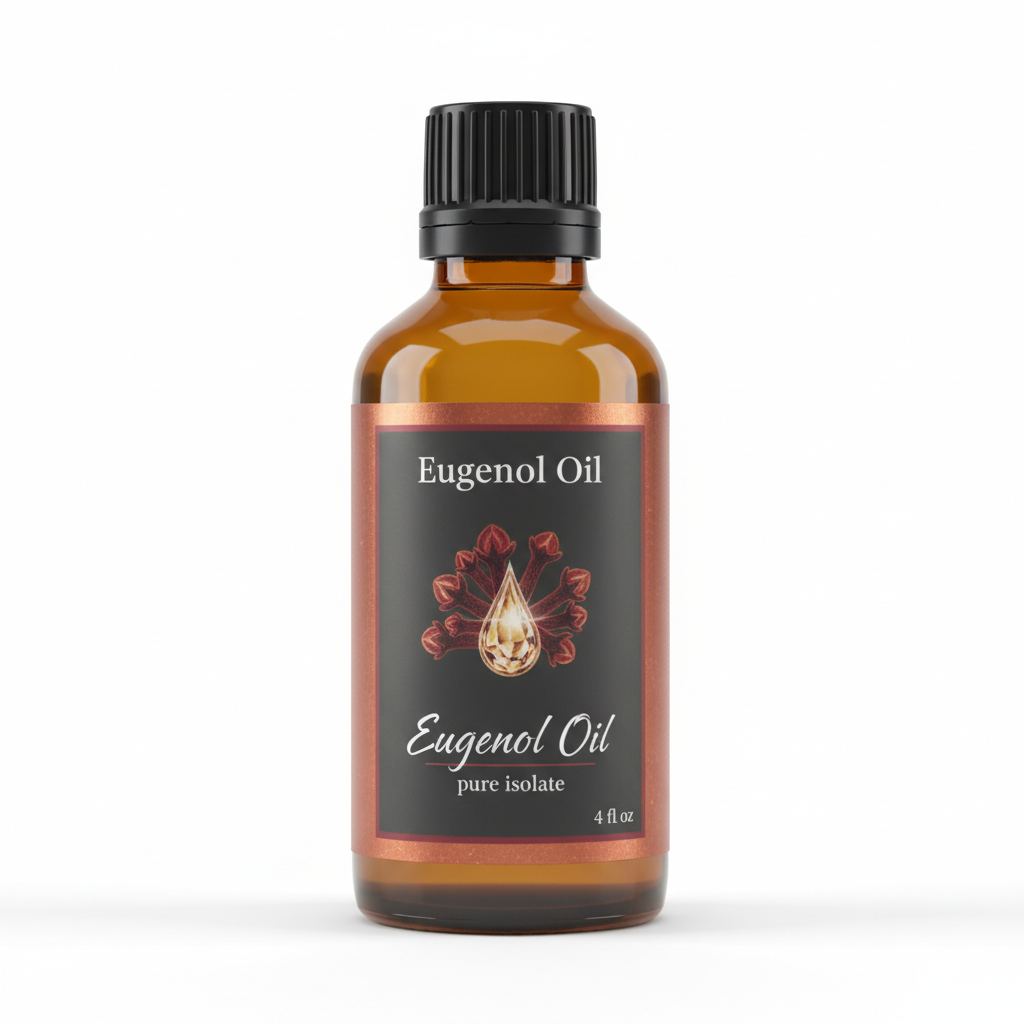
Our eugenol oil is a refined isolate from clove oil, sold undiluted, so the dilution maths above is yours. It is not an essential oil and it is not a stronger clove oil. The published COA on our shop page reports physical parameters (density 1.065 and refractive index 1.541, both at 20 C) for one batch and no assay or GC result, so before you put our material in the first row you need the assay for your lot. Ask for it in writing. Why that matters and how to read it is in our COA guide, and for clove oil composition by plant part see our clove oil content post.
The sum is simple, and the work is in the inputs: get a lot-specific analysis for every eugenol-bearing ingredient, keep the sheet, and round in the conservative direction.
Sources & Further Reading
- EFSA FEEDAP Panel, 2023. Safety and efficacy of feed additives consisting of essential oils derived from the flower buds or the leaves of Syzygium aromaticum (clove bud oil and clove leaf oils). pubmed.ncbi.nlm.nih.gov/37522096 (full text: PMC10375362)
- Sytykiewicz H, et al., 2026. GC-MS profiling of basil and clove essential oils and their binary mixtures. Molecules. pmc.ncbi.nlm.nih.gov/articles/PMC13609182
- Batiha GE, et al., 2020. Syzygium aromaticum L. (Myrtaceae): traditional uses, bioactive chemical constituents, pharmacological and toxicological activities. Biomolecules. pmc.ncbi.nlm.nih.gov/articles/PMC7072209
- Eldahshan OA, et al., 2025. Chemical profile of essential oil from Pimenta racemosa leaves. Scientific Reports. pubmed.ncbi.nlm.nih.gov/40841731
- Mutlu M, et al., 2023. Comprehensive metabolite profiling of cinnamon (Cinnamomum zeylanicum) leaf oil. Life. pubmed.ncbi.nlm.nih.gov/36676085
- Gotz ME, et al., 2023. Occurrence of alkenylbenzenes in plants: flavours and possibly toxic plant metabolites. Plants. pubmed.ncbi.nlm.nih.gov/37299054 (full text: PMC10255789)
- Sukakul T, Bruze M, Svedman C, 2024. Fragrance contact allergy: a review focusing on patch testing. Acta Dermato-Venereologica. pmc.ncbi.nlm.nih.gov/articles/PMC11334351
- IFRA, undated (read 2026-10-23). Understanding IFRA Standards. ifrafragrance.org/understanding-standards