Eugenol Skin Sensitization: What Makers Should Know
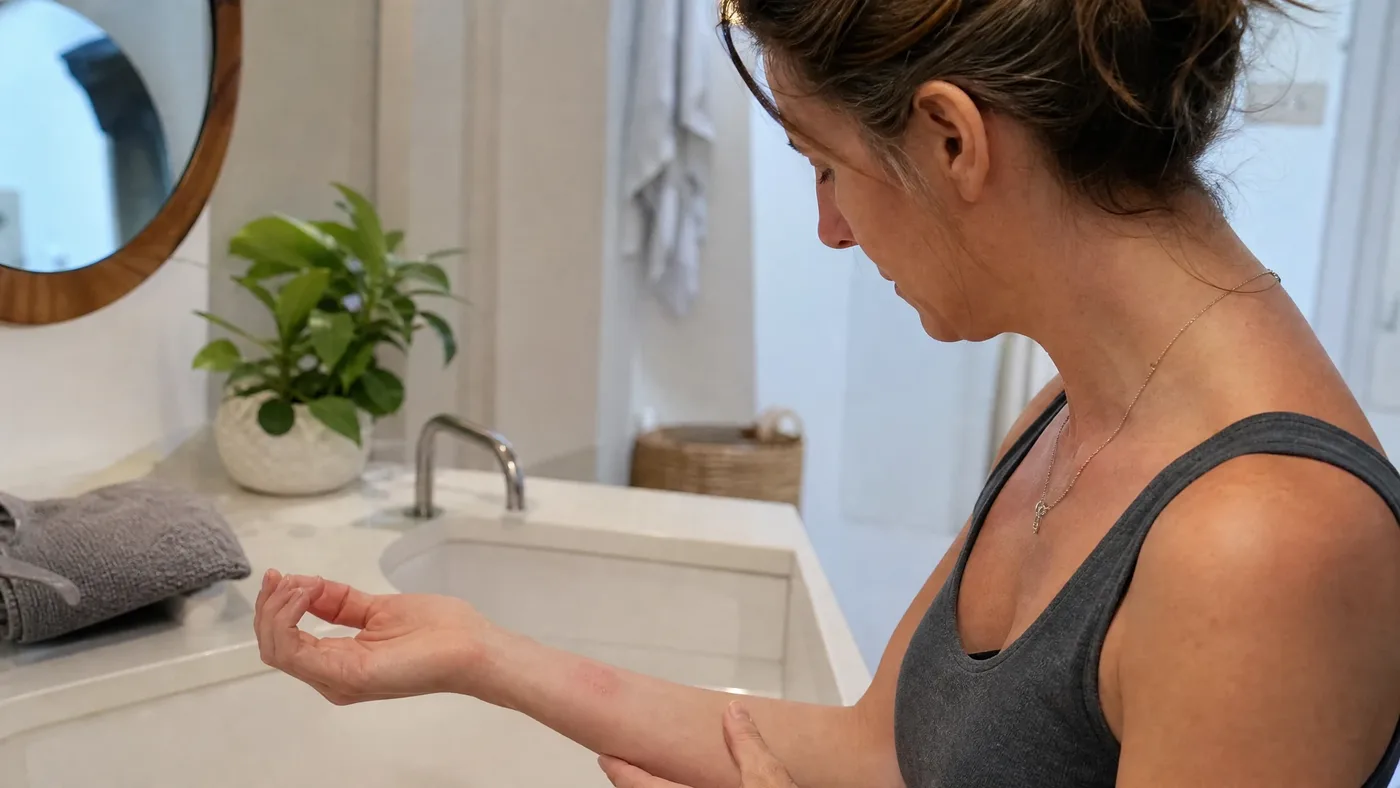
A patch test that comes back clean on your forearm does not clear you for eugenol, and a rash you get this week may not be irritation at all. Eugenol is a recognised fragrance allergen, and allergy works differently from irritation: it is an immune memory that builds up, and once built it is usually permanent. For a maker who handles the neat material, that difference is the whole risk.

First question: irritation or allergy?
DermNet describes allergic contact dermatitis as a type IV (delayed) hypersensitivity reaction. A person is first sensitised, usually without symptoms, and later contact triggers the rash, typically 24 to 72 hours afterwards; "sensitisation is usually life long" (DermNet, reviewed August 2025). Irritant dermatitis is direct damage to the skin, not an immune reaction, and it can affect anyone exposed enough. Irritation does not need a first sensitising exposure. Allergy follows the delayed pattern: a red, itchy patch a day or two after contact, in a spot that touched the material. Sorting out which one you have is a job for a dermatologist, not for a forum post or for us.
How eugenol becomes an allergen
A 2024 dermatology review calls eugenol and isoeugenol "prohaptens": the skin has to convert them into reactive forms before the immune system sees them, unlike linalool and limonene, which need air oxidation first (Sukakul et al., Acta Dermato-Venereologica, 2024). A 2023 laboratory study in reconstructed human epidermis, not in people, found that with a peroxidase added both molecules behaved as prohaptens, while under simulated sunlight the data pointed toward a "prehapten" route (Port-Lougarre et al., Chemical Research in Toxicology, 2023). The practical meaning is limited: the mechanism is chemical reactivity, not an impurity. A cleaner lot is not automatically a non-sensitising one.
On potency, a 2004 Japanese study classified eugenol as a "mild" sensitiser in guinea pig maximisation testing and gave an EC3 of 25.1% in a modified mouse local lymph node assay (a higher EC3 means a weaker sensitiser) (Takeyoshi et al., Journal of Applied Toxicology, 2004). That study used eugenol and two lab-made dimers, not aged oil, and mice are not people. We found no source that tests whether darkened, air-exposed eugenol sensitises more or less than fresh material, so we will not guess.
What human data say, and where they disagree
Here the sources do not agree, and the disagreement is worth knowing.
- 1984, industry patch-test survey. Fragrance and formulation companies pooled 11,632 patch tests on eugenol, consumer products and fragrance blends containing eugenol or clove leaf oil. They found one case of induced hypersensitivity and one case of pre-existing sensitisation, at eugenol patch concentrations of 0.05% and 0.09%, and both people also reacted to eugenol and isoeugenol mixtures. The authors concluded eugenol alone or in clove leaf oil has "a very low potential" at consumer-product concentrations (Rothenstein et al., Food and Chemical Toxicology, 1984). Note the source of the data and the age.
- 2012, repeated open application test. Eugenol-sensitised and non-sensitised volunteers were patch tested and then did a 3-week repeated open application test (ROAT) at concentrations at or below the IFRA standard then in force. None reacted in the ROAT, even among those with positive patch tests. The authors added that whether this reflects a false negative "for a weak allergen is unknown" (Svedman et al., Dermatitis, 2012).
- 2023, a larger ROAT. Sixty-seven subjects from six European clinics did a 21-day, twice-daily ROAT with three dilutions of eugenol from 2.7% to 0.5% and a control, with patch tests at 17 dilutions from 2.0% down to 0.00006%. Of 34 subjects with contact allergy to eugenol, 61.8% (21) had a positive patch test before the ROAT, the lowest positive concentration was 0.031%, and the ROAT was positive in 19 (55.9%). Time to a positive reaction fell as the concentration rose. In 13 of the 34, a repeat patch test was not reproducible, yet 4 of those 13 still had a positive ROAT. The authors conclude that eugenol can provoke a positive patch test at a very low dose and that hypersensitivity may persist even when an earlier positive test is not reproducible (Ofenloch et al., Contact Dermatitis, 2023).
Reading these together: all three tested different concentration ranges on different people, and we cannot reconcile them from abstracts. What they agree on is that sensitised people can react to low concentrations, and that a single test is a weak guide. In clinic populations the problem is common enough to measure: a southern Sweden series patch tested 3,539 dermatitis patients from 2016 to 2020 and found fragrance contact allergy in 13%, with about 10% of those cases missed unless individual fragrance ingredients were tested (Sukakul et al., Contact Dermatitis, 2022). Those were people referred for dermatitis, so the 13% does not describe the general public.
The maker's exposure problem (reasoning, not data)
We found no occupational study of eugenol allergy in candle or soap makers. The 2024 review lists occupational dermatitis reports on essential oils, bath bombs and massage therapists, where it says isoeugenol, not eugenol, ranked among the most common causes. Reasoning from the 2023 result that time to reaction falls with concentration, the largest dose a maker meets is the neat material at the bench, not the finished candle or soap. EFSA's 2023 opinion on clove oils reaches a similar practical conclusion for handlers: it treats clove bud and leaf oils as skin and eye irritants and as skin sensitisers, and advises minimising user exposure (EFSA FEEDAP Panel, 2023). That was a feed-additive opinion about clove oils, not about an isolate, so applying it to eugenol oil is an inference. The inference is reasonable, because eugenol is the dominant component.
What we say, and where our own copy is inconsistent
Our eugenol oil is a refined isolate from clove oil, sold undiluted. Our shop copy says to dilute to 0.5% to 2% in a carrier for skin use and to patch test; our How We Test page says "eugenol is a recognised skin sensitiser" and that fragrance-industry guidance puts the ceiling around half a percent in leave-on products. Those two statements do not match, and we cannot resolve them from the sources above. For anything you sell to other people, use the lower reading, take the current limit for your product category from the IFRA Standards (our IFRA explainer), and ask a toxicologist to confirm it.
On patch testing: if you do a home patch test, treat it as a minimum, not a clearance. The 2023 trial's non-reproducible results (13 of 34) mean a negative or fading test does not prove you are not allergic. A proper patch test with eugenol in a calibrated series is done by a dermatologist or allergist. Our "patch test first" line is a floor, and we would rather say that than let it sound like a safety check.
Who should skip it, and what to tell customers
- Anyone with a known fragrance allergy or a positive fragrance-mix patch test should not work with it or buy products containing it. Ask your dermatologist which allergens you reacted to, because eugenol and isoeugenol both sit in the standard fragrance mix.
- If you develop a rash after handling it, stop and see a dermatologist. Do not keep testing yourself.
- Keep it away from eyes, children and pets, as our copy says, and wash hands after handling. Wear gloves at the bench. That is general handling practice, not data from us.
- For customers: say the product contains eugenol, name it on the label where the market requires it (labelling rules), and do not describe a product as hypoallergenic. Handling guidance is in safe handling, and the regulatory overview is in our compliance guide.
We have no customer data, no reaction reports and no tested products to add to this picture. What is above is what the published studies show, with the gaps named, and the final judgment on a formula belongs to a toxicologist or dermatologist.
Sources & Further Reading
- DermNet, reviewed August 2025. Allergic contact dermatitis. dermnetnz.org/topics/allergic-contact-dermatitis
- Sukakul T, Bruze M, Svedman C, 2024. Fragrance contact allergy: a review focusing on patch testing. Acta Dermato-Venereologica. pmc.ncbi.nlm.nih.gov/articles/PMC11334351
- Port-Lougarre Y, et al., 2023. Antioxidant activity and skin sensitization of eugenol and isoeugenol. Chemical Research in Toxicology. pubmed.ncbi.nlm.nih.gov/37922503
- Takeyoshi M, et al., 2004. Assessment of the skin sensitization potency of eugenol and its dimers using a non-radioisotopic LLNA. Journal of Applied Toxicology. pubmed.ncbi.nlm.nih.gov/14745850
- Rothenstein AS, et al., 1984. Eugenol and clove leaf oil: a survey of consumer patch-test sensitization. Food and Chemical Toxicology. pubmed.ncbi.nlm.nih.gov/6686576
- Svedman C, et al., 2012. Does the new standard for eugenol designed to protect against contact sensitization protect those sensitized from elicitation of the reaction? Dermatitis. pubmed.ncbi.nlm.nih.gov/22653067
- Ofenloch RF, et al., 2023. Allergic reactivity for different dilutions of eugenol in repeated open application test and patch testing. Contact Dermatitis. pubmed.ncbi.nlm.nih.gov/37218587
- Sukakul T, et al., 2022. Simultaneous patch testing with fragrance markers in the baseline series and the ingredients of fragrance mixes: an update from southern Sweden. Contact Dermatitis. pubmed.ncbi.nlm.nih.gov/35152428
- EFSA FEEDAP Panel, 2023. Safety and efficacy of feed additives consisting of essential oils from Syzygium aromaticum. EFSA Journal. pubmed.ncbi.nlm.nih.gov/37522096