Eugenol in Melt and Pour Soap: Base Limits, Heat, and Labels
In melt and pour, the base maker sets your eugenol ceiling before any regulation does. One widely stocked base lists a 1% maximum for fragrance, so even if every drop of that fragrance were eugenol you could add 10 g to a kilogram of base, and a spice blend will use a fraction of that. That cap, the base's melt and pour temperatures, and what the finished bar is legally called are the three things to settle before you buy a bottle of eugenol oil for this job.

Step 1: read what the base maker allows
We have no melt and pour batches of our own, so the figures below come from one retailer's pages for Stephenson bases. They are examples of what a base maker publishes, not a rule for every base, and your base's own sheet overrides them.
- The Stephenson No Sweat White base is listed with aqua, sorbitol, sodium stearate, sucrose, propylene glycol, sodium laureth sulfate, sodium laurate and glycerin. The page says: "Keep total additives to no more than 3% of the soap base, including a maximum fragrance level of 1%." Melt at about 75 C (149 F), pour at 68 to 72 C (154 to 162 F), and avoid overheating because excess heat may darken the soap (Voyageur Soap & Candle product page).
- The Stephenson High Clarity Vanilla Stable base is listed with aqua, glycerin, propylene glycol, sodium stearate, sodium laurate, sodium laureth sulfate and sodium thiosulfate, melts at 54 C (129 F), and is described as stable with "up to 2% of most vanilla or vanillin containing fragrances" (Voyageur Soap & Candle product page).
Two things follow. First, the 1% cap covers the whole fragrance, so eugenol is a share of it. Second, a base maker had to build a separate product to reduce the darkening that vanilla fragrances cause, which tells you colour drift from a fragrance ingredient in these bases is real enough to engineer around. That page speaks about vanilla, not eugenol. Whether a given base darkens with eugenol is a question for the base maker, and we have no data to answer it.
Step 2: the arithmetic for a pour
Mass of eugenol = base grams x fragrance fraction x eugenol share. With a 1% fragrance cap, the table shows the ceiling and what a small eugenol share looks like (illustrative arithmetic, not a recommended rate).
| Base weight | Max fragrance at 1% | Eugenol at 5% of fragrance | Eugenol as % of base |
|---|---|---|---|
| 454 g (1 lb) | 4.5 g | 0.23 g | 0.05% |
| 1,000 g | 10 g | 0.5 g | 0.05% |
| 2,000 g | 20 g | 1.0 g | 0.05% |
These quantities are fractions of a gram on a small pour, which is a practical problem: use a 0.01 g scale, or make a diluted stock (1 g eugenol with 9 g of a carrier you have confirmed is compatible with your base) and weigh the stock. Our blend calculation post covers the general calculation. The same regulatory ceiling applies as for any soap; our usage rate post explains how to work from your certificate's category limit down to grams. We state no eugenol percentage here, because we could not open the official IFRA text this session. Check the current IFRA amendment, and ask a regulatory specialist when you sell.
Step 3: temperature and why the numbers matter
Add fragrance after the base is melted and before you pour, at the base's pour window, with gentle stirring, and no hotter than needed. Two reasons.
- The base maker warns that overheating may darken the soap, so a hotter melt buys you a colour risk.
- Volatility. PubChem's record for eugenol lists flash points of 219 F (about 104 C, NTP, 1992) and above 212 F (above 100 C, closed cup, NFPA 2010) (PubChem, eugenol). That is the neat material. A pour at 68 to 72 C sits below it, but a blend with lighter materials, orange oil for instance, has its own flash point, and the SDS for each is the document to read. Our SDS reading post goes through that.
Step 4: the colour and sweat check (a method, not our data)
No test data from us is published. Here is a procedure that would settle the question for your base:
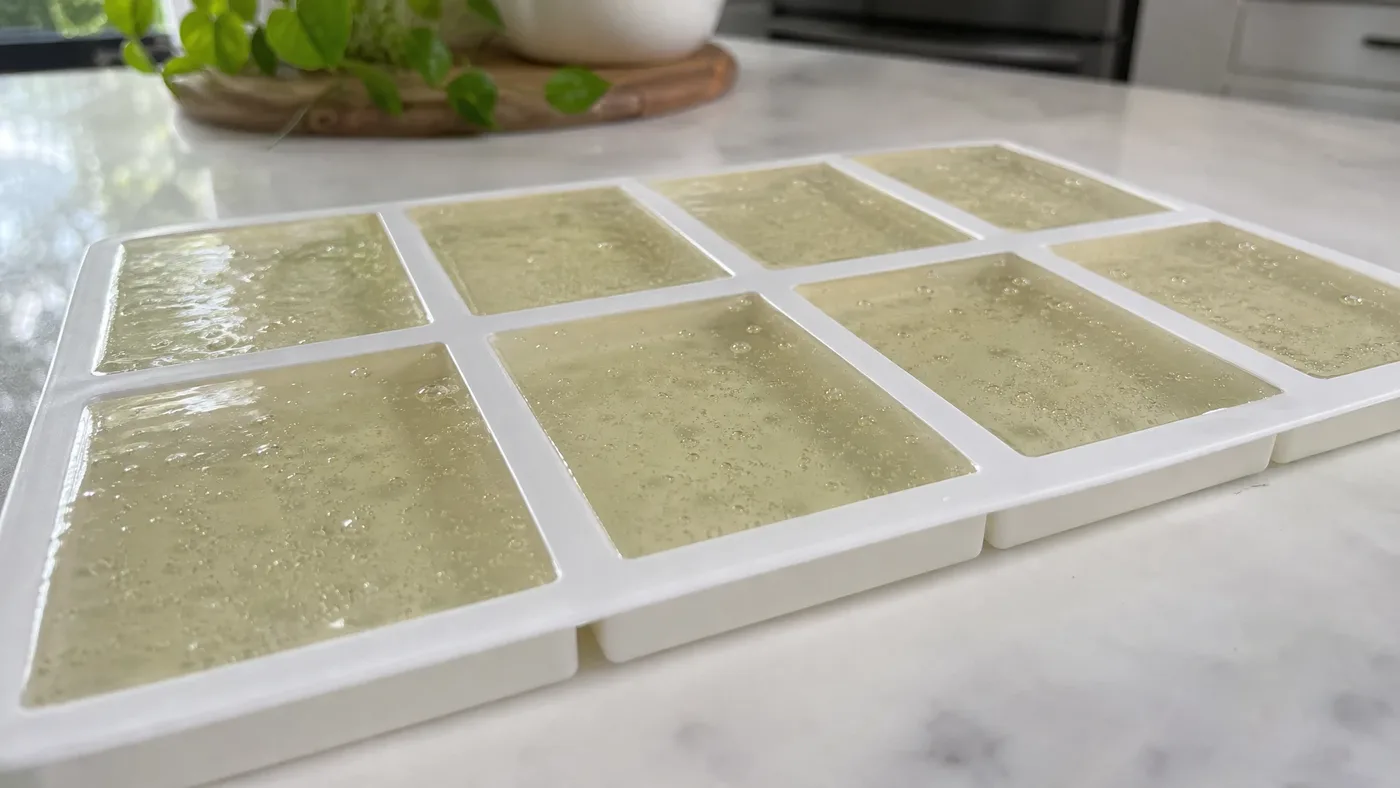
- Pour four small cavities from the same melt: unscented control, your eugenol blend at the intended rate, the same blend at half that rate, and one at the base's maximum fragrance with no eugenol.
- Photograph each against a white card in the same light at 24 hours, one week and four weeks. Compare to the control, not to memory.
- Leave one set unwrapped in a humid room, since the maker of the No Sweat base notes that results vary with humidity, added ingredients and storage, and recommends testing before larger batches. Glycerin-rich bars attract water, so beads on the surface are a base issue to separate from a fragrance issue, which is why the control matters.
- Record the scent only on bars that stay unwrapped for a week, then wrapped.
If the eugenol cavity darkens relative to the control, call the base maker with the photographs. Reasoning from eugenol's acid strength (a pKa of 10.19 at 25 C, PubChem), a base with a pH around or above 10 would put some of the eugenol in its phenolate form. We did not find the pH of these bases, and we have no evidence that this drives colour change in melt and pour, so treat that as a hypothesis to ask the maker about. Our cold process discoloration post covers a related effect in a different process.
Step 5: what is the bar called?
If you sell it, the label depends on the product's category. The FDA says a product that contains synthetic detergents is a cosmetic, not a soap, and a product intended for moisturising or making the user smell nice is also a cosmetic; disease claims make it a drug (FDA, Frequently Asked Questions on Soap). Both Stephenson bases above list sodium laureth sulfate, a synthetic detergent. Reasoning from the FDA's own sentence, a bar made from either would be a cosmetic, with the ingredient labelling that follows. Whether yours is, and what the label must say, is for a regulatory specialist. In the EU and UK, eugenol is a fragrance allergen that must be declared above set thresholds (per our How We Test page); we have not read the regulation, so look up the current figure.
Who should skip this
Skip eugenol in bars for children, for anyone with a known fragrance allergy, or marketed for skin problems; see a dermatologist or allergist. We sell only eugenol oil: not bases, scales, colourants or moulds. Use small amounts, wash your hands after handling the neat oil, and keep it away from eyes, children and pets.
The practical order is: base sheet first, regulatory limit second, scent third, and a four-cavity pour before the full batch. Our eugenol oil is an undiluted isolate, so every percentage above is yours to calculate.
Sources & Further Reading
- Voyageur Soap & Candle (retailer page for Stephenson), n.d. No Sweat White Melt & Pour Soap. voyageursoapandcandle.com
- Voyageur Soap & Candle (retailer page for Stephenson), n.d. High Clarity Vanilla Stable Melt & Pour Soap. voyageursoapandcandle.com
- U.S. FDA. Frequently Asked Questions on Soap. fda.gov
- NCBI PubChem. Eugenol (CID 3314), flash point and dissociation constant records. pubchem.ncbi.nlm.nih.gov/compound/3314