Eugenol Usage Rate in Soap: Work Backwards From the Limit
The usage rate for eugenol in soap is not a scent decision. A soap maker can set a fragrance load by nose, but eugenol is a recognised skin sensitiser, so its ceiling comes from the regulatory limit for the product category, and your nose only gets to choose something below it. This page is the arithmetic for getting from a limit to grams on the scale, written for a maker at the bench.
Three ceilings, and the lowest one wins
Every eugenol-containing soap has three separate ceilings, and a common mistake is to read only the one that is easiest to find.
- The regulatory ceiling. The fragrance industry's IFRA Standards sort finished products into numbered categories, and bar soap sits in a rinse-off category in the supplier compliance sheets we read. We could not open the official IFRA Standard text or a eugenol entry this session, so this page states no eugenol percentage. The IFRA Standards Library is the searchable database to check, and limits change with each IFRA amendment, so read the current one. Our IFRA explainer covers how to read it.
- The scent ceiling. Eugenol is dominant. Past some point you are not making a spiced soap, you are making a one-note soap, and the point is far lower than most fragrance loads.
- The process ceiling. In cold process, eugenol affects colour and speed of trace. That is covered in our cold process discoloration and acceleration post, and it is not repeated here.
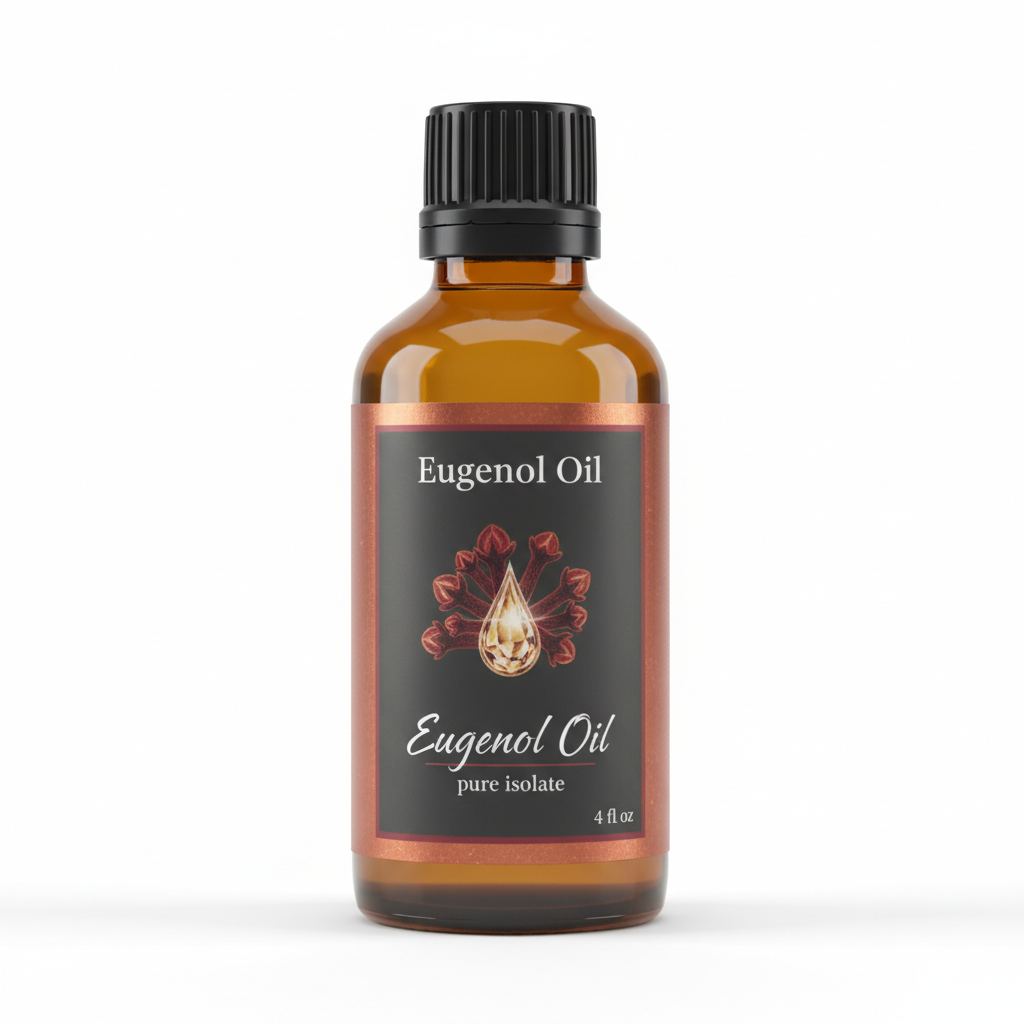
Our own shop copy says to follow fragrance-industry dilution guidance for soap and to use small amounts. We sell the eugenol oil only, undiluted, so the percentage arithmetic below is yours to do against the limit on your supplier's IFRA certificate and SDS.
Step 1: pick the basis, because soap people and IFRA count differently
Soap suppliers state fragrance as a fraction of the oils. Wholesale Supplies Plus lists its cold process test recipe with fragrance at ".7 to 1 oz per lb = 4 to 6%" against a sample recipe whose oils total 16 oz, so the percentage there is on oil weight (the page does not say so in words; that is our reading of its numbers). Soap Queen's 2015 scent-fading article suggests 0.8 oz per pound for a strong scent, which is 5.0% by the same arithmetic. The two sources differ slightly (0.7 to 1 oz versus 0.8 oz) and both stress that the figure varies by fragrance and sits inside regulatory limits.
The regulatory limit is a different kind of number. Reasoning from how supplier certificates present it, a category limit is a percentage of the finished product, not of the oils. Confirm the basis stated on your own certificate. The mass of a finished bar is larger than the oil mass, since it also carries the lye-derived soap mass, glycerin, and leftover water. So if you divide a limit across your oil weight instead of your finished bar weight, you get a lower allowance than you are entitled to, which errs on the cautious side. We would take that trade-off over the reverse.
Step 2: the formula
Three multiplications, nothing more:
- Fragrance grams = oil grams x fragrance rate
- Eugenol grams = fragrance grams x eugenol share of the fragrance blend
- Eugenol as a percentage of oils = eugenol grams / oil grams x 100
Unit conversion: 1 lb is 453.6 g, and 1 oz is 28.35 g. The table below is illustrative arithmetic at a 5% fragrance load (inside the 4 to 6% range above) and a 5% eugenol share of that fragrance. It is not a recommended rate and not a limit.
| Oil weight | Fragrance at 5% | Eugenol at 5% of fragrance | Eugenol as % of oils |
|---|---|---|---|
| 454 g (1 lb) | 22.7 g | 1.1 g | 0.25% |
| 500 g | 25.0 g | 1.25 g | 0.25% |
| 907 g (2 lb) | 45.4 g | 2.3 g | 0.25% |
| 1,000 g | 50.0 g | 2.5 g | 0.25% |
The last column does not change with batch size. That is the point of working in percentages: scale the batch and every row passes or fails the limit together.
Step 3: work backwards from the limit
The better way to use a limit is in reverse. Start with the ceiling and compute the maximum eugenol mass, then fit your blend under it. The placeholders below (0.1%, 0.5%, 1%) are invented to show the method. They are not eugenol's limit, and none of them should be read as a soap rate.
| Placeholder limit L | Max eugenol in a 1,000 g oil batch | At 50 g of fragrance, max eugenol share |
|---|---|---|
| 0.1% | 1.0 g | 2% |
| 0.5% | 5.0 g | 10% |
| 1.0% | 10.0 g | 20% |
Replace the placeholder with the figure on your certificate, and the same two columns give you your own ceiling. The second column is the number to write on the batch sheet. If the real figure is near the 0.1% row, your eugenol share has to stay very small, and that changes what kind of soap you can build.
The trap: eugenol you did not add on purpose
The eugenol in a blend is not only the bottle labelled eugenol. Clove, cinnamon leaf, and several other spice oils carry it as a major component, and your allowance is for the total. A 2017 paper by Cantó Catalá and Blázquez Ferrer ran GC-MS on seven commercial cinnamon oils from a pharmacy and supermarkets, and reported eugenol as 81.51% of the one commercial leaf oil in the set (Nereis, 2017). That is one lot, so your own lot will differ; ask the supplier for a GC report.
Worked example, with that single figure: 6 g of cinnamon leaf oil contributes 6 x 0.8151 = 4.9 g of eugenol. Add 4 g of added eugenol and the batch carries 8.9 g, or 0.89% of a 1,000 g oil batch. Against the 0.5% placeholder row that would fail by a wide margin, even though the "eugenol line" on the sheet reads only 4 g. Our spiced soap structures post builds the full blend; our blend calculation post does the general case.
Is soap the rinse-off category you assume?
Whether your product counts as "soap" depends on what you sell and how. The FDA FAQ says a product with synthetic detergents is a cosmetic, not a soap, and that a product intended for purposes such as moisturising or making the user smell nice is a cosmetic (FDA, Frequently Asked Questions on Soap). That governs labelling and who regulates the product. It does not change IFRA's categories, which concern how the finished product is used. Which paperwork applies to you is a question for a cosmetic regulatory specialist.
How you would check a rate on your own bench
We have no soap batches and no cure logs, so none of this comes from our own testing. The method:
- Write the ceiling from your certificate, the total eugenol from all oils in the blend, and the calculation on the batch sheet before you open a bottle.
- Make a small unscented control and a small eugenol batch, same oils, same temperature. Candle Science describes testing cold process fragrances in loaf moulds with minimal insulation, recording scent, odour change and discolouration at unmoulding (24 to 72 hours) and again after a four-week cure.
- Judge scent only after the full cure; Wholesale Supplies Plus says four to six weeks.
Who should skip this
If the soap is for anyone with a fragrance allergy, for a baby, or for broken skin, ask an allergist or dermatologist, not a soap forum. If you sell the bar, a regulatory specialist should check the limit and the label. Handle the neat oil with the care our shop copy describes: small amounts, wash hands afterwards, away from eyes, children and pets.
The short version: write the limit first, count every source of eugenol, calculate on the cautious basis, and let the scent fit what remains. Our eugenol oil is one input in that sum, sold undiluted, so the percentage is always yours.
Sources & Further Reading
- IFRA. IFRA Standards Library. ifrafragrance.org/safe-use/library
- Wholesale Supplies Plus. Testing fragrances in cold process soap. wholesalesuppliesplus.com
- Soap Queen (Bramble Berry), 2015. How to Prevent Scent Fading in Soap. soapqueen.com/?p=50644
- Cantó Catalá A, Blázquez Ferrer MA, 2017. Standardization of commercial cinnamon essential oils by GC-MS. revistas.ucv.es/nereis/86
- U.S. FDA. Frequently Asked Questions on Soap. fda.gov
- Candle Science. Process for cold process soap fragrance testing. candlescience.com