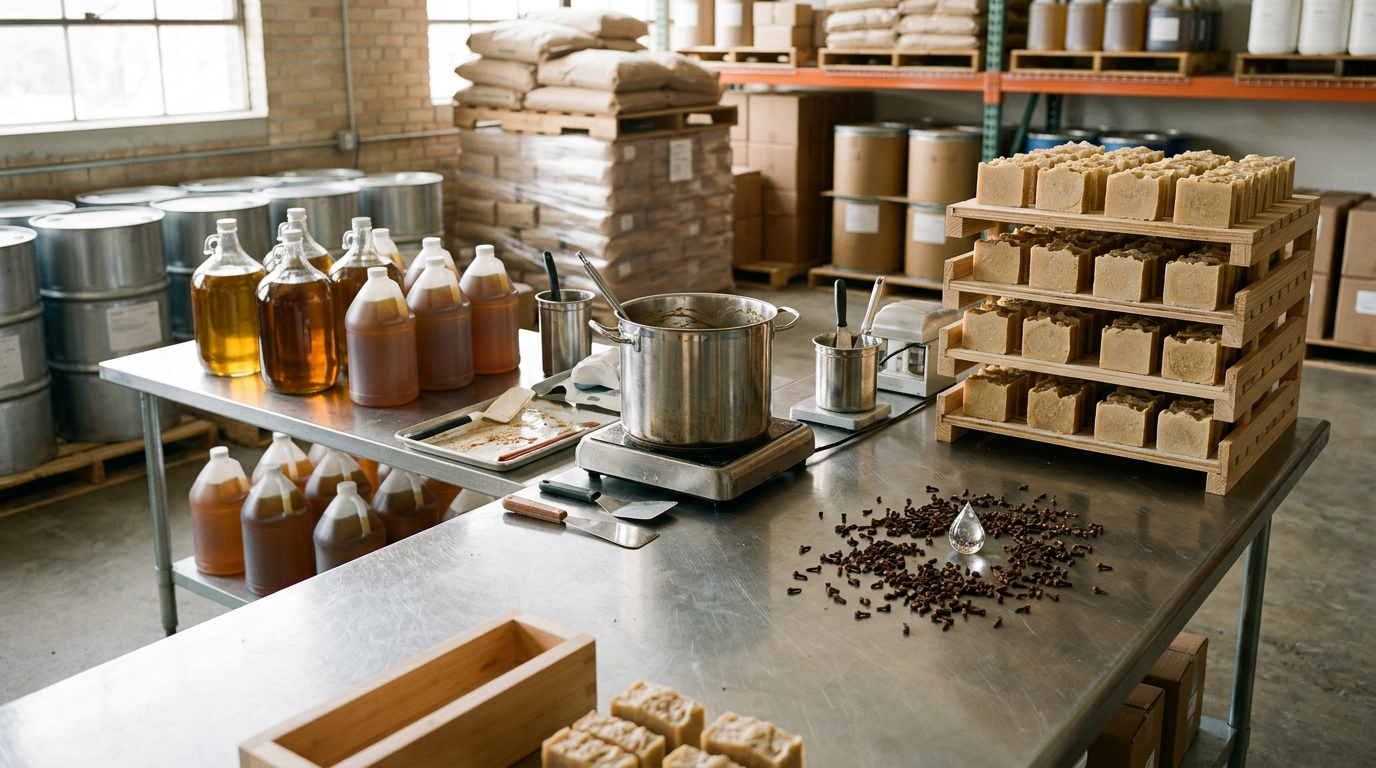
Cold process soap makers use eugenol oil as a spice fragrance note, working around its well-documented discoloration and trace-acceleration behavior in raw soap batter. This page is part of our Guide to Buying Eugenol Oil in Bulk.
Test your discoloration and acceleration timing at small scale before a full production pour.
Handmade soap makers reach for spice notes like eugenol to round out fall and holiday bar lines, valuing the same warm, carnation-adjacent character that makes it useful in candles and perfumery. Using eugenol in cold process soap covers the discoloration and acceleration behavior specific to this material, which a soap maker needs to plan for before pouring a full batch.
Because the discoloration and acceleration effects are known and repeatable, experienced soap makers treat them as a design element, a deliberately browned spice bar, rather than a defect, provided the batch is planned around the behavior instead of discovered mid-pour.
At production scale, soap makers generally run a small test batch at their intended dose before committing a full production pour, since acceleration timing can shift the working window for swirls or layering. Once a ratio and mixing sequence are locked, the same approach scales directly into larger batch sizes.
A ratio that accelerates predictably in a small test batch can still surprise a soap maker at full batch volume if mixing and pour timing are not adjusted for the larger working mass, so scale-up runs are worth a dedicated trial rather than a straight multiplication of the test recipe.
Small-batch and craft soap makers typically order in the low pound tiers, while production soap houses supplying wholesale or private label accounts move into multi-pound and drum sizing.
Request pound-tier or drum pricing and current batch documentation.