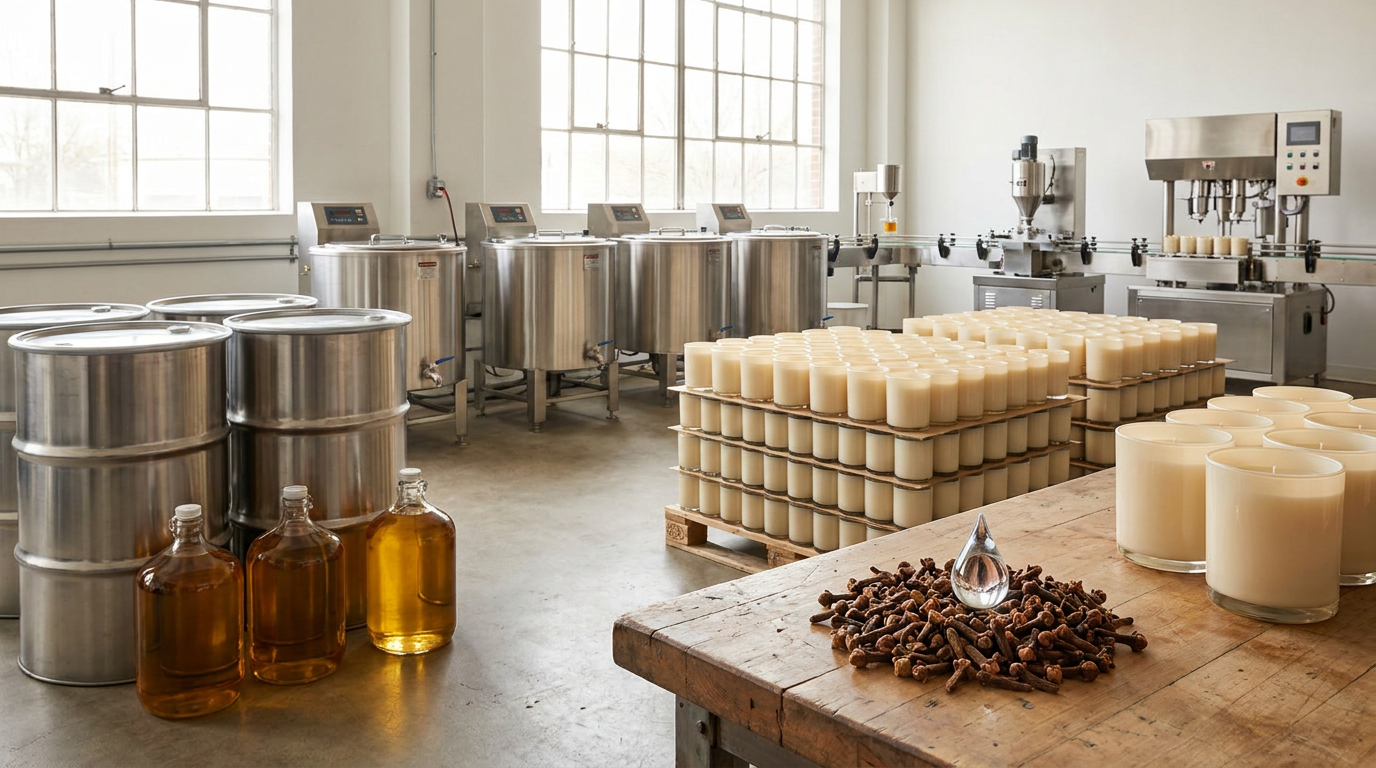
Candle and wax melt lines use eugenol oil as a concentrated spice building block, blended into larger fragrance oils rather than poured in on its own. This page is part of our Guide to Buying Eugenol Oil in Bulk.
Sample a bottle to lock your dosing ratio, then scale into pound or drum sizing.
Eugenol's carnation-leaning spice character gives candle formulators a clean, single-note way to add warmth to a blend without reaching for a pre-made spice fragrance oil that may carry its own filler load. Wax load, throw, and rest time behavior for this material differ from what a candle maker sees with a blended clove fragrance oil, since the eugenol isolate is doing the work at a much lower dose.
Buyers moving from a pre-blended clove fragrance oil to the isolate itself often do so for consistency and cost control at volume. Eugenol oil vs clove fragrance oil lays out what changes in the switch, from dosing math to how the scent reads once poured.
Production floors generally hold eugenol as one component in a house spice or holiday blend rather than the standalone fragrance, dosed alongside notes like cinnamon, orange, or vanilla to round out a seasonal line. Because it is a concentrated single note, small dosing shifts move the whole blend noticeably, so formulators typically lock a ratio during small-batch testing before scaling the blend into a full wax run.
The dosing precision that matters at bench scale matters more at production scale: a ratio that reads right in a small test batch needs to be verified again once mixed into a full drum-fed pour, since small measurement drift compounds across a large batch.
Small candle operations typically start in the pound tier to build and test a house blend, while standing production lines move into multi-pound and drum sizing to avoid reordering mid-run.
Request pound-tier or drum pricing and a batch CoA for your next pour.