Working With Eugenol on the Perfume Bench: Dilution and IFRA Basics
Eugenol is one of the great aromatic workhorses of the perfumer's palette. Warm, spicy, faintly woody, with that unmistakable clove signature, it turns up in oriental bases, florals, chypres, and countless classic accords. It also happens to be one of the more frequently mishandled materials on the home bench. Not because it is difficult, but because its restrictions are specific and its potency is easy to underestimate.
This guide walks through the practical steps of working with eugenol oil safely and effectively, covering dilution rationale, IFRA guidelines, and the bench habits that will keep your blends both beautiful and compliant. If you are brand new to the molecule itself, start with the complete guide to perfumery's spice before returning here.
Why Eugenol Requires Special Attention
Eugenol is classified as a known skin sensitizer. This means that repeated or high-level skin contact can, over time, provoke a sensitization response in some individuals. Once sensitized, a person may react to even small amounts in future exposures. This is not a rare or exotic concern. It is the reason eugenol appears on the IFRA restricted list and why professional fragrance houses have blending protocols around it.
The good news is that eugenol is entirely workable within these parameters. You do not need to avoid it. You need to understand its limits and build them into your process from the start.
For context on how this molecule came to occupy such a central place in fragrance history, the piece on clove and its famous molecule is worth a read.
Materials You Will Need
- Eugenol oil (refined, from a reputable supplier with a current Certificate of Analysis)
- A carrier for dilution: perfumer's alcohol (for fine fragrance) or a cosmetic-grade fixed oil such as fractionated coconut oil or jojoba (for leave-on skin applications)
- A precision digital scale accurate to 0.01 g
- Amber or dark glass vials or bottles (2 ml to 10 ml for working solutions)
- Calibrated glass dropper pipettes or a digital micropipette
- Perfumer's testing strips (blotter strips)
- A lab notebook or blending spreadsheet
- Nitrile gloves
- The current IFRA standards document (available free at ifrafragrance.org)
A note on sourcing: The quality and purity of your eugenol oil matters for both safety and creative work. Refined eugenol oil from clove bud or leaf should arrive with a Certificate of Analysis showing eugenol content (typically 70% to 99% depending on the source and refinement level), a specific gravity reading, and ideally a GC/MS report. Work with what you can verify.
Understanding IFRA Limits for Eugenol
IFRA (the International Fragrance Association) publishes usage guidelines organized by product category. These categories reflect how a finished product is used on the body and for how long the skin contact lasts. A rinse-off product like a shower gel has a higher permitted level than a leave-on product like a body lotion, which in turn has a higher level than a product applied to the lips or used around the eyes.
As of the most recent IFRA standards (always check the current version, as these are updated periodically), eugenol's limits vary by category. The following table shows representative limits to illustrate the range. These are expressed as the maximum percentage of eugenol in the finished product, not in your fragrance concentrate.
| IFRA Category (Examples) | Typical Use Case | Eugenol Limit in Finished Product (Approx.) |
|---|---|---|
| Category 4 | Fine fragrance (eau de parfum, cologne) | 0.5% |
| Category 5A | Body lotion, face cream (leave-on) | 0.5% |
| Category 9 | Rinse-off hair products | Higher limit applies |
| Category 11A | Products not intended for skin contact (candles, potpourri) | No restriction under current standards |
Important: Always download and read the current IFRA standards directly from ifrafragrance.org. The numbers above are illustrative. Regulations update, and the most current version governs professional and responsible home practice.
The key calculation to internalize: if your finished eau de parfum is 20% fragrance concentrate in alcohol, and the IFRA limit for eugenol in that category is 0.5% of the finished product, then eugenol can make up no more than 2.5% of your fragrance concentrate itself. Work backwards from the finished product percentage, always.
Step-by-Step: Preparing a Working Dilution
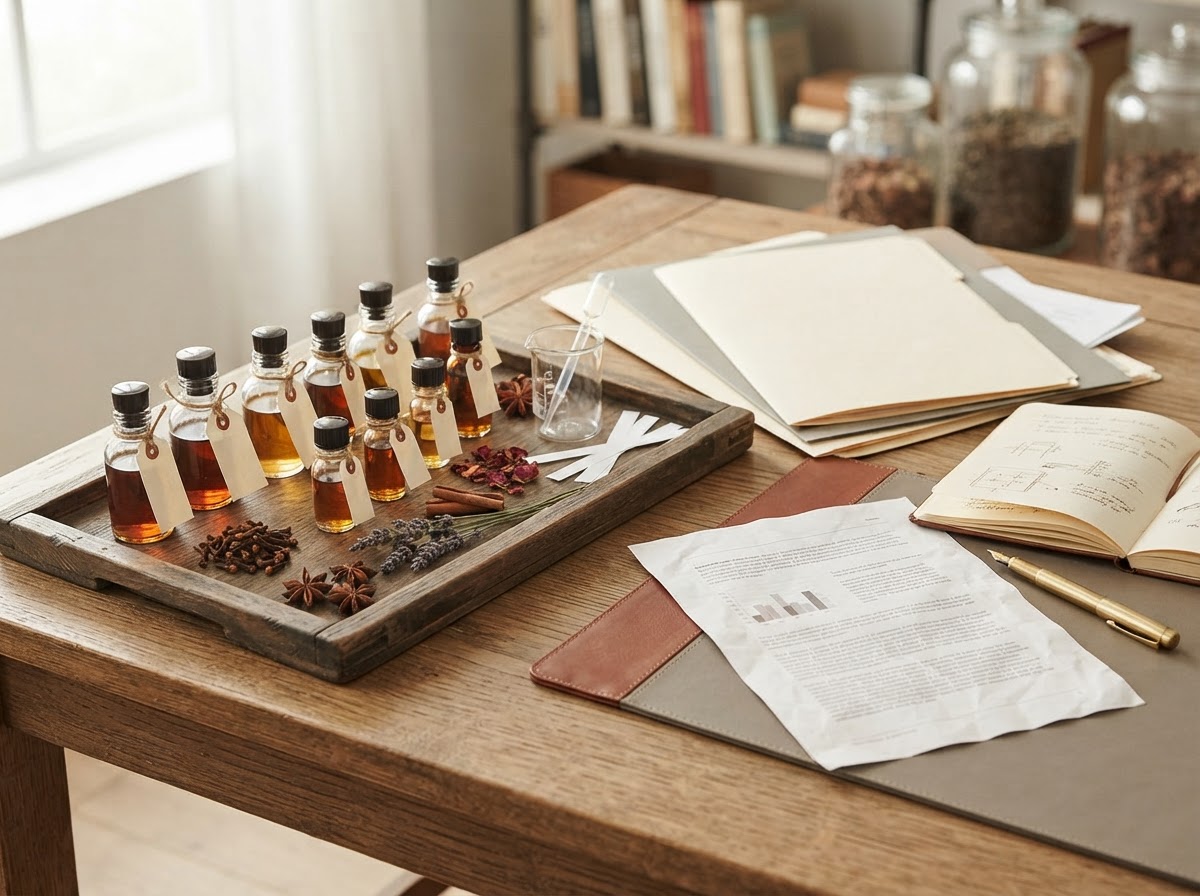
Neat (undiluted) eugenol is not practical to work with on the bench. It is viscous relative to most aromatic materials, its potency makes drop-by-drop addition error-prone, and direct skin contact with undiluted eugenol should be avoided entirely. A working dilution of 10% in perfumer's alcohol is a widely used starting point.
-
Put on your nitrile gloves
Before opening the bottle, glove up. This is non-negotiable with sensitizing materials. It also keeps skin oils off your glass and prevents accidental contamination of your solutions.
-
Tare your scale with an empty vial
Place a clean, dry amber glass vial on the scale and zero it out. You will be working by weight, not volume. Pipette volume measurements introduce too much error at small scales.
-
Weigh in your diluent first
For a 10% eugenol solution in perfumer's alcohol, add 9 parts alcohol first. For a 5 ml total batch, that is 4.5 g of alcohol (perfumer's alcohol is close to 0.79 g/ml, so account for this if precision matters). Adding the carrier first reduces the risk of accidentally getting neat eugenol on surfaces or skin during the process.
-
Add eugenol carefully
Using a glass dropper pipette, add eugenol to reach your target weight. For the 5 ml example above, you are adding approximately 0.5 g of eugenol to achieve a 10% solution by weight. Work slowly. Eugenol is denser than alcohol and will sink to the bottom initially.
-
Cap and mix gently
Cap the vial immediately and invert several times. Do not shake vigorously, which can introduce air. Label the vial with: material name, concentration, solvent, date, and your batch number.
-
Let it rest before testing
Allow your dilution to sit for at least 15 to 20 minutes before smelling. Touch the tip of a blotter strip to the vial opening rather than dipping it in. Write the material name and date on the strip. Allow the strip to air for 30 seconds before evaluating.
Calculating Eugenol Into a Fragrance Formula
Once you have a 10% working solution, every gram of that solution contributes 0.1 g of actual eugenol to your formula. This makes compliance math straightforward.
Here is a simple worked example. You are making a 20 g fragrance concentrate intended for use in an eau de parfum at 20% in alcohol. Your finished product batch will be 100 g total.
- Finished product weight: 100 g
- Target eugenol limit in finished product: 0.5% (IFRA Category 4, illustrative)
- Maximum eugenol in finished product: 0.5 g
- Your concentrate makes up 20 g of the finished 100 g product
- Therefore, maximum eugenol in your 20 g concentrate: 0.5 g
- As a percentage of the concentrate: 2.5%
- In your 10% working solution: you can use up to 25 g of the working solution per 20 g of concentrate. But since your concentrate is only 20 g total, that means up to 5 g of working solution (contributing 0.5 g eugenol) can go into the concentrate.
Always run these numbers before adding eugenol to any formula destined for skin contact. Keep the calculation in your lab notebook alongside the formula.
Blending Eugenol Into an Accord
Even within IFRA limits, eugenol is a bold material. A little goes a long way creatively. Here are some practical bench observations from working with it in different accord types.
Start low and evaluate over time
Begin with eugenol at 0.5% to 1% of your fragrance concentrate and evaluate blotter strips at 30 minutes, 2 hours, and 24 hours. The character of eugenol shifts noticeably over time. The sharp, peppery brightness of the opening softens into a warmer, almost woody-sweet drydown. Additions that smell balanced at the one-hour mark may become overwhelming at 24 hours.
Consider the eugenol contribution from other materials
This is where many home perfumers make a compliance error. Natural materials like clove bud essential oil, cinnamon leaf oil, and some rose absolutes already contain significant amounts of eugenol. If your formula includes any of these, their eugenol content counts toward your total. Check the GC/MS reports for every natural you use and add up all eugenol sources before finalizing a formula.
Eugenol and florals
Eugenol has a classical affinity with rose-type florals, carnation accords, and ylang ylang. In these contexts, it functions as an intensifier and anchor, lending a spiced, slightly retro character that many people associate with vintage rose soliflores and classic oriental florals. Use it sparingly in floral work. Even at compliant levels, it can overwhelm delicate petals.
Eugenol in oriental and woody bases
This is where eugenol tends to be most comfortable and where perfumers historically use it most freely (within limits). It pairs naturally with labdanum, benzyl benzoate, cedarwood, vetiver, and amber-type bases. In these heavier, resinous contexts it reads as a dry, warming spice note rather than a sharp clove.
Common Mistakes to Avoid

- Working with neat eugenol directly in a formula: Always dilute first. Accuracy is nearly impossible with neat eugenol at the small quantities a fragrance formula requires.
- Forgetting natural sources: As noted above, clove, cinnamon leaf, and certain florals are eugenol-rich. Always add up total eugenol from all sources.
- Not labeling your working solutions: A vial of clear liquid that has lost its label is a safety hazard. Label everything, immediately.
- Skipping the 24-hour strip evaluation: Eugenol evolves significantly. Judgments made only at the opening will mislead you.
- Applying fragrance experiments directly to skin during development: Test on strips until your formula is complete, compliant, and patch-tested properly before any skin application.
- Using an outdated IFRA standard: The standards are updated. Check the current version at ifrafragrance.org, not a cached or secondary source.
Patch Testing and Safety Before Skin Use
Once a formula is complete and you have verified IFRA compliance across all restricted ingredients, a patch test is still worthwhile before wearing a new fragrance. Apply a small amount of the finished, diluted fragrance to the inner forearm. Leave it in place for 24 hours without washing. If any redness, itching, or irritation occurs, do not use the formula on skin and review your ingredient levels.
Individual sensitivity varies. IFRA limits are population-level guidelines designed to reduce risk across a broad population, not a guarantee of safety for every individual. People with known sensitivity to spice-family aromatics should exercise additional caution.
For a broader look at eugenol questions that come up frequently in soaping, candle, and cosmetic work, the eugenol oil FAQ covers a range of practical scenarios worth bookmarking.
Keeping Records
Good record keeping is the habit that separates a chaotic bench from a functional one. For every formula containing eugenol, note: the eugenol source and its concentration (if a working solution), the weight used, the total eugenol percentage in the concentrate, the total eugenol percentage in the intended finished product, and the IFRA category you are formulating for. This takes two minutes. If you need to revisit a formula or troubleshoot a response, those records are invaluable.
Eugenol is a rewarding material. Its richness, its depth, its connection to centuries of spice trade and fragrance history make it something genuinely special to work with. Approach it with precision, respect its limits, and it will reward you with blends that have genuine warmth and character.