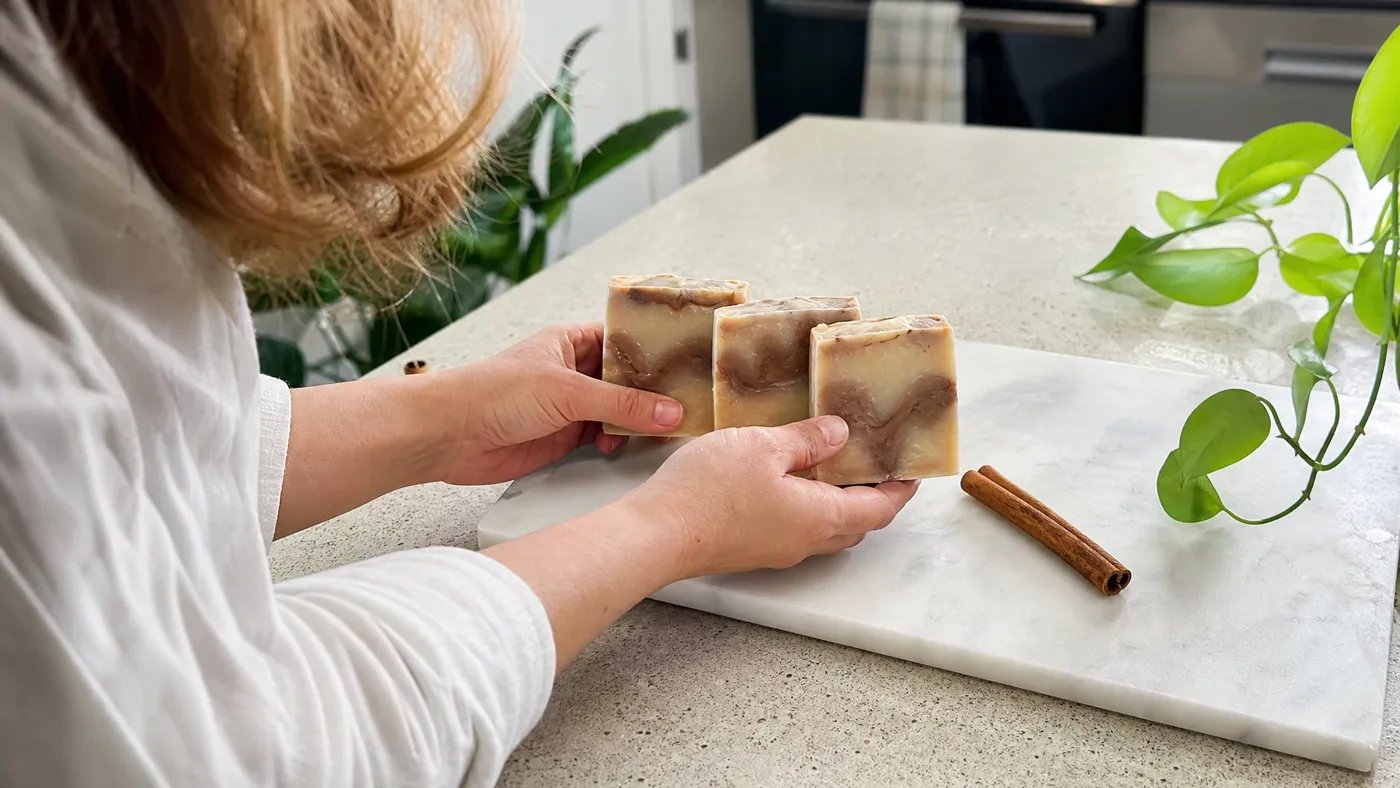
Spiced Soap Structures With Eugenol: The Total-Eugenol Sum
A "cinnamon clove" soap is often the same molecule twice. Cinnamon leaf oil is mostly eugenol, so a blend built from clove-type material plus cinnamon leaf can carry far more eugenol than the line labelled eugenol suggests. This page gives two spiced fragrance structures as proportions, converts them to grams for an example batch, and then does the sum that decides whether either one can go in a bar.
What these are, and what they are not
These are structures, not tested formulas. We have made no soap with them, we publish no batch data, and there are no oil or lye amounts here, because we have no source for a base recipe and will not invent one. Use any lye calculator and a base recipe you trust from a soap supplier, then treat the fragrance as a separate calculation. Patch test any finished bar on your own skin before anyone else uses it, and ask a dermatologist or allergist if you have a fragrance allergy.
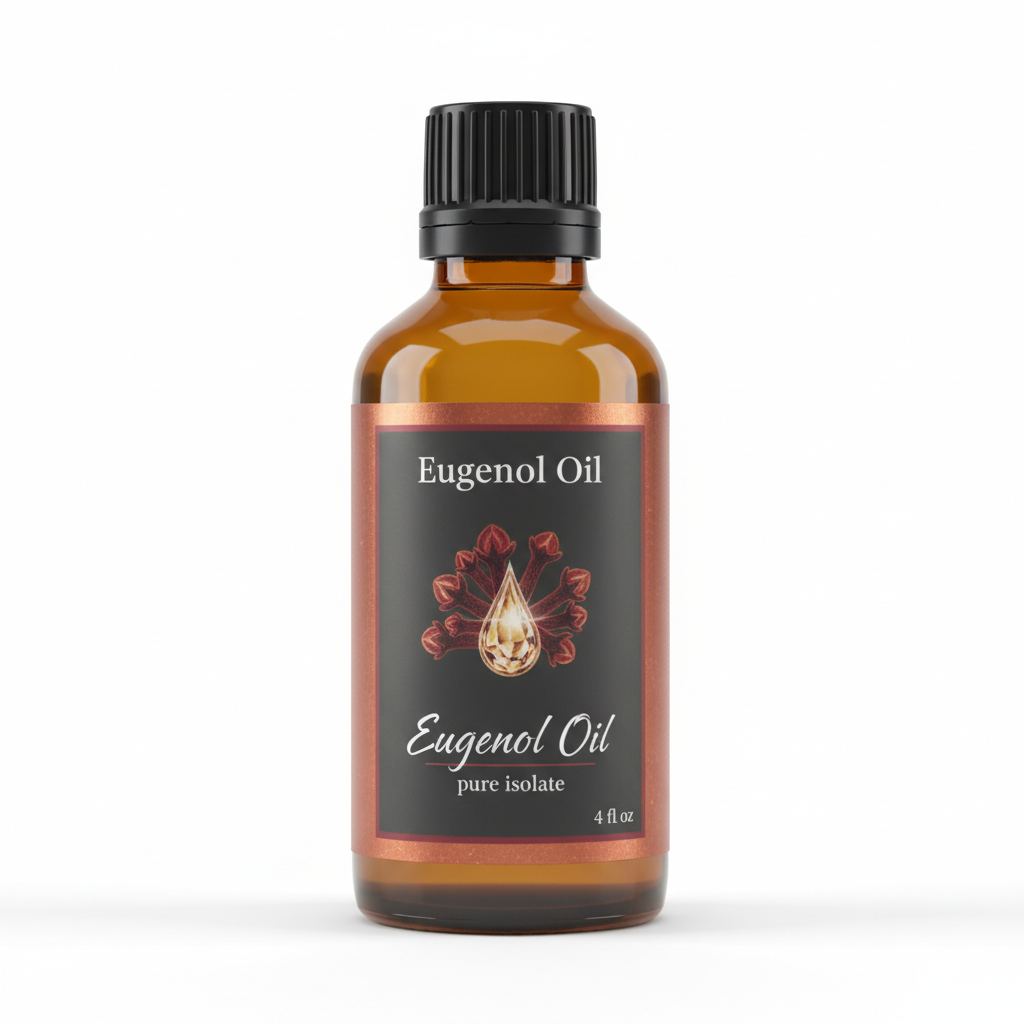
Our shop copy lists these pairings with eugenol: rose, ylang ylang, vanilla, cinnamon leaf, sweet orange and patchouli. The structures below use four of them. We sell only the eugenol oil; the others come from your usual supplier.
The fact that drives the sums
Cantó Catalá and Blázquez Ferrer (Nereis, 2017) ran GC-MS on seven commercial Cinnamomum zeylanicum oils and reported eugenol at 81.51 +/- 0.21% in the one commercial leaf oil, bought from a pharmacy. That is one sample, from one source; other lots will differ. We use 81.5% below so the arithmetic is visible. Replace it with the figure on your own lot's GC report, and do the same for the sweet orange and patchouli, for which we found no composition source this session. The sums assume they add no eugenol, and you should confirm that on their reports.
Two structures, as proportions of the fragrance portion
Both use an example batch of 1,000 g of oils at a 5% fragrance load, which is 50 g of fragrance. That load sits inside the 4 to 6% (0.7 to 1 oz per pound) range Wholesale Supplies Plus lists for cold process. It is an illustration, not a recommended load.
| Component | Structure A: orange and clove | A in grams | Structure B: cinnamon and clove | B in grams |
|---|---|---|---|---|
| Sweet orange | 80% | 40.0 g | 50% | 25.0 g |
| Eugenol oil | 8% | 4.0 g | 5% | 2.5 g |
| Patchouli | 12% | 6.0 g | 15% | 7.5 g |
| Cinnamon leaf oil | 0% | 0 g | 20% | 10.0 g |
| Vanilla | 0% | 0 g | 10% | 5.0 g |
| Total | 100% | 50.0 g | 100% | 50.0 g |
The roles: orange is the bright top that makes the soap smell like a bar, not a spice jar; eugenol is the carnation-clove centre; patchouli is the base note that Soap Queen's 2015 scent-fading article names among the deeper, earthier scents to pair with fading ones (see our anchoring post). In B, cinnamon leaf adds a second spice voice, and vanilla rounds the blend (these role descriptions are scent reasoning, not tested notes). Vanilla is the risky item for colour: a base maker engineered a vanilla-stable melt and pour base because vanilla fragrances darken that kind of base, and a spice soap that darkens anyway may not need it.
The sum: total eugenol, not eugenol added
The +/- 0.21 in that paper is the spread across repeat injections of one oil, not the difference between lots. Lot-to-lot variation is larger and unknown to us, so the sums below are a template. If the same supplier ships a leaf oil at 75% on one lot and 85% on the next, your total moves by about a gram in structure B, and that is enough to cross a ceiling.
Total eugenol = (eugenol oil grams) + (cinnamon leaf grams x 0.815).
- Structure A: 4.0 g from the bottle, nothing from cinnamon, so 4.0 g, which is 0.40% of a 1,000 g oil batch.
- Structure B: 2.5 g from the bottle plus 10.0 x 0.815 = 8.15 g from cinnamon leaf, so 10.65 g, which is 1.07% of the oils. The leaf oil supplies about 77% of the eugenol, in a blend where eugenol is listed at 5%.
Now compare with a ceiling. We could not open the official IFRA Standard this session and state no eugenol limit; see the IFRA Standards Library, your supplier's certificate, and our usage rate post. As a placeholder only, if your ceiling came out at 0.5% of the oil weight, A would sit under it and B would be double it. If it came out at 0.1%, both would fail. The structure that fails is not wrong, it is just not available to you. To bring B under a ceiling you can lower the fragrance load, drop the bottle eugenol to zero, or cut the cinnamon. With bottle eugenol at zero, 4.0 g of total eugenol allows at most 4.0 / 0.815 = 4.9 g of cinnamon leaf, which is 9.8% of a 50 g fragrance portion.
The general method, including how to carry several eugenol-bearing oils through one sheet, is in our blend calculation post. For which partners suit eugenol and why, see what blends well with eugenol, and eugenol in autumn and holiday fragrances for the seasonal angle.
Colour, as reasoning
No colour data from us exist. Reasoning from the vanilla-base case above, assume a spiced bar may drift darker, and design for it: tan, cocoa, ochre and brown colourants will read as intended when the bar warms a shade, while a white or pastel bar will show the drift as a flaw. Our cold process post covers what we know about eugenol in the process itself.
How you would check a structure
- Compute total eugenol on paper first, using the GC figure for each lot.
- Make a small control batch without fragrance and one batch per structure, same recipe and temperature.
- Judge scent and colour at unmoulding (24 to 72 hours) and after four weeks of cure, the points Candle Science records in its fragrance test process.
- If scent is weak after cure, adjust the structure within your ceiling, not above it.
Who should skip this
Skip spiced bars with eugenol for children, for anyone with a fragrance allergy, and for skin conditions; see a dermatologist or allergist. If you sell the bars, a regulatory specialist should check limits and labelling. Handle the neat oil in small amounts, wash your hands afterwards, and keep it away from eyes, children and pets.
Before you pick a structure, do the total-eugenol sum on the lot you actually hold. Our eugenol oil is an isolate sold undiluted, so the quantity in the bar is always the number you calculate.
Sources & Further Reading
- Cantó Catalá A, Blázquez Ferrer MA, 2017. Standardization of commercial cinnamon essential oils by gas chromatography-mass spectrometry analysis. Nereis 9. revistas.ucv.es/nereis/86
- Wholesale Supplies Plus. Testing fragrances in cold process soap. wholesalesuppliesplus.com
- Soap Queen (Bramble Berry), 2015. How to Prevent Scent Fading in Soap. soapqueen.com/?p=50644
- Voyageur Soap & Candle, n.d. Stephenson High Clarity Vanilla Stable Melt & Pour Soap. voyageursoapandcandle.com
- IFRA. IFRA Standards Library. ifrafragrance.org/safe-use/library
- Candle Science. Process for cold process soap fragrance testing. candlescience.com