Refreshing Potpourri With Eugenol: Diluent Maths and Limits
Do not drip neat eugenol onto potpourri. Our eugenol oil is sold undiluted, so the first job is to turn it into a refresher oil at a percentage you chose, and the second is to check that percentage against the current IFRA Standard for eugenol. What follows is the arithmetic and a method you can run yourself. We have no test data of our own to publish, and the recipe below is worked out from cited figures, not tested.
Why a few grams of oil revives a bowl, and why neat is the wrong way
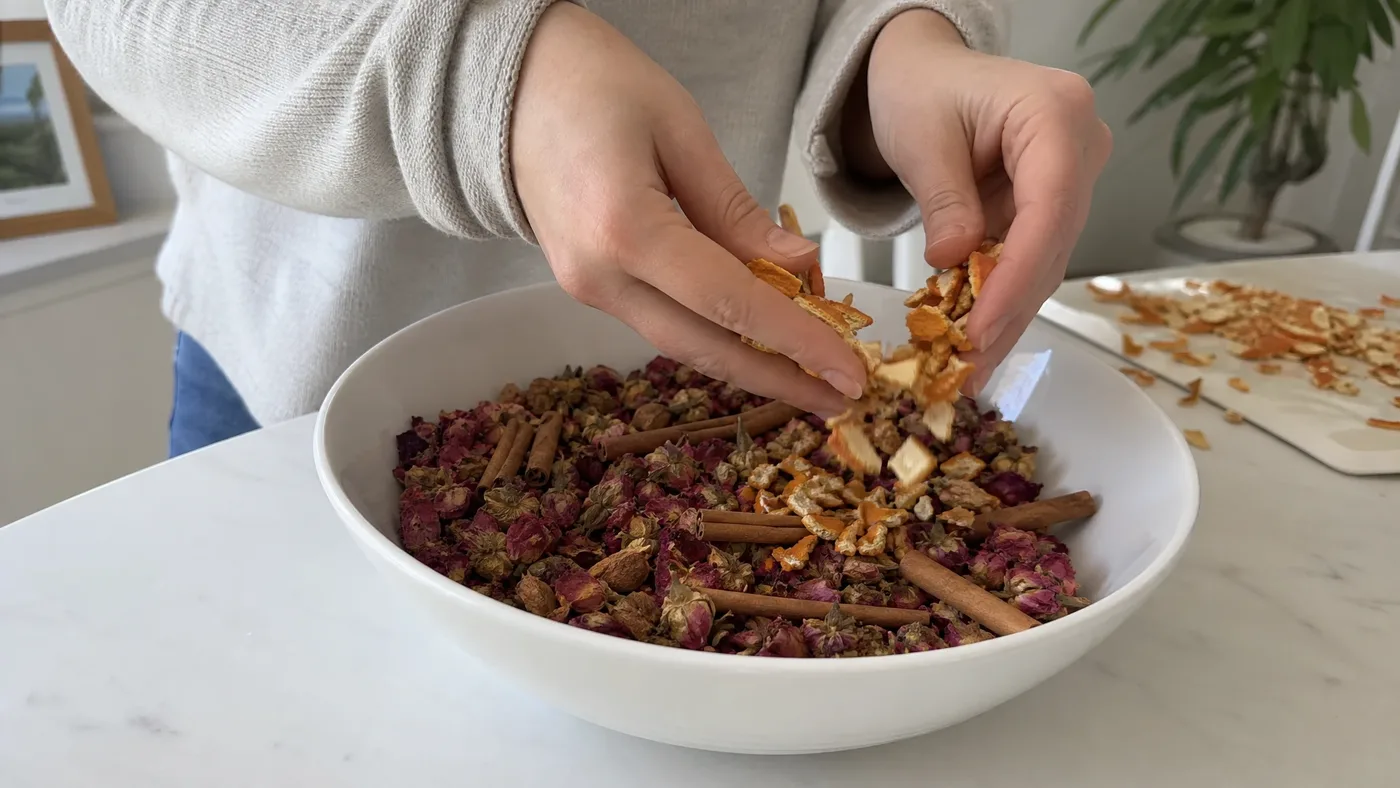
Reasoning, not a measured result: potpourri loses scent because the volatile parts of its fragrance evaporate from plant material that was dried and dressed once. A refresher puts fresh fragrance back onto the same absorbent surfaces. Eugenol is a good candidate for the job on paper because it is slow to leave. PubChem's record lists a vapor pressure of 0.0221 mmHg at 25 C (PubChem, eugenol, citing Van Roon et al., Chemosphere, 2005, via HSDB), and our shop page places it as a middle to base note. In a bowl, that means it is the part of the smell that is still there after the top notes have gone. It also means a heavy hand puts a long-lasting, strong smell on a few petals rather than an even one across the bowl.
Neat on dry material has three practical problems. First, concentration: one drop lands on one chip and stays there. Second, color: our How We Test page says eugenol darkens toward amber with air, which it calls ordinary behaviour for a phenol, and a concentrated spot on pale petals, paper or wood is where that would show (reasoning from that statement; we have not run a stain trial). Third, contact: the notified hazard classes for eugenol include H317, "may cause an allergic skin reaction", in 99.8% of 2,820 company reports to the European Chemicals Agency, and H319, serious eye irritation, in 80.4% (same PubChem record). Pouring the concentrate over a bowl you then stir by hand puts the strongest form of the material where your skin will be.
Fixatives: what the evidence is, and is not
Orris root is the fixative most often named for potpourri. The reference entry says it comes from the dried rhizomes of Iris germanica and Iris pallida, and calls it "the most widely used fixative for potpourri", citing a 1981 gardening book; it also says potpourri use needs only two to three months of drying, against five years or more for perfumery use (Wikipedia, Orris root). That is a secondary summary of a book, not a measurement, and we found no study that tested whether orris or any other powder holds eugenol longer in a bowl. We also found no source on cellulose chips as fixatives, so we make no claim about them. The honest position: a fixative powder gives the oil more surface to sit on, and that is a reasonable expectation, but you should treat it as one more variable to test, not as a known benefit.
Choosing a diluent
We sell eugenol oil only; the diluent comes from your supplier. Two common choices, with the trade-off for each (reasoning, not tested):
- A carrier oil. It does not evaporate away, so the dose you weigh is the dose that stays. It can go rancid, and it will mark paper, fabric and a wooden bowl. Eugenol is described as soluble in organic solvents (PubChem, citing the Merck Index), so mixing is not the difficulty.
- Ethanol. It carries the oil into the material and then leaves. It is flammable: PubChem lists a closed-cup flash point of 12 to 14 C for ethanol (ICSC card 0044, NFPA and a Sigma-Aldrich SDS, as compiled by PubChem, ethanol), which is below ordinary room temperature, so keep it away from flames, candles and warm bulbs.
Whatever you choose, do not use water: eugenol's solubility in water is listed at 2,460 mg/L at 25 C (Yalkowsky, 2010, via HSDB in PubChem), about 0.25%, so it would separate. The room and linen spray guide covers what is needed to get oil into water.
The arithmetic, with the limit checked first
The IFRA Standard for eugenol (CAS 97-53-0) is a restriction, published in the 51st Amendment in 2023. It lists a maximum of 4.0% in the finished product for Category 10A, and the IFRA guidance for those Standards files "fragranced oil for lamp ring, reed diffusers, pot-pourri, liquid refills for air fresheners (non-cartridge systems)" under 10A (IFRA Standards, 51st Amendment, pp. 103 to 104; IFRA Guidance, 30 June 2023, pp. 51 and 57). The same guidance says those products were put in 10A, the more restrictive of the household splits, because of the exposure from handling the soaked material. Limits change with amendments; check the current one, and ask a regulatory specialist before you sell anything.
Worked example, 50 g of refresher oil:
- Ceiling: 4.0% of 50 g is 2.00 g of eugenol, counting every source of eugenol in the blend.
- A working figure with headroom: 2.0% is 1.00 g of eugenol plus 49.00 g of diluent. Our COA reports a relative density of 1.065 at 20 C, so 1.00 g is about 0.94 mL. Weigh it; do not count drops, because drop size depends on the bottle opening.
- If your blend also contains clove-type or cinnamon-leaf oils, those carry their own eugenol. Take the percentage from that oil's GC report and add it in. A refresher built as a 10% eugenol accord would be 2.5 times the 4.0% figure before anything else was counted.
- Per bowl: 1.0 g of that refresher on 100 g of potpourri (1% by weight) delivers 20 mg of eugenol. The 50 g batch covers about 50 such top-ups.
How you would test it
This is a method, not our results; we publish no test data. Make three 20 g batches at 0.5%, 1.0% and 2.0% eugenol (0.10 g, 0.20 g and 0.40 g, which needs a scale reading to 0.01 g). Weigh three equal 100 g portions of the same potpourri into glass jars, add 1.0 g of one batch to each, seal and shake. Smell each at the time you open it, after one day, one week and four weeks, and write the scores down. Press a few dressed petals onto white card and look for marks. Leave one jar of untreated potpourri as a control. Choose the lowest batch that still reads clearly at week four.
Hands, children and pets
Our shop copy lists skin use at 0.5% to 2% in a carrier, with a patch test. Our How We Test page says standard fragrance-industry guidance puts the leave-on ceiling around half a percent. Those two numbers disagree, and we will not pick one for you. A 2.0% refresher sits at the top of the shop range and four times the other figure, so wear gloves or use a spoon, wash your hands afterwards, and keep eyes clear. Our safety copy also says to keep the material away from children and pets.
The ASPCA says cats are especially sensitive to essential oils and does not recommend using any in areas where pets have access unless they are supervised or a veterinarian approves (ASPCA, household products). Eugenol oil is not an essential oil, but it comes from clove oil, and Pet Poison Helpline lists clove among the essential oils that can poison pets (Pet Poison Helpline). We found no study of potpourri bowls and eugenol exposure in animals, so the practical rule is placement: a bowl a cat can reach is a bowl it can lick. See the pets article, and call a veterinarian or poison line if an animal has eaten or licked any of it.
How long a refreshed bowl lasts
We found no source that measures it, and we will not invent a number. The limits are reasoned: the plant material's own condition, the diluent (a carrier oil can go rancid) and the eugenol oil itself, which our shop gives a typical shelf life of 2 to 4 years kept tightly capped in a cool, dark place. See the storage guide for that part. For a scent that is meant to live in drawers rather than a bowl, the sachet oil guide is the closer fit, and the scent profile helps with what to blend it with.
Who should skip this
Skip it if you want a recipe someone has already tested, because this one has not been. Skip it if anyone in the household reacts to fragrance, or keeps cats and cannot place the bowl out of reach. If you plan to sell refresher oil, labelling and allergen declaration rules apply, and that is a question for a regulatory specialist or cosmetic chemist rather than a blog post. We also do not sell carrier oils, ethanol or potpourri bases; those come from your usual suppliers.
Sources & Further Reading
- IFRA, 2023. IFRA Standards, 51st Amendment (Eugenol, pp. 103-104). ifrafragrance.org (IFRA Standards 51st Amendment)
- IFRA, 2023. Guidance for the use of IFRA Standards, 30 June 2023. ifrafragrance.org (Guidance, 51st Amendment)
- NCBI PubChem. Eugenol (CID 3314), including ECHA C&L Inventory classifications and HSDB property data. pubchem.ncbi.nlm.nih.gov/compound/Eugenol
- NCBI PubChem. Ethanol (CID 702), flash point records. pubchem.ncbi.nlm.nih.gov/compound/Ethanol
- ASPCA. Pet Poisons: Be Mindful of these Household Products and Cleaning Agents. aspca.org
- Pet Poison Helpline. Essential oils. petpoisonhelpline.com/pet-poison/essential-oils
- Wikipedia. Orris root (secondary reference, citing Boland and Boland, 1981). en.wikipedia.org/wiki/Orris_root