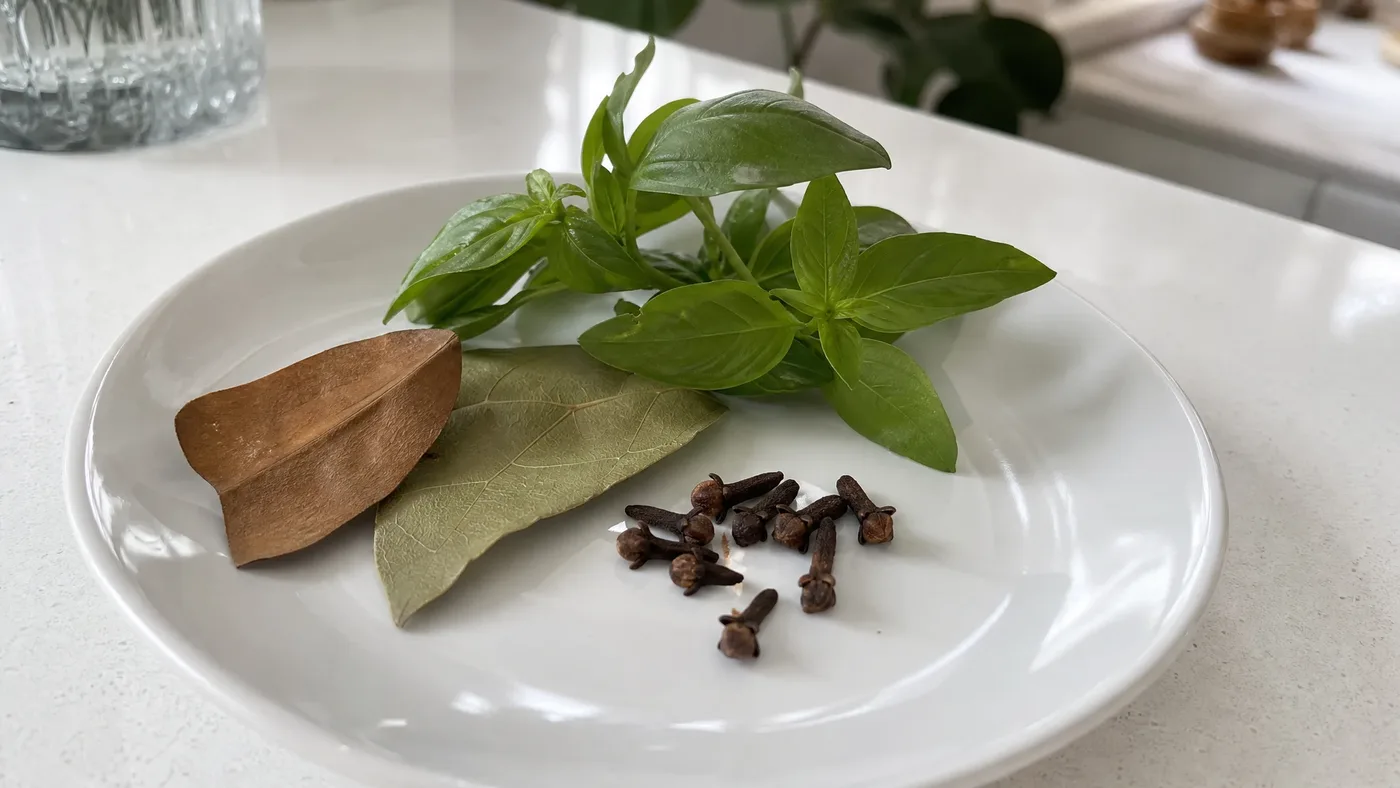
Plants That Contain Eugenol: Reported Ranges by Plant and Part
Plenty of plants make eugenol, but "contains eugenol" covers everything from a trace to most of the oil. For a maker the question is how much, in which plant part, and how far that number can be trusted from one lot to the next. This page lists what the papers we could read actually measured, and where two papers contradict each other.
The table, with the method named in each row
Every figure below is a share of the oil, as reported in the cited paper, usually by GC peak area (see our explainer on GC-MS and area percent for why that is an approximation). Rows we could not source are not here.
| Plant and part (oil) | Reported eugenol | Source and what it was |
|---|---|---|
| Clove, flower bud oil | Mean 75.06% by GC-MS (range 73.03 to 75.96%), seven batches | EFSA FEEDAP Panel, 2023; the same opinion gives a GC-FID mean of 82.7% for bud oil |
| Clove, leaf oil | Mean 82.60% (range 78.68 to 86.01%), six batches, GC-MS | EFSA FEEDAP Panel, 2023 |
| West Indian bay, Pimenta racemosa, leaf oil | 70.87%, an Egyptian-grown sample | Eldahshan et al., Scientific Reports, 2025 |
| Pimenta racemosa, leaf and stem oils | 57.84% (leaf), 59.76% (stem) | Ayoub et al., Molecules, 2022 |
| Commercial bay oil (Pimenta racemosa var. racemosa) | 44 to 69% | Range quoted in a review: Gotz et al., Plants, 2023 |
| Allspice (Pimenta dioica), oil from fruits collected in Tabasco, Mexico | 72.6% | Martinez-Bolanos et al., Plants, 2026; hydro-distilled |
| Holy basil (Ocimum tenuiflorum), Nepal | 32.15 to 34.95% across two seasons | Paudel et al., Molecules, 2025 |
| Sweet basil (Ocimum basilicum) varieties | 0 to 34% depending on variety | Gotz et al., 2023 (review) |
| Nutmeg oils, West India and South East Asia | 0.1 to 0.7%; one Sri Lankan kernel oil 0.2% | Gotz et al., 2023 (review, quoting earlier analyses) |
| Ylang-ylang, first grade | 0.5% | Gotz et al., 2023 (review) |
Four places the literature disagrees with itself
Cinnamon leaf. This is the row people expect to be high. The Gotz review says Ceylon cinnamon leaf oil is a source of eugenol "up to 92%", and cites one analysis of leaf oil at 87% against 8.8% in the bark oil. A 2023 study of a Cinnamomum zeylanicum leaf oil (Mutlu et al., Life, 2023), steam-distilled and run by GC-MS and GC-FID, reported E-cinnamaldehyde at 72.98% and eugenol at only 1.48%. We cannot tell from either paper which sample, part or chemotype explains the gap, and we are not going to average them. Reasoning from this: a bottle labelled "cinnamon leaf" is not enough to know its eugenol content; you need the GC report.
Allspice. The 2026 Mexican fruit-oil paper puts its own result (72.6%) beside values it cites for other work: 59.8% for fresh, mature leaves and 65.9 to 71.4% in other studies. The authors attribute the spread to plant tissue, environment, soil, elevation and harvest. The Gotz review adds that Pimenta dioica leaf oils have been reported with up to 95% eugenol and berry oils up to 83%, so a single "allspice" figure hides a part-dependent range.
West Indian bay. Two papers on the same species sit about 13 points apart: 70.87% in the Egyptian leaf oil, 57.84% (leaf) and 59.76% (stem) in the 2022 Molecules study, and the review's commercial range of 44 to 69% brackets both. Reasoning from that: a supplier quoting "bay oil, 70% eugenol" may be accurate for one lot and wrong for the next, and a range on a data sheet is more honest than a single figure.
Holy basil. The Nepali oil above is a eugenol-rich one. The Gotz review cites another study of holy basil hexane extracts in which methyleugenol, not eugenol, dominated (36 to 76%). Same species, different extraction and origin, a different principal phenylpropene. That matters because methyleugenol is a separate material (see eugenol versus methyl eugenol).
Plants that disappoint on the label
- Sweet basil. In the Nepali study, the basil samples were dominated by methyl chavicol (62.16 to 64.42%) and linalool; the review's 0 to 34% range shows the eugenol chemotype exists but cannot be assumed.
- Bay laurel (Laurus nobilis). Not the same plant as West Indian bay. In a Turkish study summarised by Gotz et al., the combined total of isoeugenol, eugenol methyl ether, eugenol and elemicin stayed below 1% in young leaves, buds and flowers and below 3% in older leaves; in another, wild leaf extracts held about 3.1% eugenol. A shop selling "bay oil" without naming the species is selling you an unknown.
- Nutmeg and mace. Present, but at fractions of a percent in the oils summarised. A trace is not a source.
Why a maker should care, with the arithmetic
Eugenol is one molecule, so when you blend plant oils you add up eugenol from every ingredient. Take the Egyptian Pimenta racemosa oil at 70.87% as a worked example. If 10 g of that oil goes into 100 g of a fragrance concentrate, the concentrate carries roughly 7.09 g of eugenol, about 7.1% by weight if peak area stood in for weight, which is an approximation. The same oil at the 44% low end of the commercial range would give 4.4%. A 2.7-point difference from the same label is the reason a blend should be calculated from each lot's report, not from a textbook number. Our planned blend calculation article is the place for the full method.
Two limits. First, we have not checked any regulatory threshold in this article, so we give none: whether a given eugenol total triggers declaration or a limit under the current IFRA amendment is a question for a regulatory specialist or cosmetic chemist. Second, this page says nothing about edible or other uses of any plant; it reports composition only.
Where our eugenol oil fits
Our eugenol oil is a refined isolate obtained from clove oil, so it is eugenol rather than a plant's whole oil. Using it instead of a botanical oil swaps a variable mixture (the sample-to-sample ranges above) for a narrower material, but "narrower" is not "known": ask for the GC report for the batch, as our certificate guide explains, because the published certificate on our shop page reports physical parameters and no assay. For the clove numbers behind the first two rows, see the bud, leaf and stem breakdown, and for how the isolate differs from the whole oil, the clove oil comparison.
Sources & Further Reading
- EFSA FEEDAP Panel, 2023. Safety and efficacy of feed additives consisting of essential oils derived from the flower buds or the leaves of Syzygium aromaticum. EFSA Journal. pubmed.ncbi.nlm.nih.gov/37522096
- Eldahshan OA et al., 2025. Chemical profile of essential oil from Pimenta racemosa leaves. Scientific Reports. pubmed.ncbi.nlm.nih.gov/40841731
- Ayoub IM et al., 2022. Valorization of Pimenta racemosa Essential Oils and Extracts: GC-MS and LC-MS Phytochemical Profiling. Molecules. pubmed.ncbi.nlm.nih.gov/36432065
- Martinez-Bolanos L et al., 2026. Chemical Profile of Pimenta dioica Essential Oil (fruit oil from Tabasco, Mexico). Plants. pubmed.ncbi.nlm.nih.gov/42197648
- Paudel PN et al., 2025. Seasonal Variation in Essential Oil Composition and Bioactivity of Three Ocimum Species from Nepal. Molecules. pubmed.ncbi.nlm.nih.gov/40942106
- Mutlu M et al., 2023. Comprehensive Metabolite Profiling of Cinnamon (Cinnamomum zeylanicum) Leaf Oil. Life. pubmed.ncbi.nlm.nih.gov/36676085
- Gotz ME et al., 2023. Occurrence of Alkenylbenzenes in Plants: Flavours and Possibly Toxic Plant Metabolites. Plants. pubmed.ncbi.nlm.nih.gov/37299054