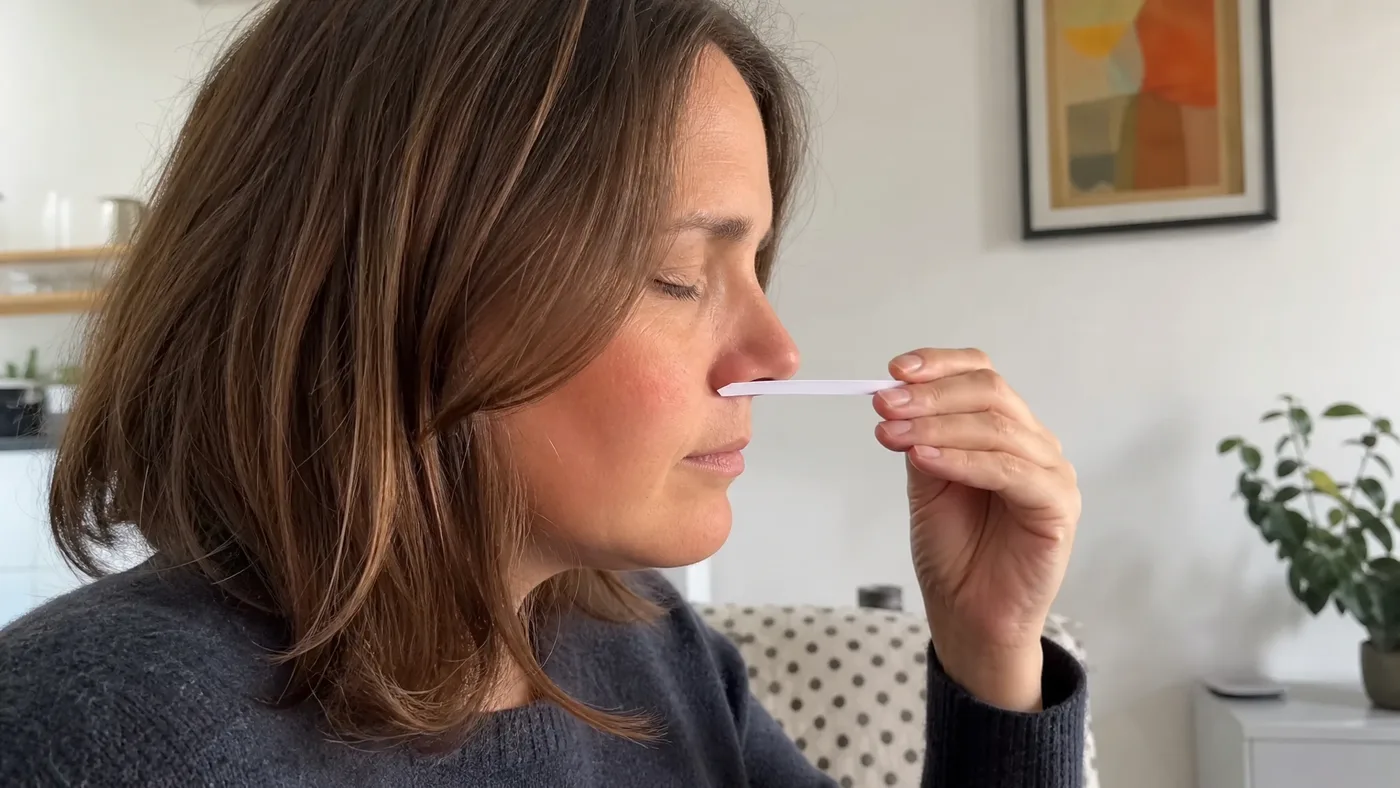
How to Evaluate Eugenol on a Smelling Strip, Step by Step
Do not judge eugenol by dipping a strip into the neat material and sniffing. Make a 10% dilution and a 1% dilution by weight, smell them on labelled strips at fixed times, and stop after a few strips so your nose is not the thing you are measuring. Below is the method, the arithmetic, and the two studies that explain why the stopping rule matters. We have no strip notes of our own to give you, and none are published here.

Step 0: decide how much contact you are willing to have
Eugenol is a skin sensitiser. On PubChem's summary of the European Chemicals Agency classification inventory, 99.8% of notifications carry H317 (may cause an allergic skin reaction), 80.4% carry H319 (serious eye irritation), 20.6% carry H315 (skin irritation) and 17.3% carry H302 (harmful if swallowed), from 2,815 company reports. Our own safety copy says the same in plainer terms: concentrated material, keep away from eyes, children and pets, wash hands after handling, not for internal use. The practical consequence is that the neat material should touch a strip, a pipette and a weighing vessel, not your fingers. Hold strips by the dry end, use gloves of the type your supplier's safety data sheet specifies (we do not state a glove material here, and you should ask for the SDS), and bin used strips in a closed container.
If you have ever reacted to a fragrance or a balsam, ask an allergist or dermatologist before you start. That is a medical judgment this article cannot make for you. Our skin sensitisation guide covers the mechanism.
Step 1: make the dilutions (the arithmetic)
- Weigh 1.00 g of eugenol oil into a clean glass vial, then add 9.00 g of your solvent. That is 10% w/w. Weigh, do not count drops: we have no drop-size data and a drop varies with the pipette.
- For 1%, weigh 1.00 g of the 10% solution into 9.00 g of solvent. That is a tenfold step down, 1% of the original material.
- Pick one solvent (ethanol or dipropylene glycol are the usual choices in practice) and use it for every sample in the session. The solvent behaves differently on paper, so changing it mid-session changes two things at once. No standard that we could cite fixes the solvent or the percentages; 10% and 1% are working conventions.
Our published certificate of analysis gives a relative density of 1.065 at 20 C for one batch, so 1.00 g of oil is about 0.94 mL (1.00 / 1.065). If you start from a volume instead of a mass, convert first. The smallest size on our shop page is 0.5 oz. Reasoning from that density, and whichever ounce the label means, that is roughly 14 to 15 g of oil, enough for about 14 or 15 dilutions of 10 g at 10%. An evaluation bottle goes a long way, so buy the small one first. Our COA reading guide explains what that density line does and does not tell you.
Step 2: strip protocol
This is a method to run, not a result. Label each strip in pencil with the material, dilution, solvent, date and the time you dipped it. Dip to the same depth each time (a fixed 1 cm is easy), wave the strip to let the solvent leave, then smell at set times. The times below are our suggestion; no source we read sets them.
- Right after the solvent leaves: top impression.
- 5 minutes, 30 minutes, 2 hours: how the smell moves.
- 24 hours: what remains on the strip, if anything.
Always run a blank strip (solvent only) beside the sample, and go from 1% to 10%, never the other way round. Add references you actually own: isoeugenol (see our comparison of the two molecules) and a clove oil (see eugenol oil versus clove oil). We sell only eugenol oil, so those you buy elsewhere.
What to look for is yours to decide, but there is a stated claim to check against. Our shop page describes the scent as warm, spicy and carnation-like, sweeter and more focused than whole clove, with a middle-to-base role in perfumery. That is a description we publish, not a result from a strip trial. Treat it as a claim and write down whether your strips agree. The fuller scent profile gives vocabulary.
Step 3: stop before your nose does the measuring
Two studies bear on session length, and neither is about eugenol.
Hintschich et al., The Laryngoscope, 2024 studied 80 adults with normal smell: younger (mean age 27.7) and older (mean age 61.5). A nasal clip delivered phenylethyl alcohol (a rose-like odorant) to one nostril for 10 minutes, and separately for 2 hours. Odour thresholds were already significantly higher after 10 minutes, and the effect was stronger after 2 hours, clearer on the exposed side, and more pronounced in the older group. It was a continuous exposure to one odorant, which is not the same as a few seconds per strip. It cannot tell you how many strips is too many. Its use here is narrower: adaptation is fast, it grows with exposure, and people differ, so your sensitivity at strip eight is not your sensitivity at strip one.
Grosofsky, Haupert and Versteeg, Perceptual and Motor Skills, 2011 tested the shop habit of offering coffee beans between fragrances. Students smelled three fragrances over nine trials, then sniffed coffee beans, lemon slices or plain air, then picked which of four fragrances was new to them. Coffee beans did not give better performance than lemon or air. It was a small exploratory student study, so it does not prove beans do nothing; it gives no reason to rely on them.
Reasoning from both, the practical consequence is to treat a rest as the only reset you have evidence for: fixed limits on strips per sitting, a pause in clean air between samples, and the sample order above. How many strips and how long a pause are your calls; we have no source for specific numbers, so write down what you do and check whether your readings drift late in a session.
The log: columns only
| Date | Material and lot | Dilution and solvent | Strip no. and dip time | Smelled at | Impression | Strips already smelled today | Compared with |
|---|---|---|---|---|---|---|---|
The "strips already smelled today" column is the one most logs lack, and it lets you spot nose drift later. When a new lot arrives, smell it beside a retained strip or vial of the old lot, same dilution, same day. Colour change on its own is not a smell result: our How We Test page calls darkening toward amber ordinary behaviour for a phenol, and our bench guide covers dilution and limits once you move from strips to a formula.
Limits of this method
A strip tells you about odour, not safety, and not what the material will do in wax, soap or a perfume base. It will not tell you assay, origin or whether a lot has been blended; that needs a GC report, which our published certificate does not include (it reports physical parameters for one batch). If you want a GC report for any supplier's eugenol, ask for it. For regulatory numbers on anything you then sell, use a regulatory specialist and the current IFRA amendment.
Our eugenol oil is sold undiluted, so the dilution arithmetic above is yours to run and write down.
Sources & Further Reading
- Hintschich CA, Ma C, Hahner A, Hummel T, 2024. Pronounced olfactory habituation with age. The Laryngoscope. pubmed.ncbi.nlm.nih.gov/38597777
- Grosofsky A, Haupert ML, Versteeg SW, 2011. An exploratory investigation of coffee and lemon scents and odor identification. Perceptual and Motor Skills. pubmed.ncbi.nlm.nih.gov/21667761
- PubChem, National Center for Biotechnology Information. Eugenol, GHS classification (ECHA C&L Inventory notifications). pubchem.ncbi.nlm.nih.gov/compound/Eugenol