Eugenol Allergen Labeling: EU, UK and US Rules, With the Maths
The EU's eugenol labelling threshold is so low that it is easy to cross without noticing: 0.001% of a 30 g leave-on product is 0.3 mg of eugenol. The harder questions are which name goes on the label, which of your products fall under the cosmetics rules at all, and what is law versus what is only coming. This article works through the arithmetic and then through the EU, UK and US texts as we read them, and it is not legal advice.
Start with the arithmetic
EU Annex III, entry 71, lists eugenol and requires its presence to be indicated in the list of ingredients when its concentration exceeds 0.001% in leave-on products or 0.01% in rinse-off products (Regulation (EC) No 1223/2009, Annex III, as published in the Official Journal in 2009). Those are thresholds for declaring the substance, not safety limits. For scale, the IFRA limit for fine fragrance is 2.5% (IFRA Standards, 51st Amendment), 2,500 times higher than the leave-on labelling line.
The calculation for a fragrance you buy: trigger share = threshold divided by the fragrance dose. These rows are illustrations of the arithmetic, not recipes.
| Product type | Fragrance dose | Threshold | Declare eugenol if it exceeds this share of the fragrance |
|---|---|---|---|
| Leave-on body oil | 1% | 0.001% | 0.1% |
| Fine fragrance (alcohol) | 18% | 0.001% | about 0.0056% |
| Bar soap (rinse-off) | 3% | 0.01% | about 0.33% |
| Rinse-off wash | 1% | 0.01% | 1% |
Two further worked numbers. A 100 g bar of soap crosses 0.01% at 10 mg of eugenol. And if you add eugenol material directly at even 0.05% of a product, you are fifty times over the leave-on line and five times over the rinse-off line, so the declaration is not a judgment call. For the dose conversion itself see our blend calculation article. You cannot do this sum without the eugenol percentage in the fragrance, so ask your fragrance supplier for it; for eugenol oil, use an assay you hold, because our published COA reports physical parameters for one batch and no assay.
What the text says, and what it does not
Article 19(1)(g) of the Cosmetics Regulation says perfume and aromatic compositions are shown as "parfum" or "aroma", and that substances whose mention is required under the "Other" column of Annex III "shall be indicated in the list of ingredients in addition to the terms parfum or aroma". So a perfumed soap lists parfum and, separately, eugenol. The same article defines an ingredient as any substance or mixture intentionally used in the manufacturing process, and excludes impurities in raw materials, which matters if eugenol arrives only as a trace in something else.
The 2023 amending regulation, Commission Regulation (EU) 2023/1545, extended individual allergen labelling to many more fragrance substances using the same two thresholds (Regulation (EU) 2023/1545). It did not replace the eugenol entry: its list of replaced entries includes isoeugenol (73) but not 71. So for eugenol the duty is old, and the reading we can support is that nothing in that regulation changed it. Other amendments may exist, so have the consolidated text checked.
The regulation's own reasoning is worth knowing. It says that for sensitised people "a much lower concentration" can trigger symptoms, that 1 to 9% of the EU population is estimated to be allergic to fragrance allergens, and that individual labelling is a secondary-prevention measure for those already sensitised. That is the logic behind thresholds this low.
Eugenol, clove oil and the name on the label
This is the part that is new. The 2023 regulation adds entry 356, clove oil, whose Common Ingredients Glossary names are Eugenia Caryophyllus Leaf, Flower, Stem and Bud Oil. The condition is that the oil be shown as "Eugenia Caryophyllus Oil" above the same 0.001% and 0.01% thresholds. A footnote allows non-compliant products to be placed on the EU market until 31 July 2026 and made available until 31 July 2028. The first date has already passed as we write, 23 October 2026.
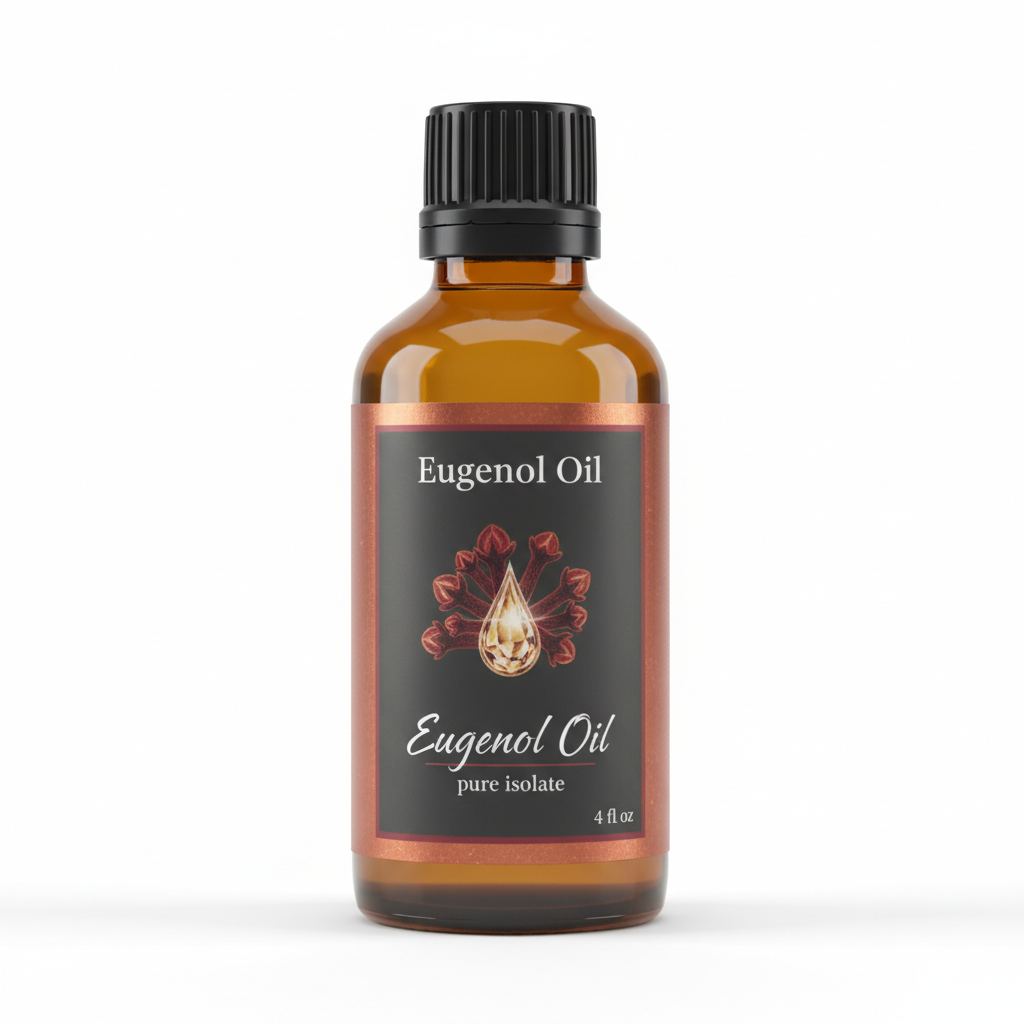
Our material is described on our own pages as an isolate refined from clove oil, which is eugenol, not clove oil, so the entry that names it is 71 (INCI name Eugenol). A formula that contains both eugenol and a whole clove oil raises a question the text we read does not answer: whether the oil's own eugenol content is declared as well as the oil. Do not guess; put it to a regulatory specialist. Isoeugenol, which is also clove-related, has its own entry (73) and an additional 0.02% cap in the 2023 text for other than oral products, so do not copy eugenol's line to it.
Which of your products are cosmetics
The regulation defines a cosmetic product as a substance or mixture intended to be placed in contact with the external parts of the human body with a view exclusively or mainly to cleaning, perfuming or otherwise caring for them. A perfumed soap, a solid perfume and a body oil fit that wording. A candle, a wax melt or a reed diffuser is not placed on the body, so Annex III labelling does not govern it, according to that definition. Mixtures are instead covered by the hazard-labelling rules (CLP), where the 2008 text we read requires a mixture that is not itself classified as sensitising but contains a sensitising substance at or above 0.1% to carry "Contains (name). May produce an allergic reaction" (Regulation (EC) 1272/2008, Annex II, 2.8, as published). That is a hundred times the leave-on cosmetic threshold, and amended texts exist, so have a regulatory specialist confirm the current text. Whether your product is a cosmetic in the market where you sell it is a classification question for a regulatory specialist.
Great Britain
The legislation.gov.uk version of Annex III shows entry 71 with the same two thresholds, and its version list runs to 15 August 2026 (legislation.gov.uk, Annex III). We could not establish whether Great Britain has adopted the 2023 EU expansion: commercial guides we found conflict, and we found no government source. For an extended allergen list in GB, ask the Office for Product Safety and Standards or a UK regulatory consultant.
United States
There is no federal fragrance-allergen list or threshold yet. The law that will create one, section 609(b) of the Federal Food, Drug, and Cosmetic Act as added by MoCRA (Public Law 117-328, enacted 29 December 2022), says the responsible person "shall identify on the label of a cosmetic product each fragrance allergen included in such cosmetic product", with the substances to be set by FDA regulation (Public Law 117-328). FDA was to propose the rule within 18 months of enactment, and the statute tells it to consider the EU's requirements and allows it to set threshold levels. The deadline passed. FDA's MoCRA page, marked current as of 10 August 2026, says only that MoCRA requires the rule and gives no date (FDA, MoCRA), and a July 2026 trade report says the federal regulatory agenda now shows a proposal in November 2026 (ChemLinked, 2026). We could not open the agenda itself. Reasoning from the statute's EU instruction, the EU numbers are the best available guide to what a US rule may look like, but that is a prediction. The statute also leaves states free to limit ingredients or keep their own ingredient-reporting laws.
What to do with this
- Decide per product whether it is a cosmetic where you sell it.
- Get the eugenol percentage in your fragrance and compute the share at your dose against 0.001% or 0.01%.
- For EU sales, list parfum and Eugenol (and Eugenia Caryophyllus Oil if used) following the ingredient-list order rules in Article 19, which are descending weight, with anything under 1% in any order.
- Re-check the consolidated text and the IFRA category before each new formula; see the IFRA explainer and the compliance guide.
This is not a labelling service. A regulatory specialist or cosmetic attorney decides your actual label, and for a person who reacts to a product, a dermatologist or allergist is the right professional, not an article.
Sources & Further Reading
- European Parliament and Council, 2009. Regulation (EC) No 1223/2009 on cosmetic products, Annex III entry 71, Articles 2 and 19. publications.europa.eu CELEX 32009R1223 (Official Journal L 342)
- European Commission, 2023. Regulation (EU) 2023/1545 amending Annex III (fragrance allergen labelling). publications.europa.eu CELEX 32023R1545 (Official Journal L 188)
- European Parliament and Council, 2008. Regulation (EC) No 1272/2008 (CLP), Annex II 2.8, as published. publications.europa.eu CELEX 32008R1272
- legislation.gov.uk. Regulation (EC) 1223/2009 Annex III, UK version. legislation.gov.uk/eur/2009/1223/annex/III
- US Congress, 2022. Public Law 117-328, section 609 of the FD&C Act (MoCRA). congress.gov PLAW-117publ328
- US FDA. Modernization of Cosmetics Regulation Act of 2022 (MoCRA). fda.gov MoCRA
- ChemLinked, 2026. US FDA sets November 2026 timeline for fragrance allergen rule (trade report). cosmetic.chemlinked.com
- IFRA, 2024. IFRA Standards, 51st Amendment (eugenol). ifrafragrance.org Standards PDF