Handling Eugenol: Gloves, Eye Protection, Spills, Storage
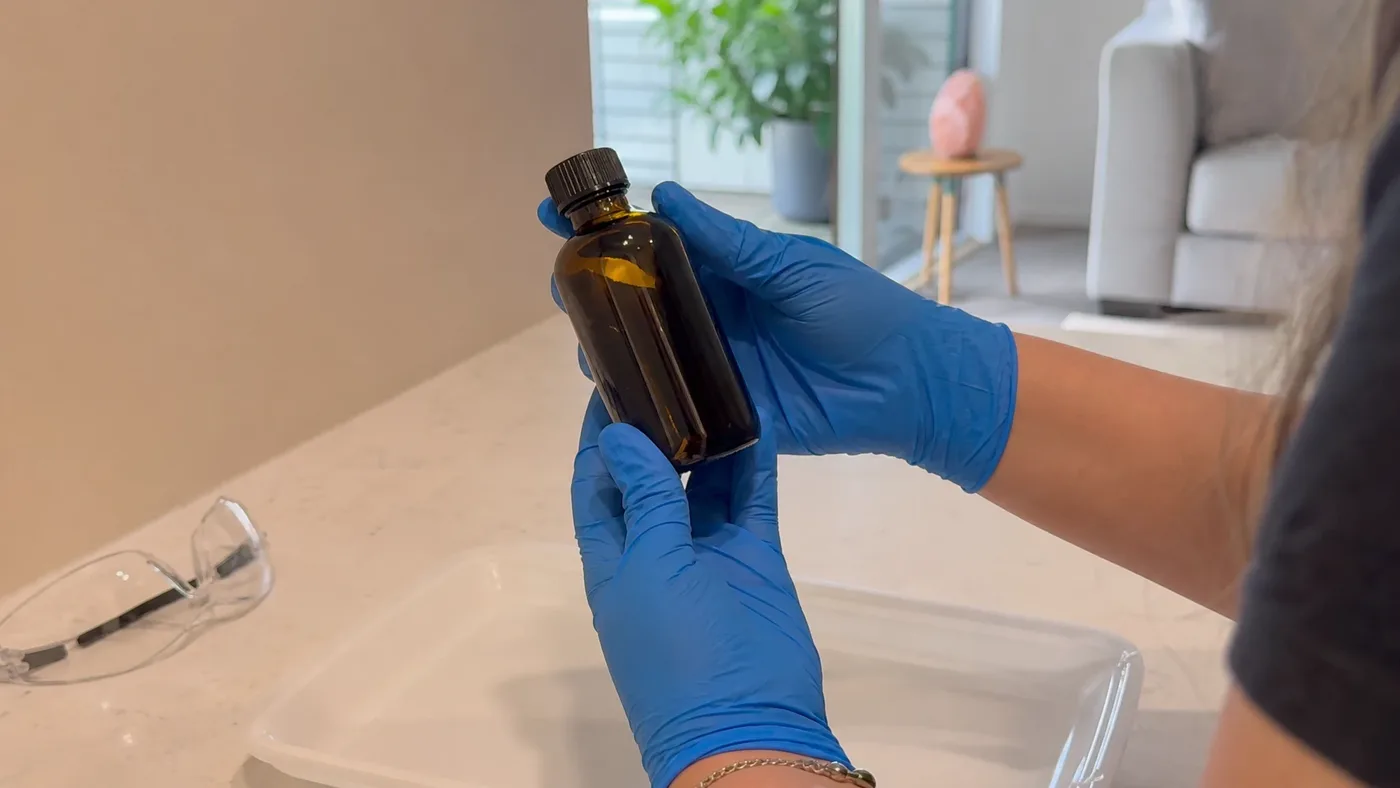
Handle eugenol as a skin sensitiser and an eye irritant first, and as a fire or inhalation problem a distant second. That ordering comes from the hazard classifications reported for it, and it changes what you buy: goggles and gloves that have been checked for this chemical matter more than a respirator. This guide goes through the sources item by item and says where they disagree. We are not industrial hygienists, we have no handling data of our own, and anything that needs judgment about your workplace belongs with a qualified industrial hygienist or safety specialist.
What the classification says, and how settled it is
PubChem's eugenol record aggregates the European Chemicals Agency's C&L Inventory: 2,820 company reports, signal word "Warning", the exclamation-mark pictogram (GHS07). The hazard statements were not reported evenly: H317, may cause an allergic skin reaction, 99.8%; H319, causes serious eye irritation, 80.4%; H315, causes skin irritation, 20.6%; H302, harmful if swallowed, 17.3%. Five reports (0.2%) said it did not meet the criteria (PubChem, eugenol). The SDS we read, a laboratory-chemical sheet for "Eugenol, Purified" (above 95%) issued 8/7/2024, lists acute oral toxicity category 4, skin irritation category 2, serious eye irritation category 2 and skin sensitisation category 1 (Lab Alley SDS). Reading the two together: sensitisation is the near-universal entry, irritation is common, and the rest depends on who is classifying and on the grade. Our How We Test page calls eugenol "a recognised skin sensitiser". Whichever SDS comes with your bottle governs; ask your supplier for the current one, and our SDS reading guide goes section by section.
Gloves: the chart that does not name eugenol
That SDS says "Wear appropriate protective gloves and clothing" and names no material, and the NOAA CAMEO entry for eugenol gives no glove materials either (CAMEO Chemicals). The closest published data we could read is a university glove chart (University of North Carolina Laboratory Safety Manual, Appendix 5-B, April 2007, reproduced by EPFL). It does not list eugenol. For saturated phenol it rates nitrile "NT" (not tested), neoprene "E" (excellent), natural rubber "E" and PVC "NT". Phenol is a different molecule, so this is a hint and not an answer. A second source warns against trusting the generic name: a 1987 study of eight nitrile and five neoprene products of the same nominal thickness found large differences between manufacturers (for perchloroethylene, mean breakthrough times of 30 to 300 minutes), and most products measured up to 40% thicker or thinner than labelled (Hall and Mickelsen, AIHA Journal, 1987). Practical consequence, reasoned from those two sources: ask the glove maker for permeation data against eugenol (CAS 97-53-0), treat a thin disposable glove as splash protection only, and change it as soon as it is wetted, not at the end of the session.
Eyes, and the eyewash rule that does not quite apply
The SDS asks for "tight sealing safety goggles" and a face shield, and says eyewash stations and safety showers should be close to the workstation. Its first-aid text for the eye gives two instructions: "rinse cautiously with water for several minutes" in Section 2, and "rinse immediately with plenty of water, also under the eyelids, for at least 15 minutes" in Section 4, then medical attention. Follow the longer one and call a physician or poison center. For employers, OSHA's hazard assessment rule requires an assessment of whether PPE is needed (29 CFR 1910.132(d)(1), via eCFR), and 1910.151(c) requires facilities for quick drenching or flushing "where the eyes or body of any person may be exposed to injurious corrosive materials" (eCFR). Eugenol is classed as an irritant, not corrosive, so on the plain text that sentence is not triggered by classification; the SDS wants an eyewash near the work anyway, and whether your workplace needs plumbed or bottle-type is for an industrial hygienist. If you work alone at home, none of these OSHA rules apply to you, but they are a reasonable checklist.
Ventilation and respirators: two sources, two answers
The SDS says to ensure adequate ventilation, notes that no occupational exposure limits have been established for it by the regional bodies it checked, and says no respiratory protection is needed under normal use conditions. CAMEO says that where the neat chemical is weighed or diluted, use a NIOSH-approved half-face respirator with an organic vapor/acid gas cartridge and a dust/mist filter. These conflict. With no exposure limit, there is no number to compare a measurement with, and the choice is a judgment, which is the industrial hygienist's job. The vapor pressure helps frame it: 0.0221 mmHg at 25 C (Van Roon, 2005, via HSDB in PubChem), so an open bottle at room temperature gives off little, while warmed or heated material, as in melting wax, gives off more (reasoning, not a measured exposure).
Spills: what two sources say, plus the arithmetic
The SDS: soak up with inert absorbent material, keep in closed containers for disposal, do not flush into surface water or the sanitary sewer, and check local waste rules. CAMEO: remove all ignition sources, pick up with absorbent paper, seal contaminated items in a vapor-tight plastic bag, and wash surfaces with 60 to 70% ethanol, then soap and water; it also notes that dirt or earth may react as an absorbent. Two practical notes of our own, reasoned: a wipe with plain water spreads oil, because eugenol's water solubility is about 2,460 mg/L at 25 C (Yalkowsky, 2010, via HSDB), and 1 mL, which is about 1.07 g at the 1.065 relative density on our published COA, would need roughly 0.43 liters of water to dissolve; and the ethanol wash brings its own fire risk, so keep flames out of the room. Expect a mark on porous surfaces; our darkening guide explains the color change we describe on our How We Test page as ordinary for a phenol.
Storage, and a warning for soap makers
The SDS says keep containers tightly closed in a dry, cool, well-ventilated place and lists strong oxidizing agents as incompatible; it also marks the material as air sensitive and, in storage conditions, says to store under an inert atmosphere. CAMEO adds that it reacts with strong alkalis and is incompatible with iron and zinc. Reasoning from the alkali statement: do not shelve eugenol next to lye. Our shop says shelf life is typically 2 to 4 years capped in a cool, dark place, our How We Test page says three years, and amber glass is how we pack every size. The storage guide covers the rest.
Labeling bottles you decant into
OSHA's Hazard Communication rule says each container of hazardous chemicals in a workplace must be labeled, tagged or marked, but exempts portable containers for "immediate use" by the person who transfers the chemical, within the shift of transfer (29 CFR 1910.1200(f)(6) and (f)(8), via eCFR). A 10 mL dropper bottle you keep for next month is not immediate use. A label with the product name, the signal word and the hazard statements on your supplier's SDS, and the date, takes a minute. A hobbyist is not an employer under the rule, but anyone else who opens that bottle is a person you owe it to.
What our shop says, and what it does not
Our shop copy asks for small amounts, hand washing after handling, and keeping the oil away from eyes, children and pets, out of casual reach, and not for internal use. It lists skin use at 0.5% to 2% in a carrier with a patch test, while How We Test puts the leave-on ceiling near half a percent; the compliance guide picks that up. We make no medical claims and we do not supply gloves, goggles or eyewash.
Sources & Further Reading
- NCBI PubChem. Eugenol (CID 3314): ECHA C&L Inventory classification, solubility, vapor pressure. pubchem.ncbi.nlm.nih.gov/compound/Eugenol
- Lab Alley, 2024. Safety Data Sheet, Eugenol, Purified (issue date 8/7/2024). media.laballey.com (SDS PDF)
- NOAA. CAMEO Chemicals: Eugenol. cameochemicals.noaa.gov/chemical/20399
- University of North Carolina at Chapel Hill, 2007. Laboratory Safety Manual, Appendix 5-B: Glove Selection Chart. epfl.ch (GloveChart.pdf)
- Hall R.C., Mickelsen R.L., 1987. A breakthrough time comparison of nitrile and neoprene glove materials produced by different glove manufacturers. Am Ind Hyg Assoc J. stacks.cdc.gov/view/cdc/185552
- OSHA, 29 CFR 1910.132, personal protective equipment, general requirements. ecfr.gov (1910.132)
- OSHA, 29 CFR 1910.151, medical services and first aid. ecfr.gov (1910.151)
- OSHA, 29 CFR 1910.1200, hazard communication. ecfr.gov (1910.1200)